

The Blog
Recently Featured

All Blogs











How to handle disappointment
“Faithless is he that says farewell when the road darkens.”
― J.R.R. Tolkien, The Fellowship of the Ring

I’ve experienced my fair share of disappointment lately, as I know we all have. Whether it’s a health scare, a broken relationship, a passed-over job opportunity, or simply the sharp blow of life’s unruly outcomes, one thing is certain: life doesn’t always go as we’d planned. In fact, the older I get, I’m getting strangely accustomed to these hiccups.
I’ll go ahead and put myself on the the operating table, quite literally, for a minute. At every turn throughout my cancer journey, something went wrong. It could have been a seamless, one and done, get the cancer out and sew her up kind of situation. And if that’s your experience, you still earned a purple heart in my book. But between a genetic mutation, family history of breast cancer on both sides, tidal waves of anxiety, pre-cancer cells found after the double mastectomy, chemotherapy as a result, necrosis/infection of the skin post surgery, removal of the left prosthetic expander, walking around in a body I didn’t (and still don’t) recognize for more than a year, and three more surgeries to reach the finish line (perhaps) of reconstruction, I’m over it.
And still…
I remain convinced of the plan God’s had all along: “all shall be well,” as Teresa of Avila confidently quipped.
Not to whip out my journal and unload on you, but I do want to share with you something that has painted me into the most beautiful landscape of life I’ve ever known. Two words:
And still…
I was approached by a woman in Whole Foods this past week. Due to my current corkscrew pixie coif, I have become a magnet for women who have also gone through cancer and chemo because let’s just say, they see the silhouette of my uneven frame and the pile of curls on my head and have a hunch. And I love it.
She asked me a bit about my story, hoping to align, and started probing deeper. I didn’t begin to know her story, but I could sense a deep sadness and loneliness in her wide brown eyes. As I smiled and opened up, I sensed her surprise as I detailed my experience and how well I felt despite it all. Her experience was not as positive. There was grave disappointment and it leaked out everywhere. And I get it.
And still…
The grace I’ve been given each step of the way has steadied my gaze on what I DO have. I have strength, a loving family, my faith, purpose, a job I love, the gift of a child who’s smile gives me reason to believe, and a community of committed people I don’t deserve, but cling to. That’s what I’ve focused on. Every day. It’s become my most potent prescription.
There are very few guarantees in this life. I’ve learned to hold everything openly, gratefully. But most of all, I consider two tiny words in the face of loss and disappointment. They tether me not to what’s missing in the moment, but what is there.
There will always be missing pieces.
And still…
Tiny Changes, Massive Impact
“True life is lived when tiny changes occur.”
-Leo Tolstoy
You’ve heard the saying, “Rome wasn’t built in a day.” So why have these crazy unrealistic expectations of ourselves? I have thoughts on this.
For most people, extremes are easier than balance. Unless we’ve already arrived in the vibrant land of Growth Mindset, we tend to get stuck in the purgatory of all or nothing. Black and white, dualistic belief systems keep us stuck in the rigidity of a fixed mindset.
Here’s an example most of us can relate to. You’ve indulged in way too much of Jeni’s Salted Caramel ice cream. I mean, holy dairy that stuff is like crack. You’re feeling the sugar coma set in along with a delayed wave of shame and a stomach ache.
So you beat yourself up and swear you won’t touch it again for the foreseeable future. In fact, You’ve been flirting with the idea of going Keto so this is your shining opportunity.
Sound familiar? Or am I the only one who loses all self-control in the face of temptation?
That type of all-or-nothing behavior is baked into our DNA as humans. Opening up to a growth, or responsive mindset rather than a reactionary one typically must be learned.
And yet when do we actually learn this mature approach to self-development? It’s something that has been a powerful exploration in my life as I’m a total perfectionist in recovery.
A growth mind-set is all about both/and.
A fixed mind-set is all about either/or.
A growth mindset says,”I ate too much ice cream, I’ll choose something healthy for dinner.”
A fixed mindset says, “I ate too much ice cream. I’m going to go run six miles to burn it off and skip dinner.”
One feels kinder, more spacious...and more balanced. Unless you really just love running 6 miles with a belly ache.
A growth mindset is also built on the firm foundation of consistent, small changes, over time. It allows for doable goal setting and implementation rather than extreme makeovers in less than a week. Why? Because that kind of hustle can’t ultimately be sustained. It will likely throw us back into a yo-yo approach to relationship with self and others.
Just like when you board a plane to L.A., if the pilot is just two degrees off in navigation, you’ll likely end up in Seattle. Tiny shifts, over time, create big results.
What are some desired outcomes you’d like to see in your life right now? Give yourself plenty of time to get there and break it down into bite-size changes that will help you get there.
As always, I’m here for you if you need a little extra support on the journey.

Something you may not know about the Enneagram
“Our task is not to seek for love, but merely to seek and find all the barriers within yourself that you have built against it.”
-Rumi

In my self-care Enneagram subscription program, The Practice, I teach people to use the Enneagram as a holistic tool for self-care—one that cares for the whole person: mind, body, and heart.
This may take you by surprise. If so, you’re not alone. The ancient wisdom of the Enneagram suggests that we are three-brained beings. In fact, modern neuroscience is finally catching up to the wisdom of the Enneagram that suggests we have neural cells in our brains as well as the lining of our stomachs and hearts. That said, we have three centers of intelligence.
Why is this important to us as we practice self-care? I thought you’d never ask.
There are two big reasons this is important.
First of all, it’s necessary to bust the myth that our most important intelligence is our thinking mind. Whereas your brain is literally a genius and a highly elevated source of intellect and functioning, we must understand that living from the neck up, as we do so often, isn’t the only way.
In fact, we overemphasize this capacity and as a result, experience an imbalance as it pertains to our other centers of intelligence, equally as powerful: the body and heart.
I believe self-care is bringing balance where there is imbalance in our experience. And so, part of the invitation as we learn to apply the Enneagram for self-care is to balance out our relationships to all three centers. Essentially, to integrate into more wholeness.
Secondly, the nine types are housed in three triads that correlate to these three centers of intelligence. As a type four, I experience the world most readily through the lens of emotional intelligence. Why? Because Two’s, Three’s, and Four’s are in the heart, or feeling triad.
This helps me cultivate a more specific self-care regimen because it tells me I need to dial up my relationship with my body center—learning to drop deeper into my instinctual capacity as well as being mindful to create structure and analysis where feelings tend to run the show.
In a way, understanding the Enneagram as a holistic tool is necessary for building out a more whole and compassionate relationship with self.
P.S. Want to do a loving thing for you and go deeper into your very own self-care prescription? Sign up for the Practice today.
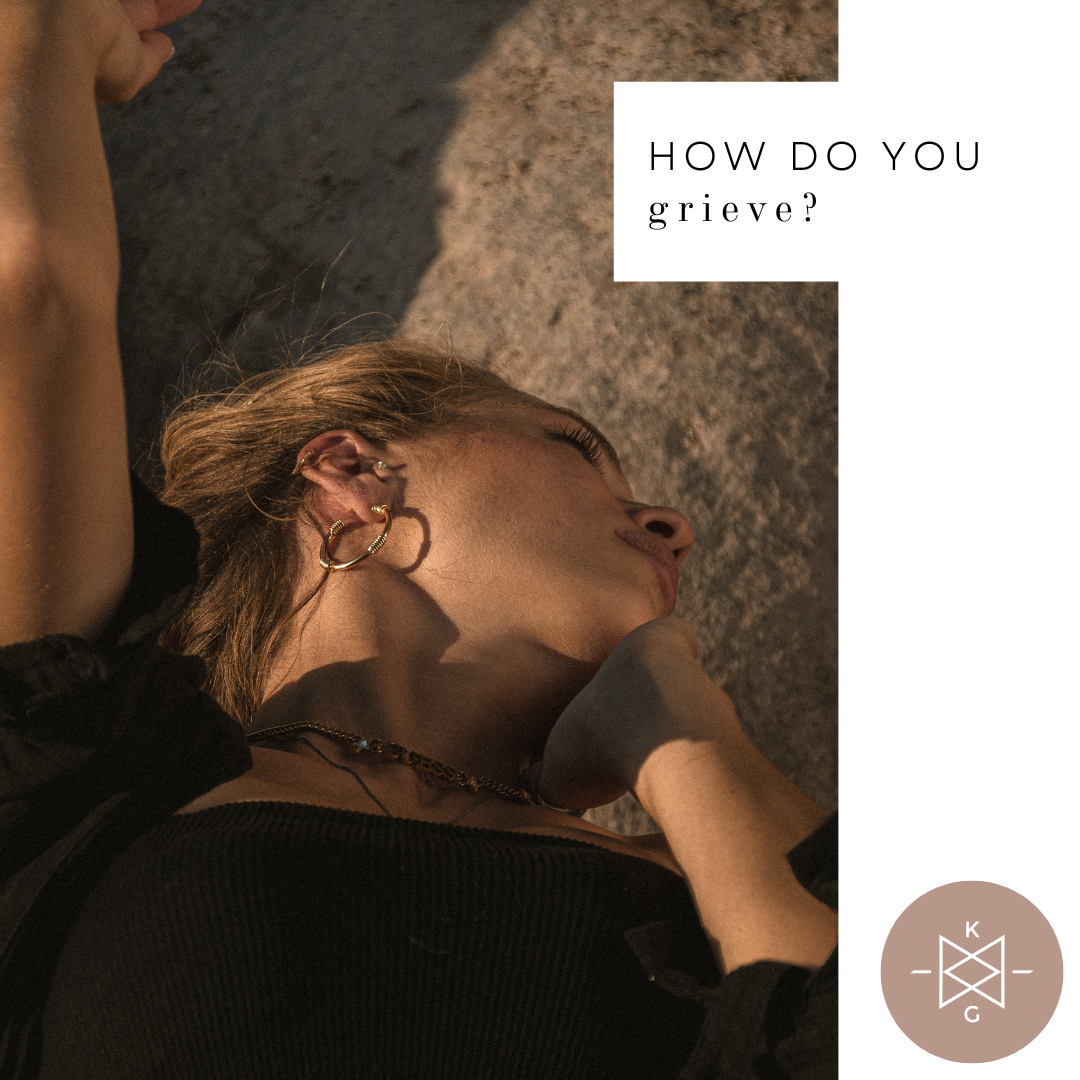
How do you grieve?
“Let everything happen to you, beauty and terror. Just keep going, no feeling is final.”
-Rilke

How do you grieve?
Let’s back up. What do you know about grief? How is it different from sadness or depression?
We know they are look-a-likes. Both involve intense sadness and even despair. Grief, however, is the normal and appropriate response to a great loss, often the death of a loved one. Whereas they share several characteristics such as heightened emotions, fatigue, appetite disturbances, loss of pleasure, and inability to enjoy things, they are not the same.
A big contrast is depression is usually marked by a tendency to isolate from others with little or no experience of pleasure. The grieving person usually stays connected to others through the process and hopefully experiences pockets of joy or pleasure along the way. Something I learned from the grief guru himself, David Kessler, is that grief must be witnessed—loved one(s) hopefully walk alongside and see this pain integrating into our lives so we can process it better.
There’s also this thing called anticipatory grief: deep sadness for what will be lost. The fact that life will never fully go back to the way things were pre-covid is what that tastes like. Just as air travel did after 9/11, this virus has and will mark history in an unprecedented way.
You may know there are five main stages of grief: Denial, anger, bargaining, sadness, and acceptance. So as it pertains to the pandemic that’s coursing through the unwilling veins of our world:
Denial: This won’t affect me.
Anger: I’m so pissed we didn’t act faster as a nation. And I hate staying at home all the time without work and independence!
Bargaining: If we wear a mask and keep our distance, this will all be over, yes?
Sadness: I feel helpless because there’s no real endpoint.
Acceptance: This is really happening and I can do my part to help out.
Grief is complex and not linear. For all you type A’s out there, beware of trying to grieve neatly. It won’t happen. It’s messy, cyclical, and much like whac-a-mole.
One day we can be fairly poised, the next mad as hell, and the next denying anything’s actually happening because the weather’s finally warm and sunny.
As you can imagine, the real power lies in the acceptance piece. When we are able to simply allow what’s coming up emotionally and let it move through us, we can access acceptance more quickly. After all, the word “emotion” is mostly comprised of the word “motion.” That said, we must allow them to come up and move through us as they are created in our bodies. If we don’t do this, we create bigger problems down the road.
So how do we grieve what used to be? The lovely life you’d grown accustomed to? The lifestyle and rituals you carved out over the years? How do you make sense of this new normal?
By assigning meaning to it.
We must appropriate purpose to our grief. Eventually, we must be the hero in our grief story as opposed to the victim.
David Kessler, (grief guru) actually built out the grief process to include “meaning” as the sixth stage. How powerful is that?
Let your grief work for you and create deeper, richer meaning in your life right now. Your shock is appropriate, your tears are precious, your anger—valid. We are all on this spiritual journey together as we become more real through our pain.
P.S. Need a safe space to process and grieve? I’d love to support you on your journey. Fill out my online inquiry for a free 20-minute discovery call.

Your (Easy) Guide to Self-Care
“Self-Care is creating a life you don’t want to escape. It’s the process of self-befriending.”
-Katie Gustafson

There’s a lot of talk about self-care these days. That said, a lot of it is fluffy…bloated if you will. So much so, I started a monthly membership program called the Practice that is devoted to helping you create and maintain a true self-care plan using the Enneagram as a roadmap. More on that later…
Unfortunately, society has taught us a version of self-care that falls drastically short in terms of actually promoting deep care and restoration. It makes sense to me that many of us have lost hope in it or see it as indulgent and even selfish. Spa treatments, retail therapy, and wine nights to take the edge off might appear to work temporarily, however they fail to support our process in any lasting change. They can also get really expensive! Don’t get me wrong, I’m a huge proponent of pampering and celebrating, yet we need to be clear about the fact that these are not the same as self-care.
So if these self-care imposters temporarily boost our spirits (and appearances) yet leave us feeling just as empty as before, don’t you think it’s time we take a deeper look at what real self-care looks like? Let’s do it.
Life continues to present us with challenges. We know that now more than ever. We need a brand of self-care that will help us stay present as opposed to escaping our lives–one that will connect us to more compassion, energy, perspective, balance and grace in order to move through the tough times and even thrive amidst the chaos.
Now I know this process might seem frustrating and even confusing. However, I don’t think it has to be. I firmly believe whatever we practice, we improve. In my monthly subscription, we will explore your dominant Enneagram type and what the best self-care practices are for you to process difficult, stressful emotions and create balance where there is imbalance.
When you learn a few practices that are clinically proven to help you grow, you’ll have a self-care routine that will eventually help you flourish. Not only that, you will know and understand yourself so much better, gaining clarity into the why behind how you think, feel, and act. You will start to heal old wounds that keep you stuck and perhaps most importantly, you’ll open up to lasting desired outcomes you once thought out of reach.
I believe self-care is a process of befriending yourself. Much like self-compassion, it’s showing yourself the heartfelt care and support you’d show a loved one in need. It’s learning to speak to yourself with a softer tone. It’s developing practices that promote connection rather than isolation.
You’ll not only become a more integrated, or whole, version of yourself, you’ll:
reduce stress and anxiety
learn how to identify and take care of your felt needs
promote deeper connection with yourself and others
develop healthier relationships
understand what you want and how to get there
develop better eating, sleeping, and exercise habits
improve your overall mood, and
connect to an overall mental, spiritual, and physical well-being.
So, are you ready to take your self-care to a whole new level?
Join me in The Practice. Click here to sign up today.
In April, I bombed a keynote—45 minutes late, broken A/V, a room that wanted their drink tickets.
Here's what that failure taught me about participation, discernment, and why every Enneagram type has its own sophisticated reason to wait until it's "ready."