
Enneagram typing Cards
for therapists, coaches, and facilitators.
Help clients move from curiosity to genuine self-recognition without guesswork, leading, or overanalysis.
Most Enneagram typing tools put the burden on the client to decide their type.
Questionnaires produce scores. Scores produce confusion. Clients end up type-shopping, second-guessing, or landing on the type they wish they were rather than the one that actually fits.
The result? A conversation that stalls before it starts.
The KG Typing Cards give you a clear, repeatable process that lets type recognition emerge naturally—through sorting, noticing, and reflection rather than scoring or interpretation.
Clients don't choose their type. They begin to recognize it.
How It Works
1. Sort: Clients read simple, experience-based statements and sort them by recognition—not by what they admire or aspire to, but what feels automatically, consistently true.
2. Notice: Patterns emerge on their own. Clients see which types appear most in their "sounds like me" pile and begin to notice without being led.
3. Narrow: Deep Inquiry cards guide reflection on the 2–3 closest types—exploring focus of attention, core motivation, and habitual strategy in plain, non-clinical language.
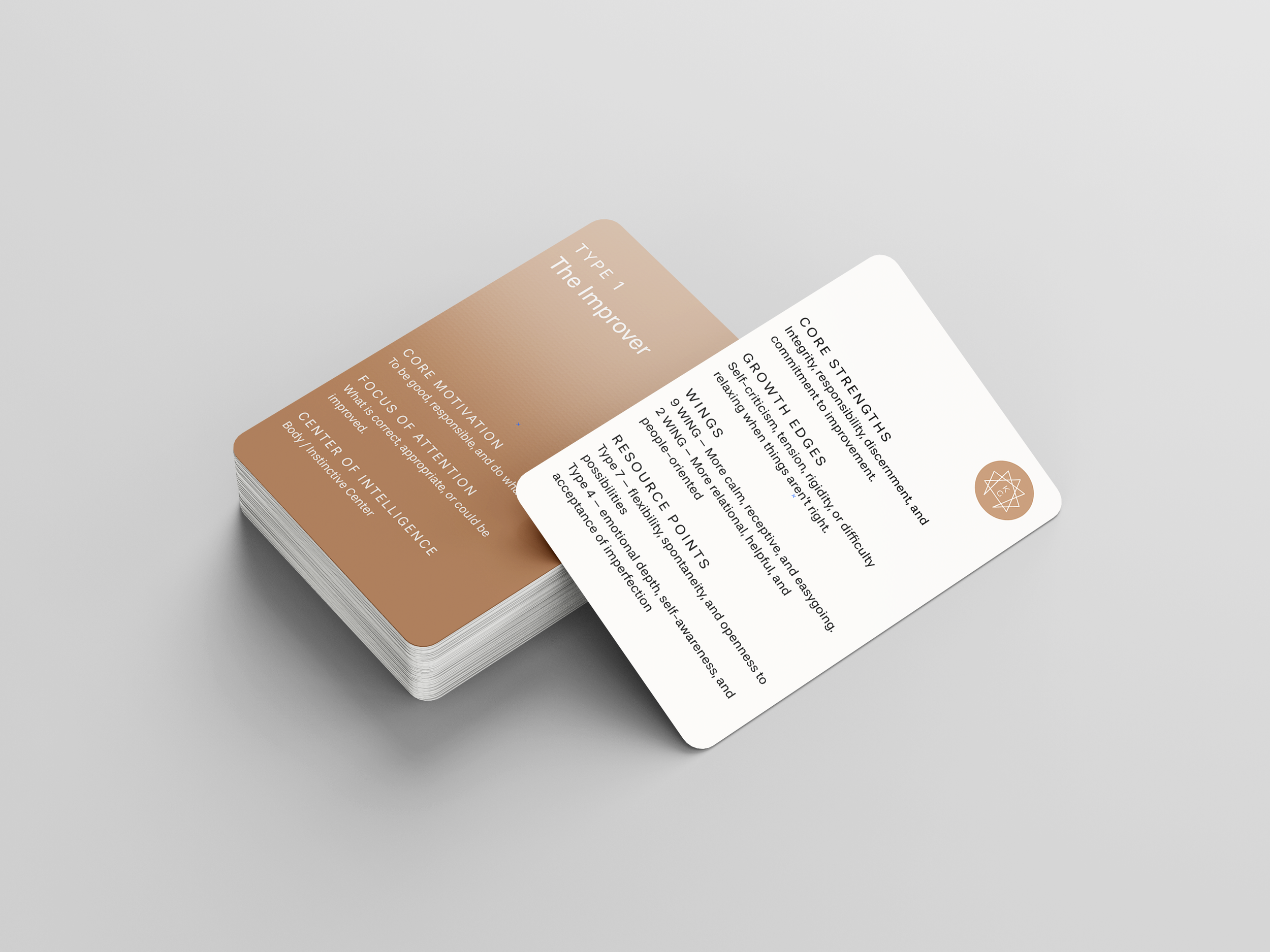
4. Recognize: Type Summary cards confirm the pattern and open the therapeutic conversation—strengths, growth edges, wings, and resource points included front and back.
What’s Included
54 cards total. Everything you need to facilitate the full typing process.
36 Quick Recognition Cards: Simple, experience-based statements organized by type. Clients sort them by what feels familiar. Designed for fast sorting that reduces overthinking and surfaces natural patterns.
9 Deep Inquiry Cards: Used after sorting, when a client has narrowed to their top 2–3 types. The front explores focus of attention, core concern, and habitual pattern. The back reveals core strengths and growth edges—designed as a clinical entry point, not just a typing tool.
9 Type Summary Cards: Confirmation and psychoeducation in one place. Covers core motivation, focus of attention, center of intelligence, strengths, growth edges, wing descriptions, and resource points for growth work.
3 Orientation Cards: Plain-language facilitation guidance for providers and clients. Covers how to use the deck, key concepts, and the typing process.
Why Providers Choose This
It keeps the process client-led. The sorting format puts recognition in the client's hands. You're not interpreting results or steering toward a type—you're holding space while the pattern becomes visible.
It works across multiple sessions. This isn't a one-time typing exercise. The Deep Inquiry cards are designed to be revisited, and the reflection process continues between sessions. Type clarity often develops gradually—the deck supports that.
It opens the therapeutic conversation. The back of every Deep Inquiry card is a clinical entry point. Strengths, growth edges, and the cost of the pattern are already named—giving you a natural bridge into deeper work without having to build that framing from scratch.
It's easy to facilitate. Clean structure, plain language, and Orientation Cards that orient both you and the client. No training beyond basic Enneagram familiarity required.

About Katie Gustafson
Katie Gustafson is a licensed professional counselor, Enneagram educator, and author who has spent years integrating the Enneagram into clinical and coaching practice. The KG Typing Cards were developed out of real session experience—built for the moments when clients are curious about their type but need a process, not a personality quiz.
NOW AVAILABLE
Frequently Asked Questions
-
The KG Typing Cards are a physical card deck. You'll receive 54 printed cards—36 Quick Recognition, 9 Deep Inquiry, 9 Type Summary, and 3 Orientation cards—delivered to your address after fulfillment.
-
We're currently taking pre-orders with an estimated ship date of April 2026 or sooner. You'll receive an email confirmation when your order ships.
-
No. The cards are written in plain, experience-based language and don't assume any prior familiarity with the Enneagram. The Orientation Cards provide enough context for clients to engage with the process on their own.
-
A first-pass sorting session typically takes 15–20 minutes. Many clinicians use the Quick Recognition cards in one session and return to the Deep Inquiry cards in subsequent sessions as the client's type becomes clearer. The deck is designed to support that gradual recognition process—not rush it.
-
Yes. The sorting and reflection process works in group settings as well as individual sessions. The structured format makes it easy to facilitate with multiple participants at once.
-
Most typing tools use questionnaires that ask clients to choose between options or rate statements on a scale. The KG Typing Cards use a recognition-based sorting process—clients sort by what feels automatically true, not what they decide is most accurate. That shift from deciding to recognizing tends to produce clearer, more reliable results and creates a more natural entry point for clinical work.
-
That's a common starting point, and the cards work well as a follow-up. Online tests often produce uncertain or misidentified results. The sorting process gives clients a way to revisit their type through direct experience rather than relying on a score, which frequently leads to more accurate and lasting recognition.
-
Basic familiarity with the nine types is helpful. You don't need to be a certified Enneagram instructor, but if you're new to the system, spending some time with the Type Summary cards before facilitating will give you a solid foundation.