
The Blog
Recently Featured

All Blogs









Three Ways to Use the Enneagram for Transformation
“Practice isn’t the thing you do once you’re good. Practice is the thing you do that makes you good.”
-Malcolm Gladwell
First came type. Everyone and their dogs flapping their gums about what’s your Enneagram type? Oh, and the memes that tell you how you take your coffee as said type. And don’t forget the Instagram reels boasting how to dress for success as your type.
If this gets old fast, it’s for a reason: most people don’t like being reduced to a number.
More recently, Enneagram teachers, myself included, have focused on going deeper, beneath the optics of type, to the ways in which we can practically apply the wisdom of the Enneagram. After all, knowledge is power but knowledge plus implementation is transformational.
So today, I want to share my favorite three ways to implement the Enneagram in our lives. In the Practice, my Enneagram-based self-care subscription program, I’ve set up a roadmap and support along the way to do this work in community and it’s been powerful. Here’s a bird’s eye view of the ways we’re practicing the life-giving work of the Enneagram.
Self-Observation. This is first base and a huge game changer if you’re new to the idea. Basically, we take the role of the student, the neutral observer of our own experience, and bear witness to our thoughts, feelings, behaviors, beliefs, and interactions. This is a powerful way of creating more space between the “stimulus and response” as Viktor Frankl said. It’s a way to bake in deeper self-awareness and understanding. And don’t be fooled if this sounds like a walk in the park—it’s actually quite difficult at first because we are so used to living on autopilot!
Vice to Virtue. Each type has a passion, or emotional habit that keeps us stuck in the pitfalls of our type. It’s like the catalyst for our habits of thought and emotion within our type structure. Each type also has a virtue, or a state of essential wholeness and receptivity. When we practice the vice to virtue movement, we become aware of how our passion operates in our daily lives and make the conscious movement from the vice, or passion, to the virtue, or state of open presence and the higher parts of our personality. This invitation is always waiting and always expansive.
Balancing the Centers. Last but not least, the Enneagram teaches we are three-brained beings as opposed to one. We have thinking intelligence, emotional intelligence, and instinctual intelligence. Every type operates dominantly out of one of these. When we work to bring balance to the centers, we practice becoming aware of the other two intelligences we tend to downplay and dial up our awareness with them so as to create more balance and increase a well-rounded, grounded experience in life.
So, are you ready to take your Enneagram practices to the next level? Join me in the Practice!
This Writing Exercise Changed Everything for me
“Whatever we resist persists.”
-Carl Jung
When was the last time you wanted to confront an issue with someone but didn’t know how? Perhaps it felt too scary or threatened connection with that person? Avoiding conflict is an easy habit to fall into, especially if you’re a recovering people-pleaser like me.
And yet we know that honesty is so important. When I learned that people-pleasing was, in fact, just another form of dishonesty, I decided I needed to shift my mindset around “speaking straight,” as I like to call it.
However, There are times when honest conversation is not so helpful. The other person may not be able to give you the thoughtful response you’re looking for. In fact, it might be downright dangerous to initiate this form of transparency with the person who has caused you pain.
Whether you’re dealing with fear around confrontation or a not-so-safe situation where a clear conversation may be counterproductive, this writing exercise is a game-changer.
I’m talking about letter writing. It’s an effective, non-threatening way to process difficult emotions or experiences you have with someone…even yourself.
The best part? You can be brutally honest, working out past or present frustrations, and mentally, emotionally, and even physically manage situations that feel overwhelming.
How does it work? You simply put everything you need to say to someone down in letter-format. You can write several drafts, starting out raw and unfiltered and eventually rounding it out with a bit more tact. And, the best part is you get to decide if it’s worth sending the letter or not.
This is so effective because YOU now step into your power by saying all you need to say—the good, bad, and ugly—for YOU. When we can let go of the outcome and make this all about processing negative feeling emotions towards another person, we take responsibility for our process and slide into the driver seat of life.
We shift from the victim to the hero of our story.
Sure, you can send the letter if you want. But again, the secret sauce is in owning our power by letting go of outcomes and taking responsibility for our experience. This exercise becomes more about a healthy way to process difficult experiences and less about manipulating or fixing what’s been lost, even if you are in the right.
So, who do you need to write a letter to? What do you need closure or clearing around?
Grab a pen and some paper and let’s get to it…

How to get out of your own way
“The good news is that opportunities for love enter our lives unpredictably, whether or not we’ve perfected self-compassion or befriended our inner critic.”
―Sharon Salzberg

Have you ever felt like you are your own worst enemy? If you could only get out of your own way, life might be a lot easier?
Me too. I often feel I wrote the book on self-sabotage.
I’ll never forget sitting in my old therapists office about eight years ago and hearing the strangest homework assignment I’d ever gotten to date. Here’s what he said,
“Katie, I want you to spend the whole week simply being a student of you and your experience.”
“Excuse me?” I thought to myself as I quizzically stared back at him like he had eight heads. This would be interesting…
This seemed nearly impossible at the time because I’d become so accustomed to ruthlessly judging myself without even noticing. To merely “observe” or “witness” my daily experience would require me to slow down that automatic self-criticism. It would require me to be a neutral audience. This in turn, would require me to be a bit…kind?
It was perhaps the most profound assignment I’d ever been given. I felt as if a heavy weight had been lifted from my weary frame. I remember feeling curious, even intrigued by myself and my behaviors. Miraculously, I’ve never done drugs before, but this little experiment felt as close as I’d gotten up until that point. It was out-of-body.
Part of my lifelong work has been learning to grow that neutral observer, or inner witness, inside that allows for self-awareness and compassion to take root and grow over time. The more curious we can get about anything, the less time we spend in rigid judgment. As a result, we move from a fixed mindset to a growth one. Otherwise, we live in reaction mode, constantly being triggered and judging ourselves and others. Not a good look.
Here’s two things I’ve learned about human nature:
99.999999% of us have a pretty nasty inner critic at some point along the way. Human beings, by nature, have a negative bias. As the saying goes, “we are our own worst critic.”
It’s much easier to react out of emotion than respond out of self-awareness.
I also believe you are your absolute greatest asset in this life. However, in order to be MVP on your own team, you may need to clean out the dank and dusty attic of your thoughts, like I constantly do.
So try this…
Assume the role of a neutral observer, a student if you will. Pretend like you’re doing research for a project and any and every bit of information is fair game. It’s okay if you bounce back into the judgment seat. That’s good information too! Record your findings with this journaling prompt:
What do I noticing about myself and my experience? How can I be more curious throughout the day?
If you get discouraged along the way, take heart. In a science experiment, everything is good information, even failure. And remember, you are the ultimate expert at you.
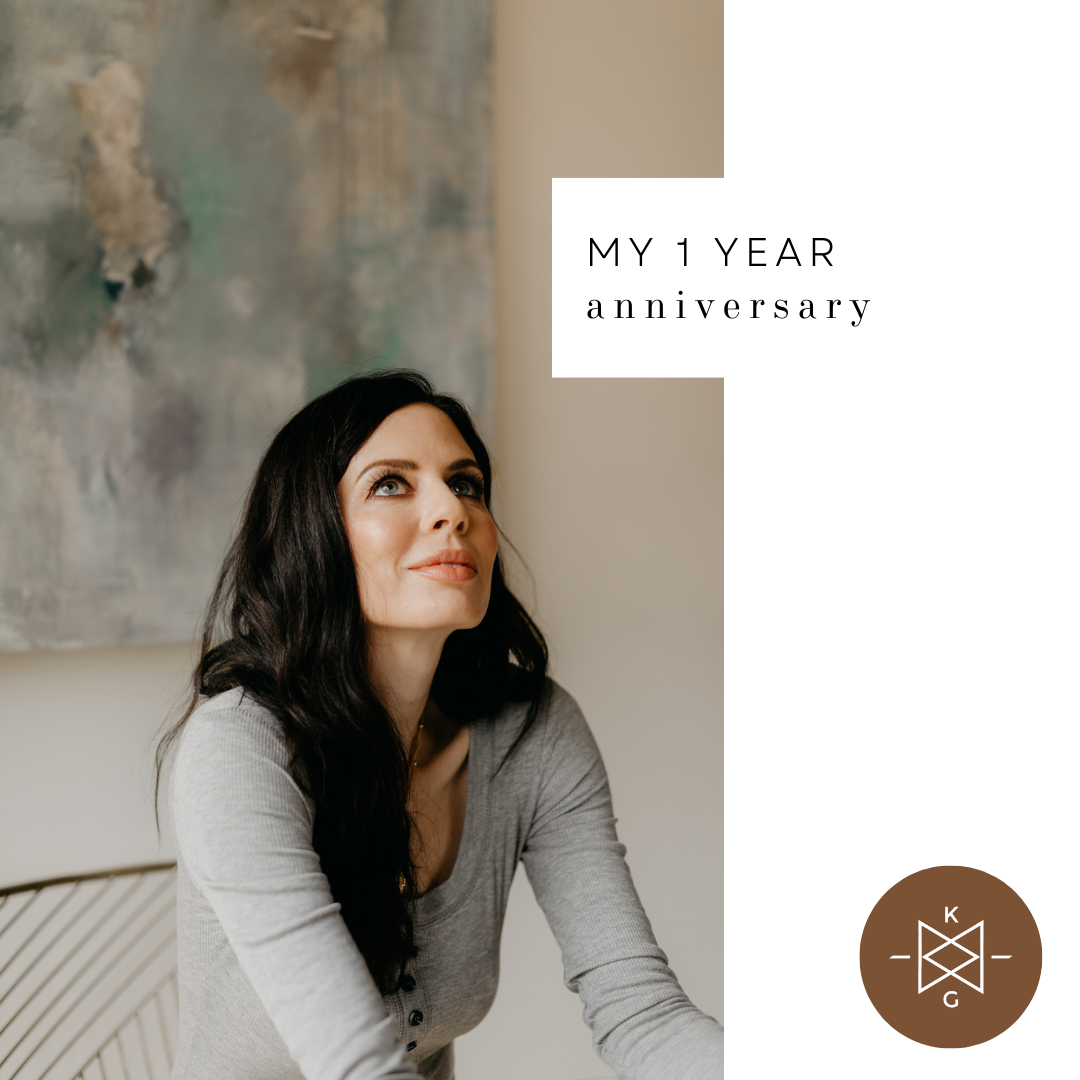
My one year anniversary
“The more you praise and celebrate your life, the more there is to celebrate in life.”
―Oprah Winfrey

May 26, 2022 was my bilateral mastectomy one-year anniversary. So naturally, I threw a party. It felt necessary, not frivolous. Ever since coming through my battle with breast cancer and getting way too close to life’s fragile edges, I’m reflecting on the importance of celebration.
And not just from a fun, put on your party dress and dance mindset. I’m all for fun, yet I believe deep down that celebration is good for the soul and the mind.
Life is hard. We’ve all learned this in living color throughout the last two years. What doesn’t really help the matter is that human beings tend to be “velcro for the negative and teflon for the positive” as I once heard it described. We come by this dynamic honestly. We as humans are wired for survival. Primal man was set on high alert, scanning for danger and foraging food to score the daily meal. Therefore we have a negative bias.
The fight-flight-or-freeze fear mechanism allowed our species to not only survive, but evolve throughout generations.
Today, our realities are much different. Hopefully we know where our next meal is coming from and aren’t running from a drooling beast rocking a big appetite and sharp teeth.
And yet we haven’t necessarily outgrown this negative bias that’s carried us through into the modern world. We tend to hope for the best and count on the worst in order to protect us from the vulnerability of joy made manifest in possible disappointment. Again, humans are wired for safety, not a risky celebration. I call this the Other Shoe Syndrome. What if you get your hopes up and then the other shoe drops? Brené Brown calls it foreboding joy. Instead of basking in joyful moments, we self-protect and beat vulnerability to the punch. This scarcity is part of our human biology and design.
Now, that’s NOT to say that we can’t work to soften this prickly edge. Neuroplasticity, or the brain’s ability to rewire, form and reorganize synaptic connections—basically to create new realities despite conditioning and genetics—proves we can change.
Do you know how we do this?
You guessed it…we celebrate. When we make it a point to consciously celebrate little victories, progress, togetherness, and people in our lives, we retrain our brains to override our brain’s natural negative bias. When we celebrate, we fire and wire new neuropathways that eventually help us create a more joyful, abundant life.
I don’t know about you, but I am here for abundance. I am here for deep and meaningful relationships. I am here for the joy that longs to be chosen as we bow down to gratitude over resentment. I’m here for the party.
This week, intently look for one or two small things to celebrate. And do it like you mean it. You never know, you might just start finding more where that came from.

What's all the fuss with Enneagram subtypes?
“The opposite of home is not distance, but forgetfulness.”
―Elie Wiesel

Are you familiar with Enneagram subtypes?
In my opinion, they are kind of a big deal.
This month in The Practice, my self-care & Enneagram subscription program, we did a deep dive into the subtypes. Every month, I interview an expert in their field. So, it was fitting that we got to hear from expert Enneagram teacher and the “Grande Damme of Subtypes,” Beatrice Chestnut.
Beatrice is an author of two books, The Complete Enneagram: 27 paths to greater self-knowledge and The 9 Types of Leadership: Mastering the Art of People in the 21st Century Workplace.
Both are must reads. The Complete Enneagram is my absolute favorite comprehensive book on the Enneagram, hands down. Not only is it a deep dive into subtypes, it’s an academic overview of the Enneagram and it’s history.
Beatrice is also a psychotherapist and coach, training practitioners and leaders to take their Enneagram knowledge to a deeper understanding and application both in work and life.
This is my passion as well: helping people harness the transformational power of the Enneagram in their own healing, relationships, and work.
To sign up for the Practice and get a front row seat to this interview, click here. In the meantime, I want to parse out the major takeaways of our conversation. Subtypes are, after all, a bit complex in nature, and can be easily misunderstood or glossed over.
Let me tee this up by giving a quick overview of this system:
The Enneagram can be broken down into three centers of intelligence: the head, the heart, and the body. Within each center, or triad, there are nine interconnected personality types. This we know. If we peel back the next layer, we discover each of the nine types is actually a triad in itself containing three more definitive subtypes within the type. So, we know there are actually 27 types as opposed to nine. The three subtypes within each of the nine types is connected to these three driving animal instincts: self-preservation, social, or sexual (or one-to-one).
Here are the three biggest takeaways from our discussion:
Subtypes help clarify type. Discovering type is often a difficult process. This is partly because there are only nine types and billions of us so it can feel downright limiting and often reductive to identify our dominant type as there is such variance within type. If you struggle to identify your dominant type, try on the subtypes within the types you feel closest describe you. You may discover a perfect match.
Subtypes are more helpful as a growth tool than wings. Wings are talked about much more than subtypes. I learned this is because there hasn’t been clear, compelling content written about subtypes readily available. Also, there is great confusion as The Wisdom of the Enneagram, the Riso/Hudson classic, calls them instinctual variants. Also, wings tend to be easier to identify. They are physically on either side of your dominant type. However, Beatrice explained that wings are more of a flavoring of type that can shift throughout life. Subtypes can be used in a deeper way to grow beyond limiting, unconscious behavior.
Instinct + Passion = Subtype. It’s so important to note the nuance of subtypes within each type. Like I said earlier, no two subtypes are alike even though there are the same three choices for each type. Instead, they can be explained by a person's predominant driving instinct (self-preservation, social, or sexual) fused with the specific passion, or emotional motivator, of a person’s type. This creates a distinct character type within each of the nine to really sink your teeth into. For me, this looks like the self-preservation instinct, as it is my dominant, mixed with envy, the passion of a type four.
To wrap it up and put a bow on it, I love working with subtypes because quite simply, they help us develop more balance where there is imbalance within our personality. I hope you will join me moving forward in the Practice as we go deeper in our Enneagram wisdom and application!
In April, I bombed a keynote—45 minutes late, broken A/V, a room that wanted their drink tickets.
Here's what that failure taught me about participation, discernment, and why every Enneagram type has its own sophisticated reason to wait until it's "ready."