
The Blog
Recently Featured

All Blogs








Why Therapy Hasn't Worked for You
“Your familiar memories related to your known world “re-mind” you to reproduce the same experiences.”
-Joe Dispenza

I hear it all the time. “Yeah, I spent five years in therapy with not much to show for it but a lot less time and money!”
This fires me up. It also makes me sad for those unwilling to try a different approach.
I believe psychotherapy is incredibly powerful for anyone wanting a deeper sense of wholeness and belonging. Yet oftentimes it serves more as a regurgitation of past trauma and dysfunction instead of a place to gain tools of empowerment for a new tomorrow. That said, we tend to learn the wrong skill set in therapy: how to play the victim.
Good therapists most definitely hold space to unpack the often brutal stories of our past. In order to write a compelling story with you playing the hero instead of the victim, it’s necessary to unearth expired lies and lay them to rest. However, good therapists won’t leave you back there.
I’ve been a student of Dr. Joe Dispenza’s work as of late. He explores this topic neurologically and absolutely nails it. Check this out:
“The stronger the emotion that we feel from some external event in our life, the more altered we feel inside of us as a result of that condition outside of us and the more we pay attention to the cause. The challenge is, every time we think about that trauma, we’re producing the same chemistry in the brain and body as if it was happening again. What that does is it activates a survival gene. And when you’re in survival, what you want to do is make sure that that doesn’t happen again. “
When we lock into this type of survival mode, we often forecast worst-case scenarios. Guess what? Our brain doesn’t know the difference between the imagined state we create and reality. Therefore we stay trapped in that old victim mentality and it tends to play out over and over again moving forward.
Here’s my point: therapy often doesn’t work because we spend so much time talking about our past to the point we are literally reliving it. Where focus goes, energy flows, therefore creating a habit of attention so strong and involuntary, it becomes nearly impossible to create new life-giving possibilities and successes in our lives. How could we? All our energy is being funneled into past emotions of survival long after the immediate threat is gone.
My approach is different. I’m convinced if we’re interested in creating lasting change, we need an experience to support us as a whole person, not just a cognitive one, from the neck up.
Yes, we need a safe space to tell our stories—100%. Yet we also need an experience of transformation as opposed to a conversation. I believe this happens through daily practices and community, or the group process.
If this peaks your interest, amazing. You’re in the right place. I’ll be bringing you a bit more on the specifics of this over the next few weeks.
If you’re ready to dive right in, simply hit reply and drop me a line. I always love hearing from you.
Love & Gratitude,
Katie

Welcome to a New Way: Why Change doesn't have to Hurt
“Yesterday I was clever, so I wanted to change the world. Today I am wise, so I am changing myself.”
- Rumi

About two years ago, I took a dear friend’s advice and made an appointment with this magical English woman named Linda Penny when I was visiting LA. I still don’t know her official title, but Linda is most certainly a healer. She uses all types of modalities such as kinesiology, EFT (Emotional Freedom Technique), and Reiki. I’ve never seen so many oils, bells, and curious gadgets to sort someone out. Without a doubt, Linda is off the charts intuitive.
I’d been feeling incredibly stuck at the time and much of it was manifesting in my body. Every night I’d wake up at around three a.m. with sharp back and neck pain that kept me up until around six when I’d doze back off only to jolt awake in 30 minutes thanks to my alarm.
The body pain and lack of sleep created a depression cycle I simply couldn’t shake. I knew the issue was emotional and at the same time felt like I had all the tools to work with. So I called in the big guns, Linda Penny (whom I affectionately now call Money Penny), being one.
That 90 minute session left an indelible mark on my life. She said so many wise things to me that day, yet the one thing that really stuck was this: “You know, Katie, change doesn’t have to be painful and dramatic. It’s really quite simple.”
I don’t know if it was her charming British accent or the fact that I’d done so much emotional heavy lifting throughout my life to grow and heal the wounded places, but her words play on repeat when I fall prey to the grip of fear and discouragement.
When we find ourselves in stuck seasons, we resort to what seems logical—we work harder. We armor up, think harder, clinch our fist, and full of determination, walk straight into a bigger pile of problems oftentimes affecting our physical health.
I’ve learned that Money Penny is spot on. Change doesn’t have to be an exhausting uphill battle. Rather, it’s more about getting back to the basics.
Over the next 20 weeks, we will be doing just that here on the blog. If you want to get emotionally, relationally, or physically unstuck and see lasting change take shape in your life, please join me on this journey. We’ll start at the root and expand out, exploring your story, where you’ve been, and where you ultimately want to go.
I’ve got some exciting opportunities for you along the way, so I do hope you’ll join me as we transform the back half of 2019 and unlock desired outcomes you’ve been working towards a long time. I don’t think it has to be difficult. I do think we need a new way forward though.
I’ve got a roadmap…you’ve got the key.
Let’s go.
Love & Gratitude,
Katie

How to Write your Own Success Story
Seventy percent of success is showing up.
— Woody Allen

How do you define success? Most people do with two usual suspects on the scene: wealth and power.
If that’s your definition, guess what? Great! That is… if that's how you’ve chosen to write your success story…
I’m struck by how few people call into question their personal version of success. We do it all the time with our health, our relationships, and our political preferences. For example, if something in your diet is causing a strange reaction or doesn’t taste good, chances are you steer clear of that something in the future. Or if a relationship feels toxic or disrespectful, you’d likely address the issue at hand, or, even part ways after awhile if it gets bad enough.
Hopefully, at some point along the way we call into question what no longer aligns with our values and ceases to work for us. This is what showing up and advocating for ourselves looks like.
After all, as humans, we have the distinct freedom and responsibility to write and revise our stories over time. It’s what sets us apart from animals.
So why do we hold so tightly to that narrow definition of success? Besides, some of the most successful people I’ve ever known don’t measure theirs by a bank balance or a Kardashian-esque social media following. Instead, they make waves in far more lasting, impactful ways.
I believe the litmus test for success is based on character rather than clout. I also believe we get to define our own version of success based on the person we’re becoming. When was the last time you took inventory of your definition? If it’s been awhile, perhaps it’s time to revisit. After all, with age comes wisdom (we hope) and often shifting values. If in your 20’s and 30’s success looked like that big job on Wall Street or a record deal with a major label, perhaps it shifted to meaningful relationships or creative expression in your 40’s and 50’s. Who knows? Well, you do…
Here are a few pillars to build your new success story around. Push them around. Color them in a bit.
Health: Our health is the foundation of all other functions in life. Life is a much better place when we feel good. I’m not only talking about physical health, but emotional as well as spiritual.
Contentment: The ability to cultivate contentment despite our circumstances is true badassery in my book. The secret sauce in this recipe—gratitude.
Self-Awareness: How you show up in the world affects everything and impacts overall success, especially work and relationships. Cultivating greater self-awareness through therapy and self-development tools like the Enneagram creates a positive ripple effect.
Generosity: Giving back through time and resources is intrinsically a selfish act if you think about it. The practice of generosity gives an instant hit of purpose and joy if done from a place of honesty.
Presence: There is no better way of fully showing up in the world than consciously awake in the present moment. It’s the the most valuable real estate we’ll ever own. When we practice mindful presence, we stave off anxiety (“out there” thinking) and forego nostalgia (idealizing the past).
Bonus: Share your new success story and this exercise with a friend. Relationships are where these beliefs are really hardwired-in!
Love & Gratitude,
Katie

Can I get a Witness? (How to get out of your own way)
“Between the stimulus and the response there is a space. In that space, there lies your freedom and power.”
- Victor Frankl

Have you ever felt like you’re your own worst enemy? If you could only get out of your own way, life might be a lot easier?
Me too. I often feel I wrote the book on self-sabotage.
I’ll never forget sitting in my old therapists office about eight years ago and hearing the strangest homework assignment I’d ever gotten to date. Here’s what he said,
“Katie, I want you to spend the whole week simply being a student of you and your experience.”
“Excuse me?” I thought to myself as I quizzically stared back at him like he had eight heads. This would be interesting…
This seemed nearly impossible at the time because I’d become so accustomed to ruthlessly judging myself without even noticing. To merely “observe” or “witness” my daily experience would require me to slow down that automatic self-criticism. It would require me to be a neutral audience. This in turn, would require me to be a bit…kind?
It was perhaps the most profound assignment I’d ever been given. I felt as if a heavy weight had been lifted from my weary frame. I remember feeling curious, even intrigued by myself and my behaviors. Miraculously, I’ve never done drugs before, but this little experiment felt as close as I’d gotten up until that point. It was out-of-body.
Part of my lifelong work has been learning to grow that neutral observer, or inner witness, inside that allows for self-awareness and compassion to take root and grow over time. The more curious we can get about anything, the less time we spend in rigid judgment. As a result, we move from a fixed mindset to a growth one. Otherwise, we live in reaction mode, constantly being triggered and judging ourselves and others. Not a good look.
Here’s two things I’ve learned about human nature:
99.999999% of us have a pretty nasty inner critic at some point along the way. Human beings, by nature, have a negative bias. As the saying goes, “we are our own worst critic.”
It’s much easier to react out of emotion than respond out of self-awareness.
I also believe you are your absolute greatest asset in this life. However, in order to be MVP on your own team, you may need to clean out the dank and dusty attic of your thoughts, like I constantly do.
I’d like to support you in this truly life-giving process. Consider this first step the warm-up of our spring training. Here’s how we’ll get the blood pumping:
Assume the role of a neutral observer, a student if you will. Pretend you’re doing research for a project and any and every bit of information is fair game. It’s okay if you bounce back into the judgment seat. That’s good information too! Record your findings with this journaling prompt:
What do I noticing about myself and my experience? How can I be more curious throughout the day?
Email me your findings! I’d love to learn from you and share your wisdom on Instagram next week.
If you get discouraged along the way, take heart. In a science experiment, everything is good information, even failure. And remember, you are the ultimate expert at you.
Love & Gratitude,
Katie

3 Myths about Self-Care (and #2 might surprise you)
“Love your neighbor as yourself.”
- Jesus

How do you practice self-care? You would be shocked how many times I’ve heard these two responses in therapy:
“What’s that?”
“Not very often. It feels selfish.”
Thankfully, if you’ve had these same reflexes, you’re not alone. There’s no shame. This just means we’re a little confused about our most important relationship: the one with ourself.
And I know what you’re thinking, “Spare me. Sounds so indulgent.”
However, do you expect your car to run on empty? Do you drive it around for months on end without gas or an oil change? I’m not even a car person, and have been scared into submission to pay attention when that glorious red light signals E, nudging me to the nearest Twice Daily.
My hunch is, you probably want to maintain your car so it doesn’t fall apart.
Let’s take it a step further. Do you expect your nearest and dearest relationships or marriage to thrive without an occasional phone call, text or date night reminding them of your love and appreciation?
Again, I’m guessing you’re pretty good at showing others you care. In fact, you’re probably great at it. Why? Because it’s socially accepted—even encouraged—and there’s an immediate reward on the other side. When we show intrinsic kindness to others, we are often appreciated back in some way.
So why do we neglect the one relationship that is the most constant and powerful of all? Make no mistake, I’m a person of deep faith who believes in and loves God. Yet, even John Calvin said, “Without knowledge of self, there is no knowledge of God.”
If we practice self-care and learn how to relate to ourselves in a kind and compassionate way, we are then primed to love the world in a more authentic, generous way.
If you’re still on the fence, I want to bust a few myths you might buy into that hold you back from practicing some necessary self-care:
1) Self-care equals selfishness:
This is a biggie. However, self-care is actually highly responsible, adult behavior. It’s learning to take care of yourself instead of obsessively tending to other people. In doing so, we learn that part of our job here on earth is to be responsible for our needs and desires instead of undermining them for the sake of others. Jesus said, “Love your neighbor as yourself.” This suggests without knowing how to love myself, I don’t know how to love my neighbor.
Right before take-off, the flight attendant does her thing and gives you instruction for safe travel. The part that always sticks with me is when she says to first put on your oxygen mask before that of others, even small children. We love others better when we start with ourselves.
2) Self-care is takes too much time and effort
“I don’t have time for self-care.” I hear this a lot from mothers. I quickly retort, “Well do you have time for a mental or physical breakdown?” The answer is always no. Self-care is made up of a loving mindset that allows for tiny, two-degree shifts in behavior towards yourself. I’m not asking you to soak in a bubble bath all day, I’m asking you to start regarding yourself with kindness. Start listening to your needs and take tiny actions to meet them.
3) I don’t deserve self-care
Dear one, if this is your unconscious go-to belief, you may be carrying a heavy, hurtful burden. I know from experience there is another way. Perhaps the first place to start is a trusted friend or therapist to unpack past experiences or relationships that led you to believe this. Your birthright as a human being is to have needs and desires and get them met. God didn’t leave you out of this equation. You’re invited into the feast of wholeness just because you’re here and you’re you. Please reach out if you feel alone in this space.
Love & Gratitude,
Katie
P.S. Interested in learning more about yourself, self-care, and the Enneagram? I’ve got an exciting opportunity for you if so! Click here for more info.
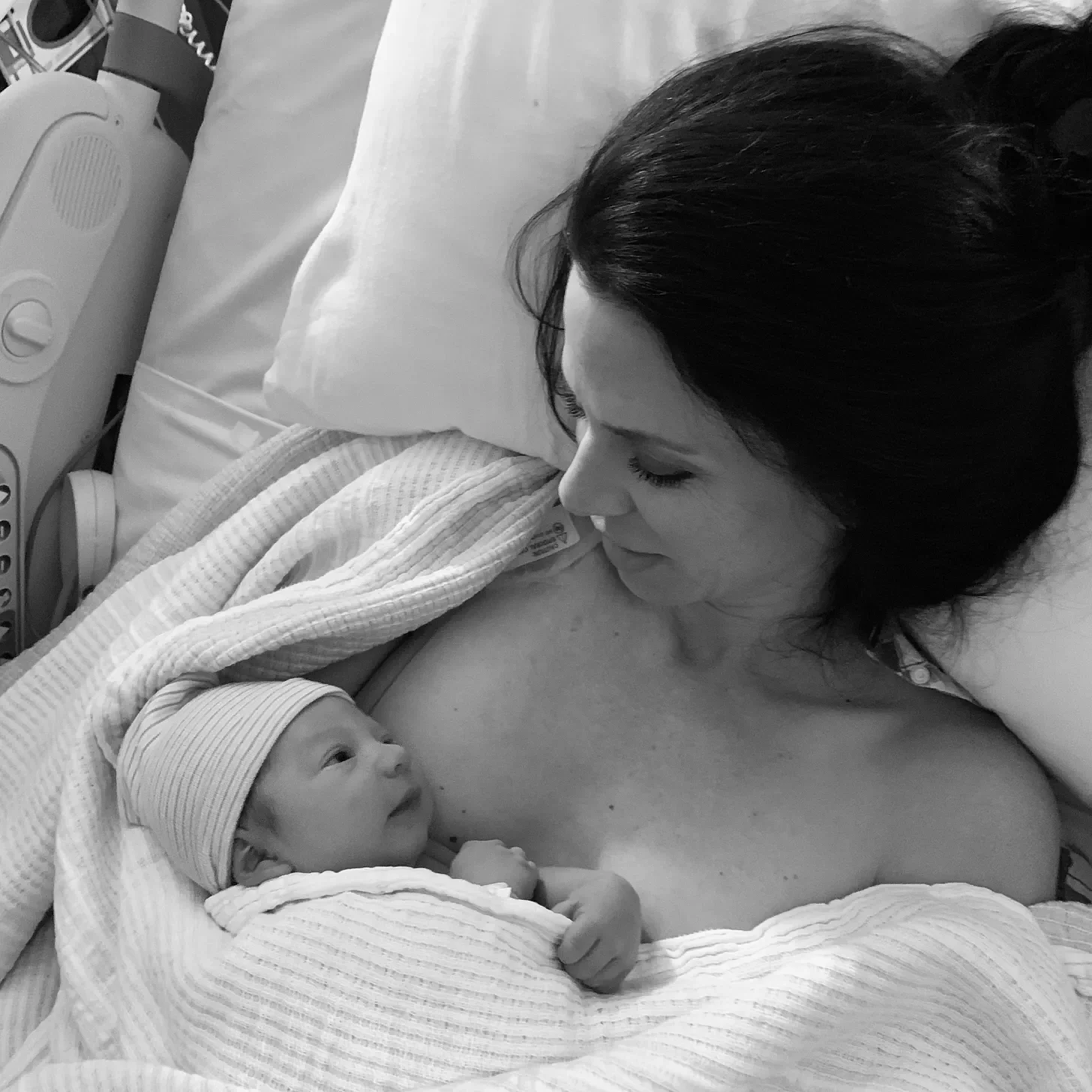
Thoughts on motherhood, breast cancer, and what attachment theory and the Enneagram taught me about being loved