

The Blog
Recently Featured



All Blogs








Fall, Body Image, & the Gift of Procrastination (Yep, you heard me.)
“Almost anything will work if you unplug it for a few minutes, including you.”
Ann Lamott

Do you feel the swing of fall kick up all the busy energy like I do?
It happens every October. The kids are back in school, schedules lock in step, and a cozy waft of pumpkin spice beckons our senses around every corner.
Fall is my favorite. I’m not sure if it’s because I was deprived of clear-cut seasons growing up in Mobile Alabama’s constant humid sweat or if it is simply the fact that I’m a sucker for jackets, boots, scarves, and those glorious warm colors. It’s both–perhaps. The moral of the story here is: there is a crisp, tangible shift that dials in and carries me through to the year’s end.
Festivity is the oversized centerpiece of fall’s table. The striking hallmark in that centerpiece—busyness. Work schedules often really wake up as do social gatherings and travel, leaving self-care and connection optional at best. For me at least, the treadmill starts to speed up, and I let go of all the rituals and reasons I’ve come to rely on for a sense of sanity and serenity throughout the year.
Last Wednesday, I had the distinct honor of joining my friend, Mary Hyatt, on her Facebook Live show. Mary’s an incredible personal coach, entrepreneur, and Essential Oil guru who shares a passion for empowering others to live their fullest and most authentic lives. We had the best time talking about perfectionism, especially as it relates to body image.
Now you may be thinking, “What the heck do perfectionism, body image, and Fall have to do with anything?”, and that would be fair. Hang in though.
After the show, I left her studio still marinating in our conversation. I was curious why perfectionism is this rampant, especially for so many women, and how we grow to get so attached to its limiting and fearful message.
Perfectionism is such a manipulative lie and one that actually stunts any lasting success, acceptance, creativity, and joy. It always backfires.
As a recovering perfectionist, I’m all too familiar with its soul-sucking grip. At the bleeding heart of it is the bondage of comparison with others, and/or some unrealistic version of who we should be that doesn’t actually even exist.
We can’t throw the baby out with the bathwater though. After all, the seed of perfectionism’s pursuit is a massive desire for acceptance and belonging, two things we actually block when we become captives to the prison of its stark and lonely cell.
Your Desire is everything! It indicates a longing for something more and leads you into the path of your truth. However, the straight jacket of control, typically fueled by fear, stunts the hope of desire.
Perfectionism won’t allow for vulnerability and acceptance, and belonging requires loads of that V stuff. It’s a tricky conundrum, indeed.
In my experience, when I’ve fallen so hard into the lull of perfectionistic sleep, it’s a subtle process, one that definitely doesn’t feel intentional. This typically happens in seasons of disconnection with self—busyness.
So procrastination is a thing. You get it. Chances are, you’re really good at it too. My hope for you and I in this yummy fall season is that we would practice awareness as to exactly what we are procrastinating. What are you putting off in order to facilitate the ramped up energy of fall?
Is it sleep, exercise, meditation, journaling, or simply downtime? Where will these deficits show up? Typically, they show up at some point in relationships with self and others. Another resulting deficit is our peace. I love the quote that says, “If it costs me my peace, it’s too expensive.”
With the alluring temptress of perfectionism lurking not so subtly on social media, presenting universes of shiny, packaged worlds, my challenge to you today is this:
Rebel. Procrastinate perfectionism— Just for today.
Perhaps tomorrow you can pick it up, maybe. Instead, slow down and lean heavily on the courage of self-compassion. Look at yourself,—your life, in the mirror and speak to that longing, loving soul as you would your best friend. No one ever accomplished great things by hating themselves into submission.
Life does get busy, and stress often feels like our annoyingly perky roommate. Just remember, your “me,” that little person who looks a whole lot like you, is patient and up for the adventure. Don’t leave her behind or worse, trade her in, for an illusory version. The most beautiful life happens when we embrace ourselves as perfectly imperfect, quirky, messy, and all.
Freefall into the unique loveliness of you. Perfectionism is playing far too small.
Love & Gratitude,
Katie
xoxo

Rising from the Rubble — 3 Timely Reminders about Trauma
"Don't allow your wounds to transform you into someone you are not."
- Paulo Coelho

Hello Friend,
Today’s post is one I’ve had a difficult time writing for two weeks now. The horrific blow of last Sunday’s shooting at the Route 91 Harvest Festival in Las Vegas has left me pretty numb in the way that this type of fear-generated evil does. I hate it.
I don’t know how you’ve processed it, yet if you are like me, layers and layers of hateful behavior tend to leave me feeling helpless, and often as a result, apathetic.
How can I help?
Is our world going to hell in a handbasket?
What next?
The grim reality sets in and my callouses begin to peek through.
Wait a minute though, that’s me responding to fear with fear… or even worse, apathy!
This is perhaps the greatest danger possible: that fear would settle into apathy, and we might surrender to a new normal of acquiescence and cynicism.
Fear, in the very least, elicits some reaction. Apathy does nothing.
After a week of wallowing, I feel a healthy dose of righteous anger rising up and simply can’t back down.
I’m grateful not to have lost anyone in the tragic attack. However, I’ve witnessed several who have been directly affected, unexpectedly saying goodbye to loved ones and life partners as well as having a branded traumatic experience filed away on a cellular level. I cannot begin to comprehend that depth of sorrow, and I sincerely pray for comfort in their desperate time of need.
How are you doing in light of all of this?
Do you find yourself in the throws of pain and powerlessness despite not being directly affected by the shooting? I’ve found that highly creative people also tend to be highly sensitive to what is happening around them. You fall in this category.
You are drawn to the interior journey towards wholeness and integration which is something not everyone signs up for. Your willingness to connect is in and of itself intrinsically a creative, out-of-the-box endeavor.
Here are a couple of reminders regarding trauma as we assess the damage, lean into the conversation, and rise from the rubble:
1) Trauma is trauma no matter how you slice it.
I like the definition of trauma that says it is anything unwanted or unnatural that happens to you. Just because you weren’t there in that open amphitheater in Vegas does NOT mean you aren’t suffering secondary or tertiary trauma.
Simply being victim to 24-hour news coverage of the terror can be enough to blanket you in a thick layer of indirect trauma. Knowing our limits to information and “breaking news” is a good thing.
We’ve all been affected on different levels, and no one is comparing trauma to trauma: it's all relative, and we’re all in this together as different parts of the collective body.
2) Grinning and bearing it is old news and going the “stoic” route won’t cut it.
Inevitably, when we try to stuff our trauma or any emotion for that matter, it will eventually come out somehow and not in the loveliest of fashions.
Any time we experience loss, we must grieve it. What I’m learning about grief is it MUST be witnessed by safe people in our court whether it be a family member, a trusted friend, and/or a therapist/spiritual director. We cannot grieve in a void.
3) Find a creative outlet.
For me, this is writing. I’ve damn near filled up two journals in the past month boiling over with unfiltered and unapologetic responses to natural disasters, political conundrums, and most definitely, the recent shooting in Vegas. (I may as well be committed if anyone were to read said journal entries.)
I devoted several pages to Tom Petty in there as well— he was surely a brave and gifted soul, iconic and irreplaceable on every level.
What is your outlet? Painting, baking, sculpting, guitar, yoga, or dance? Whatever it is, pour your heart into it. Emotional energy must be expressed, not repressed. Repression and avoidance are siren songs that allure numbing agents like booze, food, drugs, work, and the like to make their seductive pitches. We’ve got to get out in front of them by tapping into our inherent creative essence.
I’ve got more resources coming to you here very soon, but for now, here’s the invitation for you and me: we all have our own work to do in keeping our interior landscapes clean so as not to fall asleep in a stagnant pool of apathy.
If you or someone you know is currently experiencing a fall-out from recent tragedies, reach out. Don’t let lack of resources, fear of judgement, or perhaps the unknown, hold you back. Nashville is fighting back from a place of love and accountability. Join me on this path to connection, integration, and courage as we bridge the gap for the broken and openly talk about our wounds.
Take heart, my friend—you are not alone. We are all inexplicably in this together. That is the invaluable, stunning nature of the human spirit in its purest form: our pain joins us together and binds us into a beautifully broken patchwork that heals us over time. Let this be your anchor as chaos and loss sweep heavily over our hearts. It has surely been mine.
Love & Gratitude,
Katie
xoxo

Magic in the Meltdown
“When we put down ideas of what life should be like, we are free to wholeheartedly say Yes to our life as it is.” -Tara Brach
If today’s title caught your eye, you are in the right place—Welcome.

If today’s title caught your eye, you are in the right place—Welcome.
When was the last time you had a meltdown? You know, the powerless, ugly-cry, shut the world out because no one seems to understand how hard it is variety?
It felt as though your body was boiling over with frustration so much so that it had to find a release so naturally, the eager emotional wheelhouse got a proverbial hall pass and skipped town on someone else’s dime. It was a bender of a meltdown, remember?
In those moments, all I want to do is fix it, run, or somehow numb it in order to escape the tight and uncomfortable tension I’m feeling. It’s simply too much.
Days later and with time’s firm and steady grip around my limp hand, I realize something magical: there was and always is a clear way out. However, against my resistant heart’s desire, that magic occurs as we willingly walk through the pain, not around it.
I feel this sometimes when I can’t sleep. I’ve been known to struggle with insomnia. Sometimes there’s a reason for it, and sometimes my stubborn body simply won’t shut off.
You know what the most frustrating bit of this dilemma is? It’s not the actual inability to sleep; it’s the belief that I “should” be able to sleep; that I am somehow guaranteed this right without question. The entitlement trap is what gets me every time, leaving me resentful on top of delirious.
What I realize after those seasons of scant shut-eye pass is something pretty basic, yet poignant:
It didn’t kill me.
In fact, it gave me something to learn from, write about, and understand better in order to amp up my arsenal of sleep tools. (PSA: If you have trouble sleeping, let’s totally talk.)
Last week, I shared a very special interview with Miles Adcox, Owner and CEO of Onsite Workshops, a regular guest expert on the Dr. Phil Show, new Dad, among many other cool things. If you missed the episode, definitely go back and check it out, he delivers some brilliant insight in there for us.
I ask every guest the same question: If you could give your 25-year-old self a piece of advice, what would it be? (For you millennials out there, let’s say 15.)
What he said was stunningly simple and so applicable to you and me: “It’s okay to not be okay.”
Wait. What?
You mean, when I’m mid-meltdown of the century and nothing, I mean, NOTHING, looks as it should, it’s….OKAY?
Yes.
I’ve sat with those words a lot lately, and they bring me continual peace. In my experience, like with the sleep situation, often it’s not the actual pain of the problem that is most piercing. Instead, it’s the belief that whatever is happening shouldn’t be. That, I believe, is the difference between pain and suffering.
Pain inevitably ebbs and flows throughout this life if we are walking around with anything vaguely resembling a heartbeat. However, suffering is the delicately crafted narrative we create about our pain. “I shouldn’t be feeling this way” or “my past was too much to bear.”
Curiously, life is made up of a 50/50 split of positive and negative feeling emotions.
Lately, I’ve been a student of this highly valuable process called unlearning: unlearning the entitlement stories, the fixing agents, the escape routes, and the harsh judgements that accompany my pain.
We spend so much of our lives trying to fix the flaws we think hold us back in life, and little do we know that the unlearning of these remedies will be the savior who picks us off that fast and broken road.
We must be the un-teacher of these numbing agents as we lean into the discomfort and tension of the moment.
After all, it very likely won’t kill us.
You don’t need fixing; you need to be understood. If we are constantly trying to escape ourselves and our pain, we will never get close enough to understand the root of it and answer its cry. We must gently, and with loads of self-compassion, listen and embrace the voice of our dilemma, whatever it speaks. This is the magical crossroads of our painful experience and total acceptance. Not only that but ironically, this is the surest route to our deepest joy.
Love & Gratitude,
Katie
xoxo
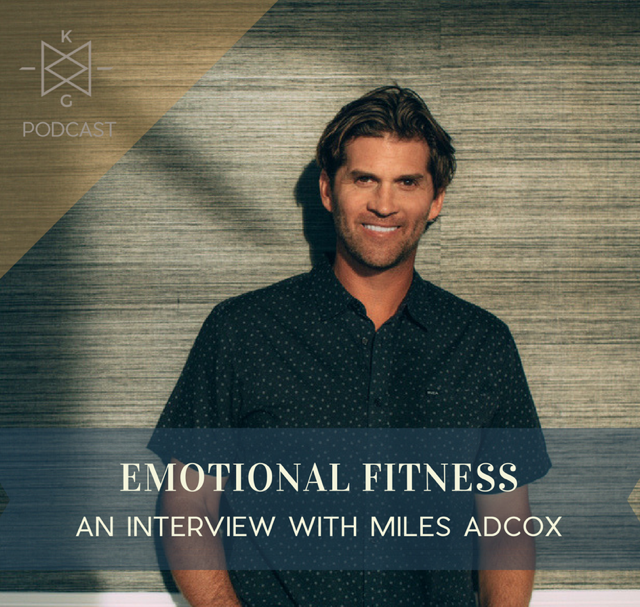
Emotional Fitness: An Interview with Miles Adcox
“If we don’t reconcile our stories, they will absolutely define us.”
-Miles Adcox
Happy Thursday!
Today’s episode is near and dear to my heart, perhaps because it’s personal.
Life is absolutely full of light and dark, good and bad, ups and downs—all kinds of colorful seasons. Something I love about the passage of time is we get to see many of the complex questions of yesterday make a bit more sense in our today.

Happy Thursday!
Today’s episode is near and dear to my heart, perhaps because it’s personal.
Life is absolutely full of light and dark, good and bad, ups and downs—all kinds of colorful seasons. Something I love about the passage of time is we get to see many of the complex questions of yesterday make a bit more sense in our today.
Often times, our painful past experiences have birthed resilience stories that we get to carry along in our pocket and give away to those in need. It doesn’t mean we’d want to go through those seasons again, yet it sure gives levity and meaning to the wounds.
Part of my story has been a crippling battle with depression/anxiety dating back to high school. About a decade ago, it came to a head, despite years of therapy, cocktails of medication, you name it.
Thankfully, I heard about Onsite workshops from Cindy, a dear family friend. I could tell by the way she described her time there that this wasn’t your typical treatment program. No, Onsite was different; experiential in nature and truly transformative.
I was desperate, so I went. Scared out of my mind? Yes. I still went.
Desperate trumped scared.
Grateful doesn’t begin to describe how I feel in retrospect. Going through “Living Centered,” their flagship program, was an unforgettable healing experience.
Today, I’m beyond excited to share a very special interview with Miles Adcox, owner and CEO of Onsite. As you’ll learn in the intro of today’s episode, Miles has quite an impressive resume, and yet, his humility and transparency about the shifting journey he’s been on is inspiring and endearing.
I can’t wait for you to listen and learn more about Miles’ story and upcoming projects. Every time I talk to Miles, I’m reminded of what it means to truly make life matter, taking each day as a new opportunity for growth and change. I have a hunch you’ll know exactly what I’m talking about after listening to this interview.
Enjoy and share away!
Love and Gratitude,
Katie
*My podcast theme song is titled “Land of the Living,” written and performed by the very brilliant and gracious Matthew Perryman Jones.

Leaning into Loss- 4 Lessons on Grief
“Resilience comes from deep within us and from support outside us. It comes from gratitude for what’s good in our lives and from leaning in to the suck.”
Sheryl Sandberg
I recently attended an all-day workshop led by David Kessler, self-help author and grief guru. He is most well known for his groundbreaking work with Elisabeth Kubler Ross, a Swiss-American psychiatrist who pioneered what we know as hospice care as well as the Kubler-Ross model, or the five stages of grief (denial, anger, bargaining, depression, acceptance).

“Resilience comes from deep within us and from support outside us. It comes from gratitude for what’s good in our lives and from leaning in to the suck.”
Sheryl Sandberg
I recently attended an all-day workshop led by David Kessler, self-help author and grief guru. He is most well known for his groundbreaking work with Elisabeth Kubler Ross, a Swiss-American psychiatrist who pioneered what we know as hospice care as well as the Kubler-Ross model, or the five stages of grief (denial, anger, bargaining, depression, acceptance).
Despite Kessler’s expertise in death and grieving, he is hilarious. He cracked jokes throughout the entire day, poking fun at himself and taking some light-hearted stabs at the afterlife. I found this profound in light of his work’s focus.
It’s impossible to funnel all the takeaways into 500 words or less, but I’m going to do my best to share some punchy truths about grief that rocked me to the core.
Here are four key insights to remember about grief and the grieving process:
We Grieve in Character
Have you ever known someone who is super level-headed, maybe even annoyingly practical and even-keel, experience a major loss and recover with seamless resilience? Perhaps to the point you even asked them, “Are you sure you’re okay? You don’t even seem like this phased you!”
Unless there is a very small chance (less than 15% I learned at the workshop) they’re experiencing delayed grief, he/she is grieving in character, meaning— the way we normally do life is the way we also grieve.
Me, on the other hand, grieve all colors of the rainbow; with intensity and every shade of emotion. However, as an Enneagram four, my feelings even have feelings, so this is par for the course.
Suffering is Optional
Throughout the day, Kessler kept coming back to this truth bomb: Pain is inevitable; suffering is optional.
Pain and loss are absolutely a part of life. Suffering, however, is the story we make up about our pain. For example, “This shouldn’t be happening to me” or “It wasn’t supposed to end this way.” We quickly forget how much a part of life loss is as the proverbial record gets stuck on that screeching note of overwhelming shock and awe.
The upside to this is we have complete power over whether we suffer long-term or not. When we suffer, we live in our heads and attach to narratives of futile embellishments…”why me?”
This is where resilience shines center stage as we courageously “lean into the suck” as Sheryl Sandberg cleverly puts it in her latest book Option B. Loss is painful, and the quickest way to the other side is through it, not around it.
Fixing Doesn’t Work
There is no rational way to fix traumatic loss just like there is no way of scientifically explaining romantic love. It just is.
Grief must be witnessed, not explained. When I try to relate to someone in their grief by offering up a “me too,” what I’m doing is making it about me, not actively listening, and in doing so, cheapening their very real experience. Don’t worry, grief will inevitably run its complex and necessary course. We don’t have to, nor can we ever simply fix it. A hug, an open ear, and a shoulder to cry on will work far better.
From my own experience, I’m reminded that isolation wreaks havoc on the grieving soul. No, I’m not saying we need to extrovert-up and throw ourselves into social chaos. However, knowing we’ve got a few safe people who will witness our grief is vital.
We’re not meant to go this road alone.
Math
As I wrap up this recap, I am sort of cringing on the inside. It’s so pat…so formulaic. The grieving process is far from math. It’s ghastly. It feels like death. It’s bigger than space and time and breaks us in a way that feels violent, wrong. So how do we intentionally bring awareness to this part of life, even when what we currently experience feels light and joyful? I think it’s a combination of two things: we give thanks a helluva lot more for the things we have that bring life, laughter, and meaning. We also talk more openly about the reality of loss, not to focus on the negative, but mindfully acknowledge the fragility of it all. These two go hand in hand.
If you or someone you know is alone in their grief, know that there are options. Please reach out if your grief needs a witness.
It won’t stop the pain, but it might ease the suffering.
Love & Gratitude,
Katie
Thoughts on motherhood, breast cancer, and what attachment theory and the Enneagram taught me about being loved