

The Blog
Recently Featured


All Blogs








The Power of the Pause
“Between the stimulus and the response there is a space. In that space lies our freedom and purpose.”
-Viktor Frankl
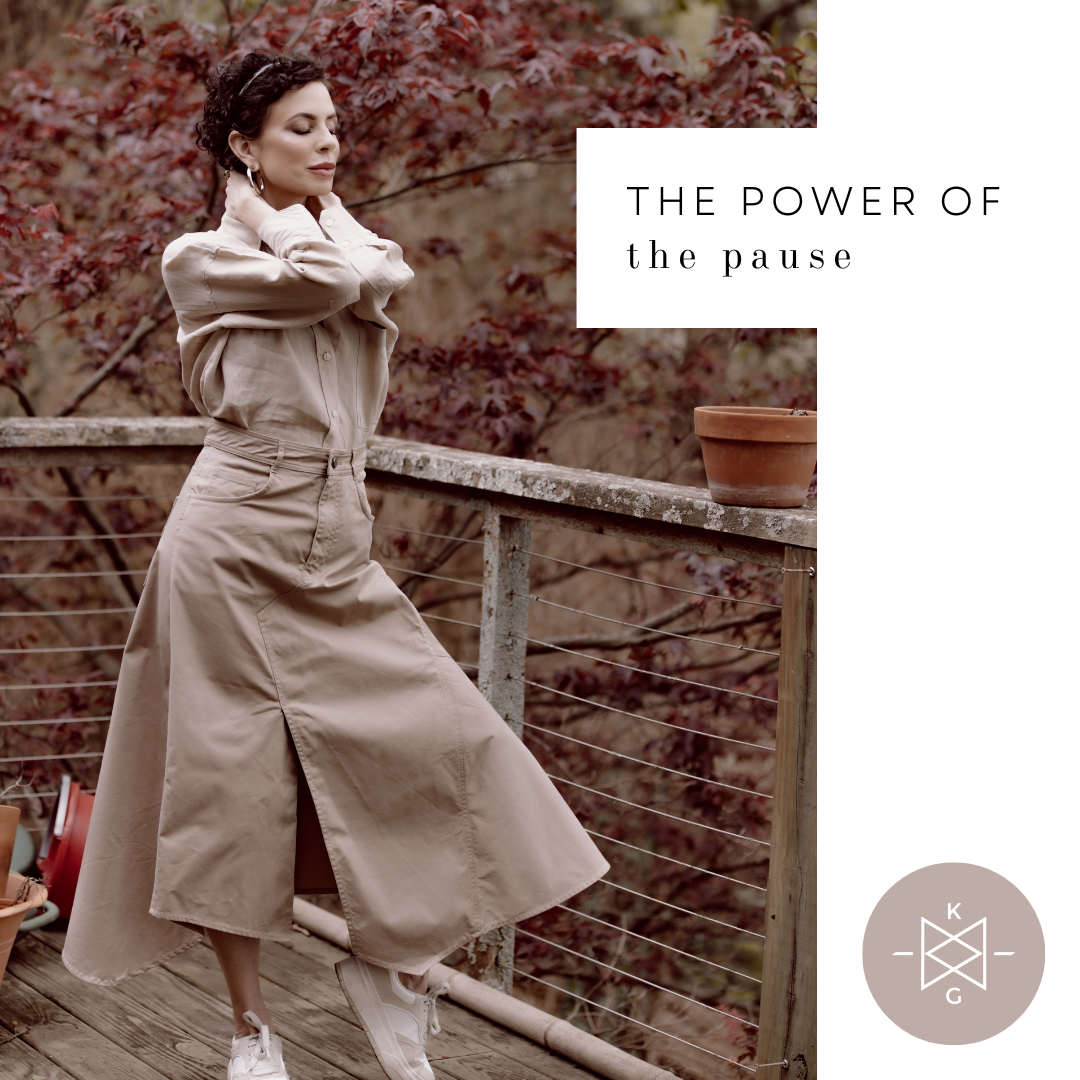
I swear I quote the late Dr. Frankl every day. Must mean I really need it! So, what’s the big deal? It sounds like a philosophic science experiment.
I’ll paint a beginners’ back drop.
Frankl was an Austrian neurologist, psychiatrist, and Holocaust survivor. Fluffy stuff, right? (Jk!)
His famous book, Man’s Search for Meaning, is stunning and tells the story of how he survived the Holocaust by finding personal meaning in the experience, which gave him the will to live through it. He went on to later establish a new school of existential therapy called logotherapy, based on the premise that man’s underlying motivator in life is a “will to meaning,” even in the most difficult of circumstances.
Okay, so how does this pertain to this powerful “pause” we’re talking about today.
I believe most of our problems in life stem from living out of reactivity rather than responsiveness. There’s a big difference. Reactivity might look like popping off at your co-worker (or significant other), flipping someone off in traffic, yelling at your toddler when they have a melt down in Trader Joe’s (who…me?), or even playing the victim when confronted with disappointing news.
Reactivity is this quick, reflexive, emotional way of meeting those tricky curve balls life has and will continue to serve us.
Responsiveness, on the other hand, is a more intentional, thoughtful way of meeting those same curve balls.
The inconvenient stimuli will always be a part of life. It’s how we create space and meaning in the in-between that invites us to more freedom and purpose.
I believe through my own experience that the opposite of depression isn’t happiness—it’s purpose. It’s meaning making.
I believe we do this a bit easier through the Power of the Pause.
This is an effective tool I teach, especially when helping groups and individuals apply the Enneagram. And it’s ridiculously easy—maybe so much so we overlook it.
It doesn’t require a 20-minute meditation, although I heartily believe in those too if you’re the meditating type.
It requires a simple self check-in whenever we get triggered. Before you spin out and go postal, take a space of 30 seconds to a minute to simply pause, breath deeply, and ask yourself, “what am I believing about me right now?” those beliefs often go like this:
“I’m a terrible mom.”
“I fear this will never end.”
“No one understands me.”
“You make me feel worthless and helpless.”
“I’m too much.”
You get the idea. When you stop to investigate what’s coming up in any experience, and bring some inquiry and fact-checking into the mix, it’s easier to take the emotion out of it and RESPOND rather than react.
So, push this around this week in your own experience. Practice taking a pause or several throughout the day to explore what’s really going on inside and just BREATHE. Even this little practice can create the space to step into your wise, loving, adult self and leave that adaptive, reactive self in the rearview mirror.
The best part of this? It really works! Try it on for size and let me know what you think.

If It Makes You Happy
“The subconscious does not originate ideas but accepts as true those which the conscious mind feels to be true and in a way known only to itself objectifies the accepted ideas. Therefore, through his power to imagine and feel, and his freedom to choose the idea he will entertain, man has control over creation.”
-Neil Goddard

You’ve probably heard it before, the pithy phrase, “Happiness is an inside job.” But have you ever stopped to ask yourself why? After all, isn’t happiness based on circumstance while joy is the real coveted virtue? In that case, happiness would seem outside of ourselves all together.
While I’m not sure about that, I do know I like being happy more than not.
In the last several years, I’ve been fascinated by the human brain and have spent tons of time trying to understand it more. After all, your brain is literally a genius and has the power to heal itself completely over time. This is why there’s such hopeful prognoses for those who’ve experienced horrific traumas.
You can’t study the brain without delving into concepts such as the conscious and unconscious mind. While that’s another post for another day, know this:
Just as the quote mentions above, we possess unfathomable creative control as humans when we learn to harness and practice intentionally directing our thoughts and feelings in the way of our desires. Sound too airy fairy for your taste? Fair enough, but check out Dr. Habib Sadeghi’s book, Within, to understand the science behind it. It’s undoubtedly a game-changer.
Today, I want to give you five helpful reminders as you go about cultivating more happiness and meaning in your everyday experience:
Happiness is a practice, not a destination. We must learn to practice happiness in the small, insignificant moments throughout the day rather than “saving up” for an unrealistic circumstantial pay-off.
We can’t experience happiness without pain. Life is a series of contractions and expansions. Picture a caterpillar inching right along. There are equal contractions and expansions that keep him moving forward.
We create our own emotional experiences by the beliefs we choose to adopt. Beliefs are simply thoughts we practice thinking over and over again. Your past thoughts and beliefs have created the reality you’re in today.
Happiness is not contingent on your story. You and I have agency to write the stories we want to live into. By taking total responsibility for our experiences and resulting emotions, we are able to move through them and create greater hope and meaning.
It’s okay to not be okay. We put so much pressure on ourselves to be happy. Yet if life is equal parts expansion and contraction, we must learn to be okay with sadness, heartache, loneliness, and anger. When we learn to contain and process our emotions in a healthy way and extend self-compassion to ourselves on the other side, we will likely experience less resistance and more equilibrium in life. If you have a bad day, let yourself be in it, process it, and move through it instead of faking it.

You're Invited! An Enneagram Community
“Tell me and I forget, teach me and I may remember, involve me and I learn.”
-Benjamin Franklin

What are you doing TOMORROW, April 26th at noon?
Let me tee up my question.
This year has already been an integral one for me in so many ways. Namely, I came to the welcomed-end of a two-year breast cancer recovery with my final (fingers crossed) surgery just a couple weeks ago. I’m 100% certain that my cancer journey was victorious due to years of my own self-care and a multitude of prayers. I learned first hand, attitude is, indeed, everything.
As we stretch well into Spring, I’m so thrilled to bring you a deeper dive into both self-care and the Enneagram. Over the course of the last couple of years, the founding members of the Practice, my Enneagram-based self-care membership program, gave us some vital feedback—more Enneagram content and community!!!
So that’s what you get. The monthly subscription will give all the goods of the original program: daily journal prompts, yoga flows, guided meditations, expert interviews, core Enneagram content each month, PLUS a 1-hr long virtual group Enneagram coaching session led by me. We will explore concepts like growth paths, subtypes, wings, relationship styles, and more. More importantly, you’ll meet new friends on the same self-discovery path you’re on.
To love yourself is to first know yourself—to really understand the why behind how you think, feel, and act. The Enneagram is the best tool we have for self-understanding and development. Further understanding how to take care of you in all your glorious uniqueness is exactly what we’ll do! I’ve been studying and using this powerful tool for 16 years now and I can honestly say it has illuminated life and relationships in remarkable ways.
No matter where you are on your Enneagram journey, I believe you can find a place to go deeper with me in 2023!
Join us TOMORROW at 12:00 pm CT for a free peek into one of our sessions!!! (Passcode: 932076)

I wish I would have known this at 25
“Where we think we need more self-discipline, we usually need more self-love.”
-Tara Mohr

What piece of advice would you give your 25-year-old self? Sure, she may not have listened, but like any loving parent, you do what you can to steer your children in the right direction. That head-strong seeker was only doing her best. And yet today, you have matured into the expansive space of perspective and balance. You have a lot to offer your younger, stubborn self.
Me? I would have a spirited come-to-Jesus about how to relax into the unknown one brave and wobbly step at a time. I’d tell her that having all the answers isn’t half as important as asking honest questions.
Specifically, I’d love for her to understand what it means to have a growth mindset as opposed to a fixed one. Less either-or and more both-and.
As a recovering perfectionist, I’ve been all too familiar with what it means to have a fixed mindset. A fixed mindset is a way of thinking that is rigid and narrow. It’s all about pass or fail, win or lose, good or bad, black and white. It’s rooted in judgment rather than curiosity. It’s refusing to take myself on a brisk 20-minute walk because I didn’t have enough time to do my hour-long high intensity workout.
Here’s another example. You have your 6-month review at work. Your boss gives you high marks in several areas but points out one specific necessary improvement in your performance on a big project. A fixed mindset self-criticizes, labeling your performance as a failure. A fixed mindset disregards the praise and zeros in on the area of improvement. A growth mindset celebrates the positive feedback and understands the value of constructive criticism for future success. A growth mindset sees life as a slew of peaks and valleys all leading to personal freedom and expansion.
A growth mindset is the petri dish that breeds resilience. A fixed approach creates rigidity, closing us off from abundance and opportunity.
This isn’t about glossing over reality. It’s about softening your approach to the inevitable ebbs and flow of life.
Spend some time this week pondering this: What area of your life could you stand to soften into?
Is it your relationship with food, your body, parenting, or work? Is it your self-care? Whatever it may be, I believe a great way to find out is to pay attention to our self-talk, that often nagging inner critic that rages on, involuntarily.
Write it all down.
I love what Tara Mohr says, “Where we think we need more self-discipline, we usually need more self-love.”

What do you really want?
“Desire is the starting point of all achievement, not a hope, not a wish, but a keen pulsating desire which transcends everything.”
-Napoleon Hill

What’s stopping you from doing what you truly desire? In my experience, it is much harder to do what I truly desire when I’m acting as my own worst enemy.
However, when I get out of my own way and start playing for instead of against my team, big things happen. It’s up to me to get out of my own way and embrace the responsibility of loving and taking care of myself.
Perhaps the greatest tool alongside therapy that has equipped me to do this is the Enneagram. It has been a steady companion, giving me the language to express lonely truths I thought were mine alone, as well as reasons for doing the clumsy things I so often do. The Enneagram has gently shown me all the ways I wear false--if not fashionable--masks of personality to protect myself from being truly seen and perhaps rejected. It has shown me the great potential that awaits (when I do step out of my own way).
You may know about the Enneagram, and if so, I’m grateful. It’s not just a hyped-up trend or personality box. In fact, it traces so far back, experts can’t quite nail down its conception. Even the modern Enneagram of personality has stood the test of time, and I’m thrilled more and more people are bringing it into their homes, relationships, and dinner conversations.
As we gear up this Spring, let’s take the time to become our own best friend…to connect back to the little girl who only knows love and has no clue how to lie or be afraid or confuse success with love.
If this feels wildly out of reach and too esoteric, don’t worry, you’re not alone, I’d love to support you in your desire to truly thrive. I’ve got a trusted roadmap to get us there.
You ready? Join me in the Practice.