
The Blog
Recently Featured

All Blogs






5 Things I Learned During Chemo
“…You’ll figure it out—all the little things seem so big now. Don’t worry about all the little things—they only get bigger…wish you could see me now.”
-Katie Gustafson’s “See Me Now”
My cancer diagnosis back in April of 2021 was an unexpected gift in many ways. Perhaps most glaring was that it forced me to take a forensic inventory of my life—and how I’d been living it up until that point. It crystalised the things that were and are truly important. It invited me into more personal integrity—alignment with my deeply held values. It convinced me there was no reason to sweat the small stuff—adulting means we have more responsibility, more to live for, more to lose, and more to let go of when it ceases to serve us.
I’ll never forget the day after I was diagnosed with breast cancer. We attended a friend’s over-the-top gorgeous wedding outside of Nashville. I had no idea what the course of treatment would be at that time. All I held to that day was the certainty that my story had taken a dramatic shift to the tune of that terrifying “c” word.
I savored every single minute that day. I got to dress up (which is my spiritual gift), hugged and kissed my then 2-year old when we dropped him off at my folks house on the way, sipped champagne, and held my husband’s hand tighter than I can ever remember. I even got to slow dance with him. As my cheek pressed up against his crisp suit jacket, I cried hot tears of joy, gratitude, and fear all at once. I’d been given another day and the days of taking this beautiful life for granted passed right then and there. That was another gift I was granted: perspective.
From where I sit today, nearly two years later, the lens I look through isn’t fear, it’s possibility. I’ve undergone a bilateral mastectomy, a brutal recovery, countless doctor visits, three smaller surgeries, and chemotherapy. I lost my hair completely. (Thankfully it’s back…and corkscrew curly! Who knew?) I lost the illusion of invincibility. But I’ve gained so much more. I’m pretty sure my heart grew a new chamber. I know my faith did.
Along the way, especially during chemo, I learned five things that I believe we can apply in the face of any challenge. I want to share those things with you today.
Guard an open mind: Keeping an open mind in the face of adversity is necessary. We will never be able to predict the future and going to the worst-case scenario is futile as a result. Though oftentimes we slide right into a fight-flight-or-freeze fear response, practicing curiosity is everything as we start to thaw out.
Life is hard—it’s our attitude that makes it a bit easier: At my last oncologist appointment, my doctor told me something that I’ll always be grateful for. She told me that in all her years as an oncologist treating cancer patients of every kind, I was in the top one percent whose chemotherapy experience seemed easy and even inspiring. She attributed that to my positive attitude every step of the way. I’ll tuck that away in my pocket the rest of my days and forever swear by the power of a positive attitude.
Protect your time and energy: It is totally okay and even necessary to pull back from our normal responsibilities during difficult seasons. One way we do this is by setting boundaries around our time and energy. For me, my immunocompromised state required this. However, it was a lesson either way. I learned to let my “no” be as good as my “yes” without guilt.
Self-care pays off: It’s no accident I started the Practice, my Enneagram-based self-care business, the same year I got cancer. It was a lesson in synchronicity. I have been practicing self-care (esp. meditation, exercise, therapy, etc. ) religiously for decades. I witnessed first hand how every single time I showed up for myself over the years paid it forward to undergird me in the most physically and emotionally daunting season of my life. Practicing self-care will always serve you when you need it the most.
Let people support you but not always advise you: People are well-meaning. I do believe this. However, each of us has a unique story and process. There’s no one size fits all. Take the advice of others with a grain of salt and as a gesture of support. My chemo experience, (that 1% situation my oncologist observed) was not informed by the stories of other’s experience with cancer. And boy am I glad!
Thank you for accompanying me through this incredibly wild ride. I’m on the other side for sure. I hope and pray your journey unfolds in beautifully unexpected ways…and where there is suffering…I pray God’s grace surrounds you.
Your Brain on the Enneagram: A Chat with Dr. Jerome Lubbe
“Neuroplasticity tells us that we are capable of change. If we understand the function of the brain, we can improve our way of life.”
-Dr. Jerome Lubbe
I had the pleasure of interviewing Dr. Jerome Lubbe, an innovative thinker, functional neurologist, and author of The Brain-Based Enneagram: You are not a Number, to talk Enneagram and the brain. It was truly fascinating.
The Enneagram stole my heart 17 years ago, but neuroscience and specifically, neuroplasticity came in hot on my radar soon thereafter. It was around then that I started studying trauma and it’s effect on our brains and bodies.
You may be wondering what the heck the brain has to do with the Enneagram. And that would be fair. That’s why I’m excited to unpack it a bit here today.
According to Dr. Jerome:
Neuroscience tells us that our brains are plastic. They can and do change. Brain anatomy reveals that our operating system is composed of three primary components which mirror the structure of the Enneagram--Brain-stem (instinct triad), Right hemisphere (intuition triad), and Left hemisphere (intellect triad). Functional Neurology shows us how to target areas of the brain in order to physically improve the efficiency of the distinct natures of our identity.
The Enneagram integrates seamlessly. It provides language and definition for the process of development. It opens channels for growth by connecting values and expressions to brain function. It offers a guide for increasing physical, mental, and emotional efficiencies by practically implementing effective methods at effective times in effective ways. The Brain-Based EnneagramTM empowers every human being on the planet to engage with the brain, heal and rebuild after trauma, encourage and strengthen efficiencies, and nourish the relational, integrated nature of our whole identity.
Simply stated, understanding how our brains work and develop habits of attention, thought, and emotion over time directly affects our behaviors and the arc of our wellbeing and experienced reality. When you integrate this knowledge of the brain with the effective self-understanding tool of the Enneagram, you are able to understand how you got where you are and can begin putting into practice a new, empowered way forward.
Sure, knowledge is power. However, once we are able to implement tools (the Enneagram) with this knowledge, power translates to growth and transformation.
Something I appreciate about Dr. Jerome’s approach to the Enneagram is his advocacy in our capacity for all nine types. He provides in his extensive research and testing that we can’t be reduced to one number. Instead, we have fluid elements of all nine that ebb and flow with life’s unfolding. This allows for the complexity of the human identity and is a sigh of relief to the boxy, stereotypical reign of type.
As I like to say, we have a dominant type (in my case, a four), yet also have strains of each of the other eight in my Whole Identity Profile, as he has pioneered.
His personal journey, breadth of work, and available resources for us is simply stunning. I hope you’ll check out his book, especially if you’ve experienced frustration around knowing your type!

Resilience: The Ultimate Life Hack
“My barn having burned down, I can now see the moon”.
-Mizuta Masahide (17th century Japanese poet and samurai)
Do you ever get discouraged because you feel like you can’t seem to get unstuck? Maybe you’ve tried therapy or read some self-help books and they bring relief temporarily but leave you wanting in the long run?
Or, perhaps you make progress along the way yet inevitably find yourself bumping up against the same flipping roadblocks, over and over.
If your hand is raised, you’re in good company. Same same.
I’m reminded that we aren’t here to finally get it right—to one day fully “arrive” and have it all figured out. If that is your goal, I hate to break it to you, you’re hosed.
As humans, we have something undeniable in common. We are imperfect—flawed at best.
I don’t believe we ever fully arrive. I believe we get good at resilience.
Resilience is simply the ability to recover (quickly) from difficulty.
What’s problematic is when we get so thrown off our game, we stay down too long, and in doing so, become calloused or defined by our struggle.
So how do we become more resilient? If this is the secret to moving through life with more ease and confidence, how do we condition ourselves to get back up after the fall, no matter how many times we stumble?
I believe we must reframe failure. Instead of seeing it as an ending, we must see it as an opening. Instead of seeing it as a personal blow, we must see it as a wise teacher who comes around from time to time. She has way more to say than her distant cousin, Success.
I know, Success is way prettier, but Failure is more than meets the eye. She has a depth and insight about her that comes from the humility only difficulty can form.
So next time you feel stuck, broken, or discouraged, I hope you won’t lose heart. Instead, perhaps the invitation and decision to sit with yourself in the space—to hold yourself in kindness—and to speak to yourself with understanding, will become the strongest parts of you. Perhaps they will be the conditioning that over time, just like a muscle—grows bigger and more pronounced.
Perhaps the goal will not become perfection…but growth tethered in compassionate resilience.

The Power of Unbecoming
“Maybe it's about un-becoming everything that isn't really you, so you can be who you were meant to be in the first place..”
-Paulo Coelho
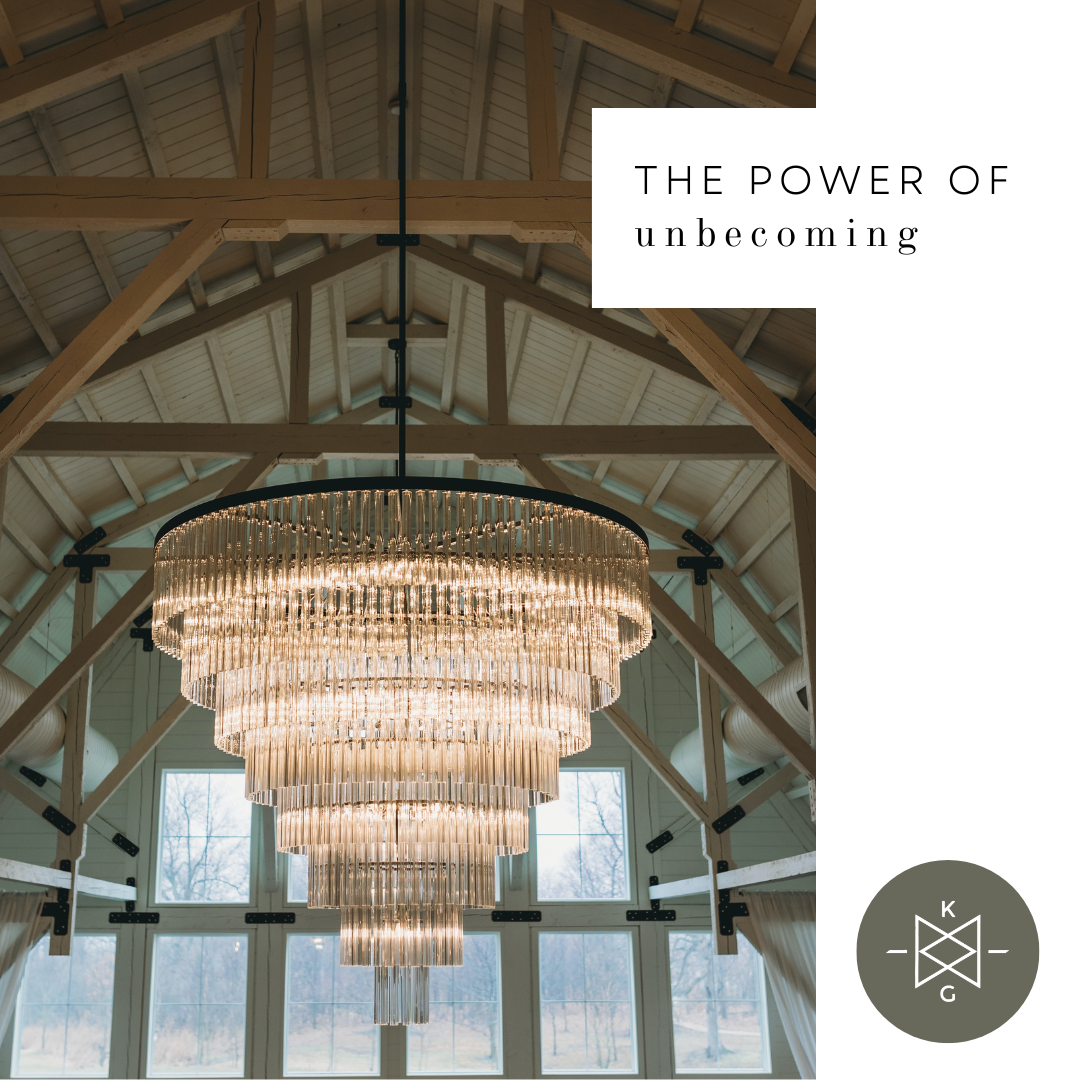
What if the real way of personal transformation is more about subtraction than addition?
What if, instead of white-knuckling our way through life, straining to gain more and more self-worth, meaning, and fulfillment, we could find a release in letting go?
When we use the Enneagram for deepening self-awareness and understanding, part of the special sauce includes unlearning—unbecoming the conditioned self or ego.
Sounds a bit wacky, right? I know, but doesn’t it also bring a bit of relief?
Part of the reason we get stuck in the first place is by living out of old, broken narratives that don’t fit and aren’t true for us anymore. Sure, they may have made sense to us early on in life when we were trying to navigate how to show up and be accepted in this world. Yet, as we mature and become adults, life becomes more complex—more nuanced.
The black and white stories of our youth won’t suffice in a world full of grey.
Consider this, the Greek word for “personality” is persona, meaning “mask.” Isn’t that interesting? This helps me understand just how much we wear our masks of personality in order to protect our true identity, or the more vulnerable parts of ourselves we aren’t too sure about.
I mean, what if I were to truly be seen for who I am? I could be rejected, found out, for the fraud I really am?
As an Enneagram four, I’ve had that thought more times than I care to count.
The great news is our Enneagram type actually helps us identify the personality story we’ve been living out of for better or for worse. By learning and understanding what that is, we bring more self -awareness into our moment-by-moment experience, allowing us to slow down our process and respond to life’s curve balls rather than reacting to them.
As we slow that process down, we can choose something novel, something different—and better. We can un-become the limiting parts of our stories that were written a long time ago and desperately need editing by our adult selves. We can….wait for it…Love what is underneath all that hustle and exhaustion.
What parts of your personality story keep you stuck? What areas in your life do you long to unlearn—to release?
Simply start there. And ask yourself, “what would my life look like right now if I didn’t believe this story?”
Want to dig a bit further? I’d love to be your guide.
How Mindful Movement Can Help Heal Trauma
“The single most important issue for traumatized people is to find a sense of safety in their own bodies.”
-Bessel van der Kolk
Today you’re in for a treat! I’m bringing my pal Koula Callahan, master yoga instructor and founding speaker for the Self-Care Workshop, on the blog to share why movement, namely yoga, is incredibly powerful and important for us to practice as we move through our days. If you’ve always wondered what all the fuss is about yoga—and why it’s really effective, today is the day—you’re going to get some answers.
Let’s dive right into my chat with Koula!
Katie: So how does movement help regulate/process emotions?
Koula: Movement is a critical part of the healing journey. So many of us forget to incorporate and listen to our bodies as we try to process emotions and hardships and we wonder why we keep feeling stuck. There’s a reason though—our entire life’s story is stored in our cells and in our body tissues. And each part of the body shares with our brain the responsibility of memory. In fact, our bodies store more information than our brains do. So if we try to process our emotions only by accessing our brains, we miss out on an enormous amount of “data” stored in our bodies that actually helps us more than our brains do. Movement helps us tap into that reservoir of “data” and develop a more integrated approach to processing emotions.

Katie: Why yoga? What’s all the fuss?
Koula: Gosh. Yoga is so freaking helpful for so many reasons. Aside from being a killer workout (long lean muscle development!!), it’s the only movement practice that focuses on presence and awareness first. A lot of people think that they “aren’t good at yoga” because they aren’t flexible. That is so not true. It’s not about flexibility, it’s not about strength, it’s not about whether or not you can touch your toes. The physical practice of yoga is all about connecting with yourself and bringing the mind, body and spirit into union with one another. Focusing on presence and awareness from moment to moment makes the practice a moving mediation. I think that’s what’s hardest about it. You have to face the truth of what’s really going on with yourself. And you also get killer abs and triceps :)
Katie: Well you are quite the inspiration there (pictured above!!)
Katie: Why should we be practicing yoga?
Koula: Yoga reduces anxiety and stress, helps us sleep better, regulates our hormones, flushes out our organs, boosts our immune systems, etc., etc., etc. The benefits are tremendous. Honestly though, I suggest practicing yoga with consistency because it keeps you grounded in a time when everything seems chaotic. This simple, practical tool is available to everyone to help us stay calm and balanced regardless of what might be going on in our lives or families.
Katie: Why is yoga so important to you as a teacher and participant? How did you come to find it?
Koula: My yoga practice has been the through line of my life as an adult. It’s the tool I rely on most to “self-regulate” my emotions regardless of what’s going on around me. When I come to my mat, it forces me to get present and simplify things that I have made way too complex in my life. When sh*t hits the fan in my life, my yoga mat becomes my little sanctuary where I can pay attention to how I feel and nourish myself. I really do notice when I go a few days without it — my sleep is off, I’m more irritable and less kind to myself. I love teaching for many reasons, one of which is what I learn from my students and their willingness to show up fully. It’s beautiful to experience the sense of connection that a yoga class creates and it really does fill me up when I get a chance to teach. To be a good teacher I believe I have to be a student first, and I’m grateful for what each one of my students teaches me.
Thank you, Koula! You have enriched my life and so many others with your passion and ability.
To meet Koula and sign up for the Self Care Workshop, click here!
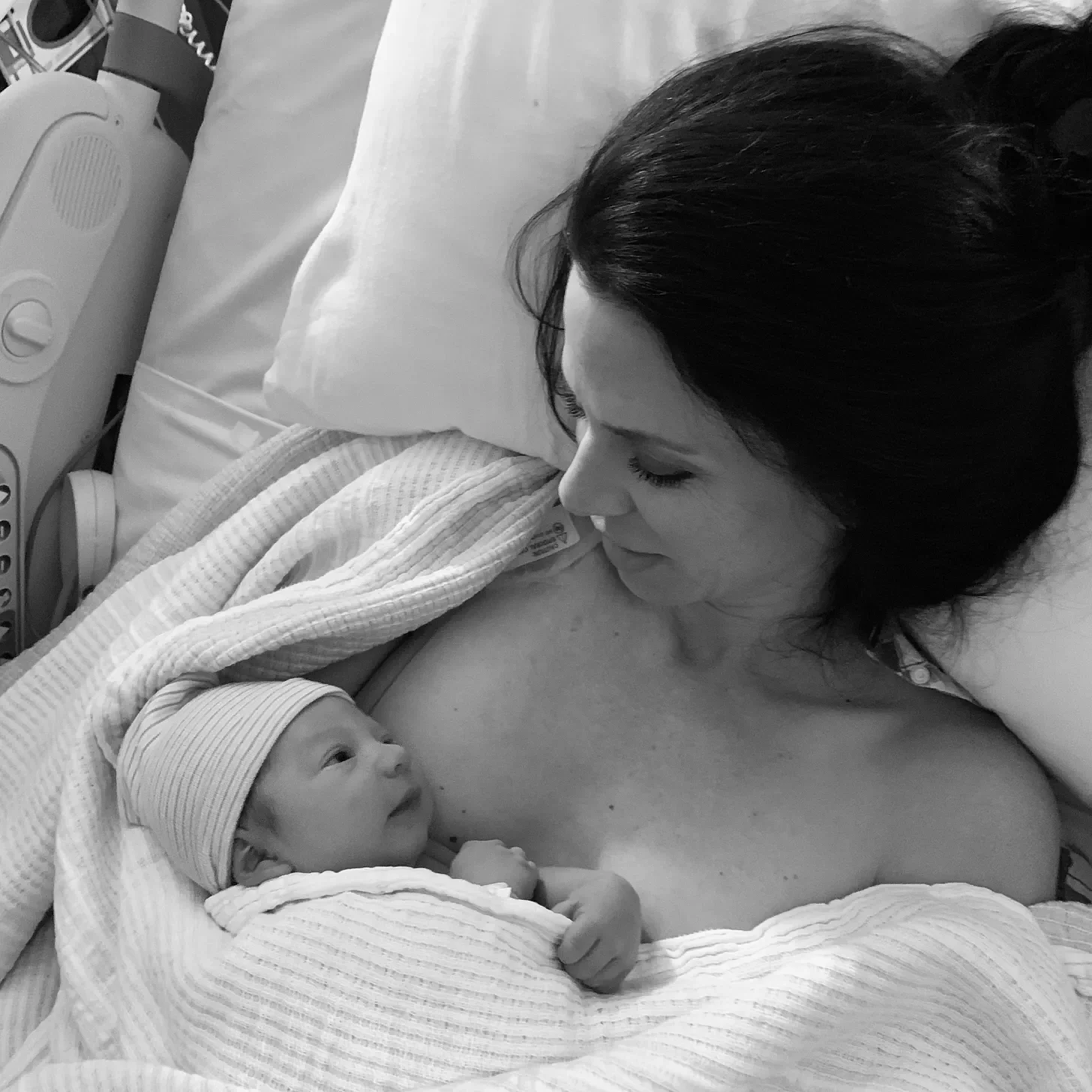
Thoughts on motherhood, breast cancer, and what attachment theory and the Enneagram taught me about being loved