
The Blog
Recently Featured


All Blogs








The Summer Self-Care Edit
"Spring being a tough act to follow, God created June."
-Al Bernstein

Summer is here, and so is the pressure to have your life together.
You know the drill—glowy skin, smoothie bowls, perfectly curated vacations, Aperol Spritz, and an endless supply of linen outfits and emotional regulation. Meanwhile, most of us are just trying not to melt into a puddle of SPF and iced coffee.
But here’s the thing: summer doesn’t need to be a performance. It’s actually one of the best times to pause, reset, and tend to yourself in a way that feels human, not heroic. Self-care in this season is less about becoming a better person and more about remembering who you already are—just maybe with a bit more sun on your face.
So, here’s my Summer Self-Care Edit—a little guide to staying grounded, nourished, and a smidge more sane while the world is out here trying to sell you a better beach body.
1. Start Slow. Like, Really Slow.
You don’t have to hit the ground running—unless that’s your thing, in which case, go off. But for the rest of us, try easing into your morning. Brew your coffee without multitasking. Sit outside and let your retinas soak up some natural light before you scroll the 'gram. Pro tip: your to-do list can wait. The world won’t fall apart if you don’t check your email before 9 a.m. (Probably.)
2. Hydrate Like a Hydrated Queen.
Water: the original wellness influencer. Your body needs it, your skin loves it, and your brain literally functions better with it. So yes, carry the emotional support water bottle—but also drink from it. Bonus points if you throw in some mint or lemon and feel like a spa guest in your own kitchen.
3. Move, But Not in a Punishment-y Way.
Let movement feel like freedom, not penance. Think dancing to Beyoncé in your living room, walking aimlessly around your neighborhood while eavesdropping on podcast strangers, or stretching on your porch while pretending you’re at a luxury yoga retreat. Whatever gets the energy flowing and the stress out of your joints.
4. Say “No” With Love and SPF.
Just because it’s sunny doesn’t mean you have to RSVP “yes” to everything. Guard your energy like a rare vintage candle—burn it wisely. If your body says “no,” trust her. She’s wiser than your calendar.
5. Eat Food That Looks Like a Rainbow Exploded.
If it grew in the ground or on a tree and it makes your plate look like an abstract painting, go for it. Summer is the season of effortless nourishment—fresh berries, crisp greens, corn so sweet it could double as dessert. Your body will thank you, and so will your tastebuds.
6. Take Your Phone Less Seriously.
We all need a break from the infinite scroll. Set a tech boundary that feels kind but firm—like a mom with good snacks. Try leaving your phone in another room, or better yet, go off the grid for a few hours. If anyone asks, you were busy communing with your higher self (or just watching clouds).
7. Play. No Seriously, Play.
Remember fun? It didn’t die after third grade. Bring it back. Chase fireflies, make a mess, laugh until you snort. It’s good for your nervous system—and it looks good on you.
8. Let Yourself Feel All of It.
Summer can hold contradictions—joy, nostalgia, grief, restlessness. You don’t have to pick one. Let it be messy. Let it be yours.
At the end of the day, summer self-care isn’t about becoming your “best self.” It’s about coming home to your real self—the one who’s still learning, still soft, still showing up.
Preferably in stretchy pants, with a popsicle in hand.
Love & Gratitude,
Katie
P.S. The Self-Care Workshop is coming BACK! Mark your calendars for Saturday, October 11th in Nashville!

Tell Me Your Story
“The Enneagram helps you discover who you were before the world told you who you were supposed to be.”
-Ian Cron

One of the most illuminating truths I’ve come to believe is this: we’re all living inside a story. You, me, your ever-loving mother-in-law—even my adorable 5-year-old, Tucker. Yep, I’m already noticing the clues come together. But here’s the catch—more often than not, it’s a story we didn’t consciously choose.
Somewhere along the line—usually in those delicate early years—we picked up a narrative that helped us feel safe, seen, and secure. It was adaptive. It got us through. But over time, what once protected us starts to confine us. That story becomes the air we breathe… and we forget we’re even breathing it.
That’s where the Enneagram comes in—not as a personality test or a trendy self-help tool, but as a kind of sacred mirror. It reflects back the core narrative you’ve been living out, often without realizing it. And not just any narrative—one that, while once helpful, is now keeping you stuck.
Each Type Tells a Different Story:
Type One: “If I don’t get it right, I’m not worthy.” The pressure to be good becomes exhausting, and the voice of the inner critic never lets up.
Type Two: “If I’m not needed, I’ll be forgotten.” So they give and give, quietly hoping someone will see them behind all the helping.
Type Three: “If I’m not successful, I won’t be loved.” They hustle hard, wearing masks of achievement, even when the soul underneath is aching.
Type Four: “Something’s missing in me.” They long for authenticity, often haunted by the feeling that they’re just… not quite enough.
Type Five: “The world takes too much, so I’ll retreat.” They guard their energy like gold, believing safety lies in self-sufficiency.
Type Six: “If I’m not prepared, everything will fall apart.” They seek certainty in a world that offers very little of it.
Type Seven: “Pain isn’t safe, so I’ll chase what’s next.” They run fast toward the light, afraid if they stop, the darkness will catch up.
Type Eight: “Only the strong survive.” They armor up, not realizing their true strength lives in tenderness.
Type Nine: “My presence disrupts peace.” So they go quiet, fading into the background, even when their voice is desperately needed.
But here’s the thing: once we can name our story, we can question it. We can soften our grip. We can remember we’re not just characters—we’re also authors.
The Enneagram doesn’t tell you who you are. It helps you wake up to the story you’ve been living… and maybe, just maybe, imagine a truer one.
And that, my friend, is where the healing begins.
Remember, I’m your girl if you need some help with the editing process!
Love & Gratitude,
Katie

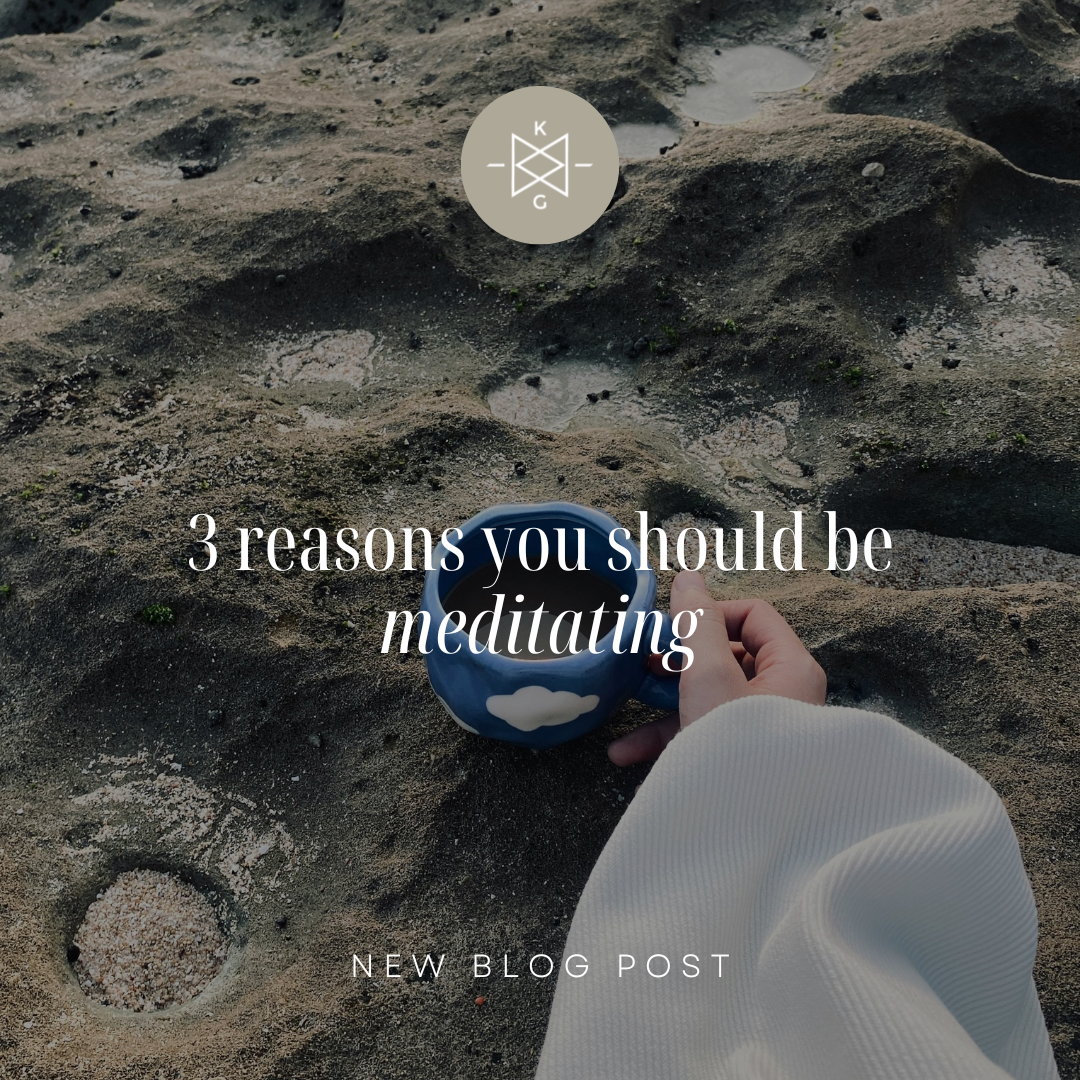
3 Reasons You Should be Meditating (Free Guided Med!)
“Distractions are everywhere. Notice what takes your attention, acknowledge it, and then let it go.”
-Andy Puddicombe, Founder of Headspace
Tomorrow is World Meditation Day. So I thought it apropos to share some of my story around the practice. There are volumes of scientific research boasting all the reasons meditation is a game-changer. I’m sure they are quite thorough and convincing, too.
However, today, I want to share from my heart and experience how meditation has and continues to change my life for the better.
This post is for all you fellow perfectionists, control freaks, planners, cardio-lovers, results-oriented, make-it-happen folks who feel 20 minutes of meditation sounds like a large helping of time-suck.
Oh, I know you…
About 10 years ago, I began noticing an overarching, intense physical discomfort out of nowhere (or so I thought). My throat and jaw locked up. My mid-back twisted in a knot. It became difficult to sing and speak, even in sessions with clients. Sleep became a distant wish.
As a health-conscious, avid exerciser who’d done her fair share of work in therapy throughout the years, I felt discouraged—and powerless.
After seeking out every alternative healing modality I could find, I noticed a subtle common theme emerge from acupuncturist, chiropractor, voice coach, and therapist alike. Quite simply, their sage voices all harmonized in a singular chord. It was in the key of: RELAX.
I wasn’t depressed or anything. In fact, I was quite content. Yet I’d been running so hard on a treadmill of survival mode that had become my norm. My body, brain, and emotions formed a strike, actively rebelling against the grueling pace I’d had them on for decades.
Meditation has been my vehicle into this new world of rest, yet interestingly enough, has also opened up my life in a new way, allowing for increased willingness and opportunities. Funny how that works. I firmly believe we all should develop some type of mindfulness practice, now more than ever.
Here are the three big reasons I think we should all be meditating:
We Build more self-awareness and self-acceptance: Self-awareness is the biggest indicator of success in life, relationships, and work. However, we’re so busy (and often stressed) we don’t carve out the time to practice the stillness required to grow that necessary muscle of self-awareness. In my experience, I’d over-developed the muscle of self-criticism and perfectionism instead. Practicing meditation or other mindfulness exercises allows space to unlearn that harsh inner critic and grow the safe, neutral observer needed to bake in healthy self-awareness, compassion, and positive sustained change.
We release tension and toxins in our bodies that create long-term negative health effects. It was a lightbulb moment the day I made the connection between disease in our minds and bodies with literal “dis-ease” and tension we hold tightly within. This stress, or contraction, will eventually exacerbate, causing much bigger health concerns down the road unless we learn how to release it. Practicing meditation trains our bodies and minds to slow down and release that arthritic grip we unconsciously develop over time. Added bonuses include better sleep, mood, energy, and creativity that crop up as a result.
We begin to connect to our essence, or true self, as we become aware of unconscious habits. As we move from the false self, or ego, to the true self, or essence, we experience deep spiritual transformation. It’s letting go of fear in order to embrace openness to something greater than ourselves. We simply can’t do that if we are living out of our blindspots on autopilot. Over time, as we commit to a meditation practice, a natural byproduct becomes this relaxation of old programming and an exploration of the love and curiosity that’s been there from day one. We were born loving, open beings. We learned fear to help us survive. Yet, lasting positive change is rarely built on fear. We must create the precious space in our days to excavate that little person inside that desperately longs to be seen and known. She’s honest and wise beyond her years, too. Some people swear practicing meditation over time slows down aging. I can’t speak to that; however, I believe connecting to the most loving and true parts of us inevitably lend a softer lens to whatever we may be facing in life. In this sense, we do recover that childlike part of us that sees more beauty in everything.
If you are looking for an enneagram-based mindfulness toolkit, I’d love for you to join The Practice, my online membership community! As my gift to you, enjoy this free guided meditation and practice with me this week.
Love & Gratitude,
Katie
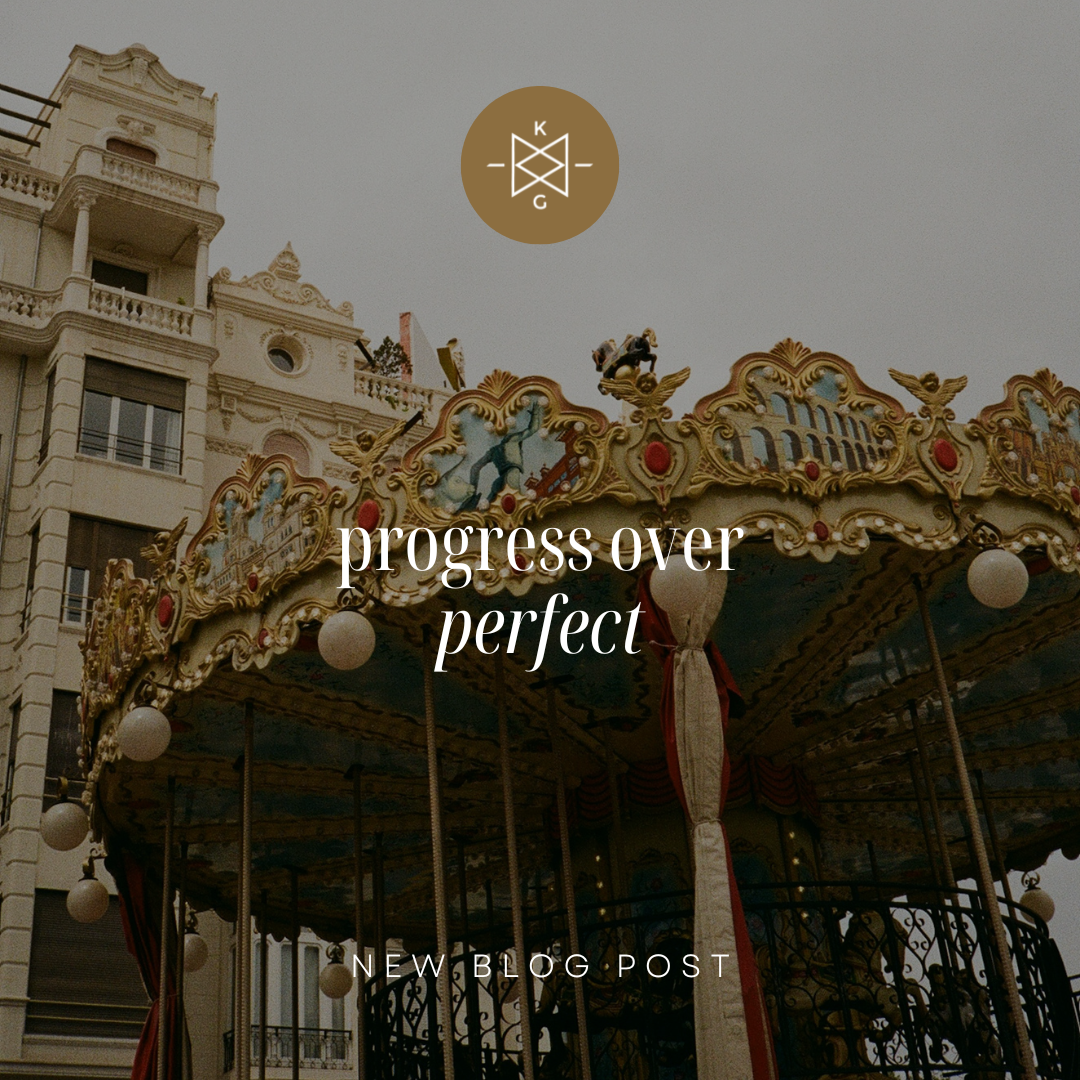
Progress over Perfect
Perfectionism is the voice of the oppressor, the enemy of the people. It will keep you cramped and insane your whole life.
-Anne Lamott
Raise your hand if you’ve ever struggled with perfectionism. Though I can’t see you right now as you read this, I have a hunch most of you have your hands up, either literally or figuratively in your heart where no one else can see, and wonder if there are bigger problems than perfectionism at stake. Oh, I’ve got your number…I’m a recovering perfectionist.
Perfection is so elusive, yet so tempting, especially for all you creative, high-achievers out there. It’s a vain and futile attempt to attain the unattainable.
And guess what?
It’s impossible. Perfectionism is an overt, egoic striving to fill a covert, bleeding insecurity. I’ve come to believe it really just runs on fear.
They say, “Write what you know.” I write these words with emboldened authority only because I’ve had a lifelong, enmeshed relationship with perfectionism. I don’t know the magic potion I sipped on so early in life to fuel the flame, but boy was it potent. I’ve been incredibly judgy and hard on myself from day one.
As a complex and sensitive kid (read: dramatic), being understood and well-received always took precedence. Where are my Enneagram 4’s? Acceptance, personal significance, and uniqueness were—and still are—my drug.
The temptation is always: “I’m doing pretty good, but there’s something missing.” This kind of thinking has kept me double-bound in the fetal position of literal and figurative dark corners in life many times.
For creatives especially, this phenomenon is deadly. Ideas and concepts are birthed in our thinking mind, which can be an absolutely lovely place to be. We have a brilliant idea for a lyric, a business, a painting, a proposal, and we run with it, executing it confidently and seamlessly, right?
Wrong. Very often that brilliant little idea gets locked up in the thinking mind, stewing and marinating in all kinds of saucy possibility and grandeur, so much so that it never even sees the light of day.
Our minds are meant to be the sacred birthplace of ideas. Our minds were not meant to indefinitely house them, ultimately squeezing the life and breath out with quenching fumes of perfectionism. Social media doesn’t make this pursuit any easier, as we get caught up in comparison games with people we don’t even know posting highlight reels from their otherwise normal life.
This can lead to such worthlessness and defeat that we either want to numb out somehow (drugs, booze, sex, shopping, busyness, work, doomscrolling, what have you) or we abandon our creative calling altogether. This is around the time therapy sounds like a promising option.
David Foster Wallace said it this way: “Perfectionism is very dangerous. Because of course, if your fidelity to perfectionism is too high, you never do anything.”
I suspect you want to do great things: to be seen, known, and truly loved. I do too. The only problem is, this requires tons of courage…and vulnerability. Perfectionism doesn’t leave much room for them.
What if we could aim for progress instead of perfection? To slowly build on the baby steps of gradual improvement—choosing the next best thing? This type of growth mindset leaves room for the successes, the failures, and the stalls. Best of all, you hold the keys to your life, not some elusive, phony version of you.
This week, what would it look like to choose progress over perfect?
Love & Gratitude,
Katie

Do You Ever Wonder What Happened to You
“As long as you keep secrets and suppress information, you are fundamentally at war with yourself…The critical issue is allowing yourself to know what you know. That takes an enormous amount of courage.”
Bessel van der Kolk

If you’ve ever found yourself reacting disproportionately to a situation—snapping at a loved one, shutting down in a meeting, or spiraling into anxiety after a simple text—you’re not alone. Often, what feels “irrational” on the surface has deep roots. Beneath the conscious mind, the body carries the echoes of experiences we’ve never fully processed. This is the terrain of trauma, and while it may seem invisible, it’s anything but silent.
Trauma doesn’t just happen to us—it happens in us.
Even if we don’t remember the moment something changed—an unsafe childhood, a moment of abandonment, or a pattern of invalidation—our nervous systems do. Trauma embeds itself in our physiology, often outside the reach of language or memory. It becomes a felt thing before it’s a known thing. As Dr. Bessel van der Kolk put it, “The body keeps the score.” And so, as adults, we find ourselves trapped in survival responses—fight, flight, freeze, or fawn—long after the danger has passed.
This is where the Enneagram becomes a sacred mirror.
Each of us, from a very young age, learned a strategy to feel safe and worthy in the world. That strategy is what the Enneagram beautifully captures. But it’s more than a personality test—it’s a map of the psyche shaped by both our essence and our wounds.
A Type Two may have learned early on that love is earned through selflessness.
A Type Six might have internalized the belief that vigilance is the only path to safety.
A Type Nine could have decided it’s better to disappear than risk conflict.
These aren’t just personality quirks—they’re trauma-informed adaptations.
What’s powerful—and deeply healing—is when we begin to notice that these patterns, once protective, may now be blocking us from intimacy, clarity, and presence. The Enneagram helps us bring unconscious survival strategies into conscious awareness, while the body offers a direct doorway into healing. One without the other is incomplete.
So, what does integration look like?
It starts with listening.
When your body contracts in fear, can you stay with it long enough to ask, “What part of me is trying to protect me right now?” When your Enneagram type flares up in stress, can you pause and notice the pattern with compassion, not criticism?
Healing trauma isn’t about fixing ourselves—it’s about reclaiming ourselves. When we honor the body’s wisdom and use the Enneagram as a guide, we begin to live less from the wound and more from the wonder of who we are.
This work is slow, sacred, and beautifully human. And you don’t have to do it alone. I’d love to support you along the way. The most powerful therapeutic approach I’ve used is a combination of IFS (Internal Family Systems) and Brainspotting, a brain/body-based trauma modality that works much deeper than talk therapy.
If you often find yourself asking, “I wonder what happened to me?” you’re not alone. Let’s talk.
Love & Gratitude,
Katie
P.S. Need a guide and a roadmap? Join The Practice, my online Enneagram group coaching program!