

The Blog
Recently Featured


All Blogs






Why Happiness is an Inside Job
“The subconscious does not originate ideas but accepts as true those which the conscious mind feels to be true and in a way known only to itself objectifies the accepted ideas. Therefore, through his power to imagine and feel, and his freedom to choose the idea he will entertain, man has control over creation.”
-Neil Goddard
You’ve probably heard it before, the pithy phrase “Happiness is an inside job.” But have you ever stopped to ask yourself why? After all, isn’t happiness based on circumstance while joy is the real coveted virtue? In that case, happiness would seem outside of ourselves altogether.
While I’m not sure about that, I do know I like being happy more than not.
In the last several years, I’ve been fascinated by the human brain and have spent tons of time trying to understand it more. After all, your brain is literally a genius and has the power to heal itself completely over time. This is why there’s such hopeful prognoses for those who’ve experienced horrific traumas.
You can’t study the brain without delving into concepts such as the conscious and unconscious mind. While that’s another post for another day, know this:
Just as the quote mentions above, we possess unfathomable creative control as humans when we learn to harness and practice intentionally directing our thoughts and feelings in the way of our desires. Sound too airy fairy for your taste? Fair enough, but check out Dr. Habib Sadeghi’s book Within, to understand the science behind it. It’s undoubtedly a game-changer.
Today, I want to give you five helpful reminders as you go about cultivating more happiness and meaning in your everyday experience:
1. Happiness is a practice, not a destination. We must learn to practice happiness in the small, insignificant moments throughout the day rather than “saving up” for an unrealistic circumstantial pay-off.
2. We can’t experience happiness without pain. Life is a series of contractions and expansions. Picture a caterpillar inching right along. There are equal contractions and expansions that keep him moving forward.
3. We create our own emotional experiences by the beliefs we choose to adopt. Beliefs are simply thoughts we practice thinking over and over again. Your past thoughts and beliefs have created the reality you’re in today.
4. Happiness is not contingent on your story. You and I have agency to write the stories we want to live into. By taking total responsibility of our experiences and resulting emotions, we are able to move through them and create greater hope and meaning.
5. It’s okay to not be okay. We put so much pressure on ourselves to be happy. Yet if life is equal parts expansion and contraction, we must learn to be okay with sadness, heartache, loneliness, and anger. When we learn to contain our emotions in a healthy way and extend self-compassion to ourselves on the other side, we will likely experience less resistance and more equilibrium in life. If you have a bad day, let yourself be in it, process it, and move through it instead of faking it.
Love & Gratitude,
Katie

How to Beat the Winter Blues
“These useless days will add up to something. They are your becoming.
- Cheryl Strayed

It’s a broken record at the moment. I can almost expect it both in conversations with friends and clients every single day. Chances are, if you’re living in Nashville, you’ve thought it or said it out loud yourself. I’m guilty as well.
Drumroll, please?
“This weather is KILLING me!”
Sure, it’s January. What else should I expect but cold grey stretches that make me want to hole up, listen to Bon Iver circa 2008, drink excessive amounts of coffee, and write for hours in my journal?
There’s good reason for this. The weather directly affects how we feel physically and emotionally and can wreak havoc on our overall experience in fall and winter months.
I used to experience heightened levels of anxiety and depression every year when clocks fell back and the sun quit her day job at 4:30pm. My motivation went on strike, healthy habits skipped town, and the feeling of loneliness was pervasive.
Finally, I got desperate enough and took matters into my own hands. I began advocating for my mental health because I knew no one else would. Through personal research, therapy, and challenging my normal behavior each year, I landed on some powerful tools that supported a more hopeful experience when the winter blues started creeping in.
For starters, Seasonal depression is slang for Seasonal Affective Disorder (SAD…aptly). It’s not simply “depression light.” It’s a subtype or specific kind of major depression that is symptomatic with the changing seasons, especially in fall and winter.
There are obvious and not so obvious reasons for SAD. The ones we all agree on are simple though: with less exposure to sunlight during the fall and winter months, our biological clock can often get pummeled, leaving depleted levels of serotonin, a brain chemical that helps govern and boost our mood, and melatonin, that gorgeous stuff of sleep.
If you experience a noticeable shift in mood, physical activity, patience for people, energy level, sleep, and desire to participate, keep reading. Likewise, if you are a human being with a heartbeat, keep reading. I have a hunch someone in your life needs your grace and support because they suffer from SAD.
Here are 4 helpful tips I swear by:
1) Routine
Structure is the sensitive soul’s best friend. For me, this means intentionally planning out my days from week to week. In fall and winter months, it’s starting a bit earlier so I can enjoy more sunlight, even just 30 minutes.
When emotions whip us around, assuming their throne in the driver's seat of life, it can be so easy to slip into victim mentality, feeling powerless. Having a set structure, or routine, for our day helps us reclaim the steering wheel.
My morning ritual is everything to me. It allows me time and space to practice the things that ground me like meditation, writing, and reading. In the coming days and months, experiment by putting some new structures into place to facilitate a more ordered interior landscape.
2) Move
Daily Exercise has officially become my antidepressant of choice. Hear me out, antidepressants can be a very helpful piece of the emotional puzzle when necessary. They definitely have for me along the way. However, exercise is one of the most effective and proven ways to improve overall mood and stress levels. Getting a good sweat also helps us sleep more soundly.
It’s tempting to let workouts trail off, but I say we fight for them. Make it a daily routine if possible, like brushing your teeth. This isn’t about rigidity, it’s about shifting our norms to facilitate more energy and vitality. Plus, there are tons of streaming workouts online when we simply don’t want to leave the house. My personal favorite is Tracy Anderson’s Online Studio, a subscription-based method, and Yoga With Adrien, which is a free YouTube channel.
3) Avoid Numbing
I get it. When depression sneaks in, we often lose our desire for the things we typically love to do. We want to isolate, sleep, eat, drink, numb. It’s so much easier, right?
Numbing out may offer temporary relief for our pain, however, we forget that along with the negative feeling emotions, your numbing strategy of choice dulls the positive ones as well. Happiness, excitement, and gratitude are harder to come by and we get thrown right back into the tangled thicket of depression once again.
4) Support
Replace the numbing with support. Identify “safe people” who know and accept you where you are. Make a list of two or three and reach out to them to let them know you’re struggling.
If you don’t have said 2-3 people, a good place to start is therapy. While I’m a big believer in individual therapy, finding a group therapy opportunity may be even more effective. I offer several options and would love to support you in this season. There is absolutely no shame in seeking professional help. It is a courageous act of self-compassion.
Hang in there, friend. Each day we inch toward one more minute of sunlight. After all, spring is simply the payoff for all the deep soul work done during winter. As Cheryl Strayed says, “The useless days will add up to something. These things are your becoming.”
Love & Gratitude,
Katie
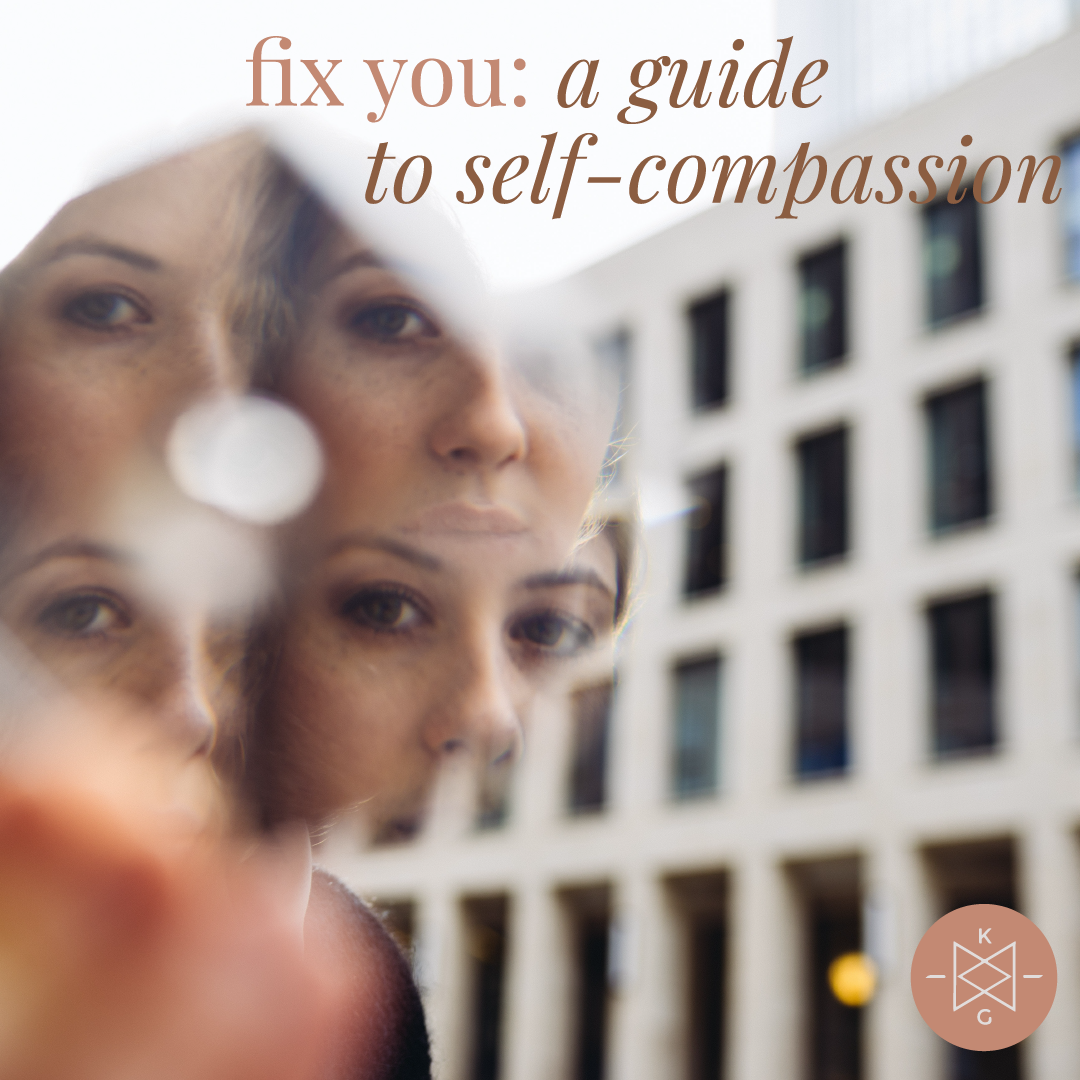
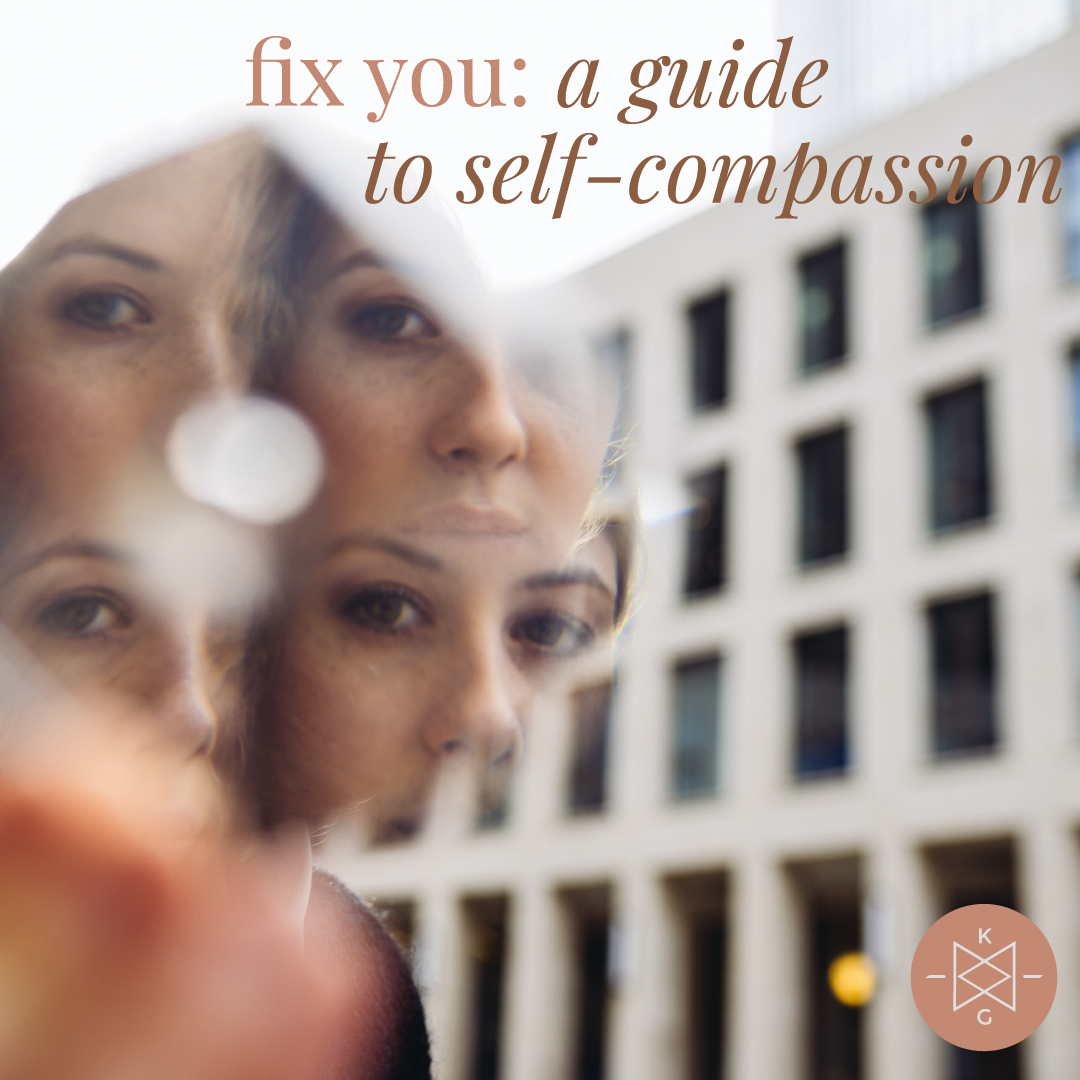
Fix You: A Guide to Self-Compassion
“The biggest reason most people aren’t more self-compassionate is that they will become self-indulgent. They believe self-criticism is what keeps them in line.”
- Dr. Kristin Neff -
I had it all wrong.
I thought if I could do self-help perfectly, I’d be well on my way to confidence and a sense of personal freedom. If I could will myself into the knowledge and experience of self-love and acceptance, I’d have arrived. There might even be a red carpet and some Valentino couture involved.
After all, I used perfectionism to my advantage for years, why stop now? Why not transfer that zipped up effort to the pursuit of self-acceptance and love. With just enough muscle, I knew I could fix her.
Spoiler alert: no matter how many affirmations or bubble baths or self-help books were had, the “am I enough?” ballot’s still out.
Oh, I went gangster with it, too—you know, the “fixing homework.”
I’d recall all my limiting beliefs about myself, write them down, cross them out, and slap ruby red lipstick on them—with feeling.
“I’m unloveable.”
Er…I mean:
“I’m the greatest thing since (gluten-free) sliced bread and have every reason to deserve love now.”
Sounds more like an SNL sketch to me. It also sounds reactionary and surface-level, not genuine or believable.
Good news!
You’re not meant to be fixed; you’re meant to be understood.
We can’t will ourselves into a loving relationship with ourselves, or anyone else for that matter. Humans aren’t math equations. We’re messy, complex, and perfectly imperfect.
The self-esteem quick fix is much like pumping a poor chicken chock full of toxic hormones to go further at your local Kroger. It may seem full of juicy possibility in the moment, yet it probably has long-term health concerns.
Why doesn’t self-esteem work?
Because it’s based on the way we view ourselves to the degree with which we like ourselves. Sounds benign, right? Sure, until circumstances change. What happens when we fail to get that promotion, call back, book deal—or can’t get the weight off?
The temporary illusion of self-esteem takes a nosedive into a muddy puddle of shame.
Typically, if we depend on circumstances to prop up our self-worth, there's a hard and unexpected fall coming just around the corner.
There’s more.
Self-esteem can be divisive in an effort to “one-up” those around us. Let’s revisit our earlier limiting belief turnaround. If I replace it with a pep talk that tells me “I’m the greatest thing around,” I’m puffing up my ego (which operates from a place of fear instead of belonging) and pitting myself against the world in an effort to prove myself, not lovingly being with myself.
So, what’s the solution? If I can’t perfect self-esteem, what am I supposed to do?
Four years ago, I picked up a book called Self-Compassion: the proven power of being kind to yourself, by Kristin Neff. It has changed the way I relate to myself and others on every level. It’s also called me into a more caring dialog with myself as opposed to the harsh, striving one that’s been so violent and intrusive for decades.
Rules without relationship breed rebellion.
If I’m constantly inflicting rules on myself instead of trying to relate to myself, I’m on the fast track to self-sabotage.
• Self-compassion is relational, not circumstantial. It’s based on the awareness that the human condition is frail at best yet capable of resilience.
• Self-compassion is cultivated like any relationship—over time. It fills in all the holes self-esteem leaves gaping. When we fail to live up to our expectation, self-esteem prompts two extremes: negative self-talk or puffed up ego (even…gasp…narcissism).
This is not the case with self-compassion. It comes flooding in when our insecurities, flaws, and shortcomings stare us back in the mirror.
• Most importantly, self-compassion binds us together in the reality of our human experience. It doesn’t divide, puff up, or need to isolate. We see ourselves through the lens of “imperfect—yet still enough.”
When that brutal inner critic pipes up, self-compassion says, “Hold on. I see you. I understand your pain. And I am here with you.”
Her voice is firm and tender.
She doesn’t wait on the clouds to pass or the proverbial sun to shine. She speaks her truth in the broken moments.
You’ve known her cadence a long, long time. Then you met fear. It drowned out the love.
You know what?
Your birthright is love, not fear. Just as you learned fear’s luring language, you can also unlearn it.
Birds don’t soar because of effort or willpower. They do so by surrender—and risk.
It’s time to work with—not against—the choppy current of life’s wind.
Alone? Not in a million. You’ve got a bold little guide waiting inside to illuminate the path. She was born ready.
Love & Gratitude,
Katie
xoxo

This Is Us
“We have all known the long loneliness, and we find that answer is community.”
-Dorothy Day

I didn’t become a therapist because I felt I’d be any good, saw myself as hyper-empathic, or wiser than the next gal. Far from it! In fact, when I started grad school, I had about as much confidence in myself as a three-legged cat. There were obstacles.
I became a therapist because I knew I had too. And for some unidentified reason, I desperately wanted to. It was and is part of my calling.
I’ll never forget my very first therapist. Her name was Angie Smith and I thought she was the bee’s knees. I was 15 and losing a battle to anorexia nervosa, the presenting iteration of my chronic depression at the time. We lived in Mobile, Alabama, an unapologetically southern town dripping with Spanish moss and too many syllables. Lovely? Indeed. Progressive? Not so much. I’d never heard of “therapy” before. I also kept the fact I was in it (and taking medication for depression) on the DL. High school is brutal enough.
My work with Angie made a lasting impact on my life and work. I’d meet with her every Wednesday at 2pm, and when I left, I noticed a vague sense of hope well up inside. This wasn’t because I got to leave school early either. It ran deeper—it was a feeling I would slowly build on throughout my recovery.
Angie had also suffered from and overcome an eating disorder. Yet today, she seemed so put together—and pretty. Not to mention she was from Nashville where she’d been a singer-songwriter for many years. So she was smart, pretty, and cool...a triple threat, but in the most inviting way.
In our work together, I learned the value of having a safe space and person to tell my story to and feel unconditional love and acceptance on the other side. I was lucky enough to have this from my parents (and big sister when we weren’t fighting over clothes), yet to have a totally objective experience without emotional ties or history was something profound.
Fast forward a decade and some change. Thankfully, I’d gotten a handle on my relationship with food. However depression still clung tightly, like a red-faced, wailing toddler to his mom the first day at pre-school drop-off.
Sure, I’d been in and out of therapy the whole time, and Lord knows it had been a lifeline. Yet individual therapy didn’t fix my loneliness. Isolation was often how I’d cope with the sadness and 50 minutes of talk therapy every week or two just didn’t cut it. This wasn’t a reflection on my therapist either. In my book, I worked with some of the best.
I discovered something shocking: I’d been hiding behind therapy. Mind you, it wasn’t the worst place to hide, it just wasn’t giving me the context to practice the insight and tools I’d been gaining with other humans who might possibly relate.
Now that was a new concept, and a terrifying one at that. Yet my depression had become life-threatening once again and I didn’t have a choice.
Enter Onsite workshops, a beautiful treatment facility right outside Nashville specializing in experiential group therapy. Just like Angie, Onsite left an unforgettable imprint on me. It was the ultimate reset button I needed and showed me the vital importance of experiencing healing in community.
Make no mistake, I wholeheartedly believe in the power and necessity found in individual therapy. I'm not saying we throw the baby out with the bathwater. However, I do feel it's simply not enough to get the optimal results we're looking for in our lives. I believe we need a layered approach consisting of individual and group work.
Before you call it a day and hit the snooze button on this post, hear me out. This is all about you and me and how we work together in order to bring more wholeness and connection into our daily experience.
This year, I’m changing up the way I work so as to provide a more holistic prescription that facilitates deeper connection with self and others. This new model is based on the belief that EVERYTHING is relational—everything. From relationship with self, to others, to food, to work, to emotions, and so on.
If this is true, (and it is), we must learn to grow and heal in relationship and community, not isolation. To that end, I’m thrilled to share with you what I’ve been designing these last few years based on tons of research and inspiration from you.
Later this month, I’ll be rolling out the specifics and an opportunity for you to take part. For today’s purposes, get excited! It’s going to be loads of fun and involves three core principles I believe to be the most powerful for the journey we’re on: community, experiential therapy, and the Enneagram.
Indeed, this is your year to tell your story, be seen, be known, and be loved. But even more, it's our year...2019, this is us.
Love & Gratitude,
Katie

Cheers! You've Arrived
“Where we think we need more self-discipline, we usually need more self-love.”
-Tara Mohr

One of my favorite pockets of time throughout the entire year is the week between Christmas and New Years. I try my damndest to carve out some “deep work” time as I call it—time to clear the space, reconnect to presence after all the going and indulging—and map out a vision for the coming year. My inner dreamer gets to dance around and color outside the lines a bit. If I’m lucky, I try to take a whole morning or afternoon to do so.
This year was a no-go. It just didn’t happen—and that’s okay. I’m learning to give myself more grace and soften into life’s messy edges.
However, in the spirit of community, I’d like to do this deep work—this dreaming if you will—together, and ease into new year.
If you’ve been on this self-discovery journey with me for awhile, you may know I’m a huge fan of ritual rather than resolutions. If you’re new to my blog and this glorious work of deepening self-awareness and transformation, welcome. You are right on time and I can’t wait to connect with you.
Here’s why I have a thing for ritual. I’m convinced, over time, practicing good habits creates this soft light in our lives that draws out potential, undergirds desire, and creates balance where there is imbalance. They are also built on loving connection with self as opposed to fear-based tactics.
Interestingly, I think humans find extremes far easier than balance. We like to react out of fear instead of respond out of desire. Marketing moguls exploit this behavior big time, and anyway you slice it, they’re clever. They know we go off the rails a bit over the holidays and tend to wake up today with a foggy head and a few extra pounds. Swooping in, they save the day with their slashed gym membership prices and programs promising a new you in just one month.
Listen, if you’ve just given Gwyneth Paltrow a run for her money and spent all of yours on the hottest new cleanse, that’s okay too. I get it. Been there and have all the tee shirts and half-used supplement boxes to prove it.
Yet with each passing year, as I show up for myself and my community, I’m learning something invaluable: what we really want is to create a feeling, not just a desired outcome. As a result, this is why we’re rarely satisfied with any level of success or accomplishment—the feeling fades. We want more.
Today, let’s lay some groundwork for the edits, habits, and goals you’d like to see crystallize in 2019. Here are four crucial questions to help you do so adapted from the podcast “The Accidental Creative.”
I hope you’ll join me and carve out some well-deserved time to journal about the picture you’d like to build in 2019. Come back to it over and over again. Realign with its truth or tweak it if your course requires deviation.
Here we go:
• What do you want to feel more of in 2019? (i.e. energized, awake, confident, accepted)
• Where do you want to go in 2019? (This can be figurative or literal. i.e. I want to explore a new city, yoga class, or I want to go from full-time to part-time at work so I can spend more time writing)
• What do you want to learn in 2019? (i.e. I want to learn to play drums or I want to learn to meditate)
• What do you want to change in 2019? (Reminder: this is desire driven, NOT fear driven! Approach this from a place of worthiness rather than insecurity. i.e. I’d like to build-in more margin for rest and play into my life.)
I can’t wait to hear your feedback from this exercise! When we give voice and ink to our desires, we take them from whim to intention. Let’s ease into the new year, listening, noticing, and responding to its inviting call to action. If you’d like some extra light for the journey ahead, I’m your girl.
I can’t wait to see all that 2019 has in store for you.
Cheers, indeed! You’ve arrived.
Love & Gratitude,
Katie
xoxo