

The Blog
Recently Featured


All Blogs






Want Love? Meet Forgiveness....
“The weak can never forgive. Forgiveness is the attribute of the strong.”
-Mahatma Gandhi

If we are shaped by anything in life, it is surely by the pang of painful past experiences. You know this pain all too well. The ones in life who were supposed to protect, provide, and nurture instead inflicted deep and sorrowful hurt, abandonment, and abuse. Expectations were dashed, self-expression wasn’t allowed, eggshells were everywhere.
In therapy, I hear the broken, brutal stories of courageous people who have somehow made it through. They look for greater freedom and joy. They refuse to let their past define their present and future. I often find myself angry as I hold space for these stories to live and breathe, sometimes for the very first time. It’s never fair.
And this is the truth. Injustice isn’t fair. Yet I am learning it’s part of life. How we deal with that injustice is truly our making. The trauma of our past breaks us in a way that often feels irreparable...futile. This trauma doesn’t just dissipate either. It’s stored in the tissues and neural pathways of our bodies. For this reason, a holistic, mind-body-spirit approach to healing is vitally important.
The voluntary and visceral reactions to a past experience are so significant it gets branded into your body. My hunch is you’ve experience the effect of painful past experiences manifesting in your body. If so, lean in. The wisdom of your body is trying to get your attention.
In fact, your body is brilliant and tends to literally block out old trauma, having no memory of it until physically exposed to stimuli. We learn to detach, shut down, and numb.
Bessel van der Kolk, psychiatrist and author of The Body Keeps the Score, explains:
“Traumatized people chronically feel unsafe inside their bodies; The past is alive in the form of gnawing interior discomfort. Their bodies are constantly bombarded by visceral warning signs, and, in an attempt to control these processes, they often become expert at ignoring their gut feelings and in numbing awareness of what is played out inside. They learn to hide from their selves.”
This insight fascinates me as it’s helped me understand that we can’t talk our way out of healing from this “gnawing interior discomfort.” We must learn two things: how to feel safe in our bodies and how to forgive. I love using Brainspotting with clients to begin unlocking the process of re-attachment and develop a sense of safety in our bodies. It has been a game changer for me and many.
I’ve noticed the more difficult of the two is often the forgiveness piece, which isn’t a surprise to me. We think of forgiveness much like we do vulnerability: as weakness. Thus we choose to carry the perpetrators of our pain around, heaping tons of power on them. Oftentimes the one we need to forgive the most is ourself, which can feel nearly impossible.
When we choose unforgiveness, we not only stay connected to the pain and its source, we allow our past to define us. Isn’t it time we put down that heavy burden? Isn’t it time we take back our power and re-focus that wasted energy on giving and receiving new, hopeful opportunities and love?
This week, I encourage you to do some inventory and see if there might be any lingering unforgiveness that weighs you down and holds you back from your highest self. Support throughout this process is key, so know that I am here if you need a safe place to process and land along the way.
Remember, you are not the crumbs of your past. You’re invited to a grand, exquisite table of the present moment to feast on freedom and be satisfied by love. It’s a wide open space to explore and move around in. You are always welcome here.
Love & Gratitude,
Katie
xoxo
Why Happiness is an Inside Job
“The subconscious does not originate ideas but accepts as true those which the conscious mind feels to be true and in a way known only to itself objectifies the accepted ideas. Therefore, through his power to imagine and feel, and his freedom to choose the idea he will entertain, man has control over creation.”
-Neil Goddard
You’ve probably heard it before, the pithy phrase “Happiness is an inside job.” But have you ever stopped to ask yourself why? After all, isn’t happiness based on circumstance while joy is the real coveted virtue? In that case, happiness would seem outside of ourselves altogether.
While I’m not sure about that, I do know I like being happy more than not.
In the last several years, I’ve been fascinated by the human brain and have spent tons of time trying to understand it more. After all, your brain is literally a genius and has the power to heal itself completely over time. This is why there’s such hopeful prognoses for those who’ve experienced horrific traumas.
You can’t study the brain without delving into concepts such as the conscious and unconscious mind. While that’s another post for another day, know this:
Just as the quote mentions above, we possess unfathomable creative control as humans when we learn to harness and practice intentionally directing our thoughts and feelings in the way of our desires. Sound too airy fairy for your taste? Fair enough, but check out Dr. Habib Sadeghi’s book Within, to understand the science behind it. It’s undoubtedly a game-changer.
Today, I want to give you five helpful reminders as you go about cultivating more happiness and meaning in your everyday experience:
1. Happiness is a practice, not a destination. We must learn to practice happiness in the small, insignificant moments throughout the day rather than “saving up” for an unrealistic circumstantial pay-off.
2. We can’t experience happiness without pain. Life is a series of contractions and expansions. Picture a caterpillar inching right along. There are equal contractions and expansions that keep him moving forward.
3. We create our own emotional experiences by the beliefs we choose to adopt. Beliefs are simply thoughts we practice thinking over and over again. Your past thoughts and beliefs have created the reality you’re in today.
4. Happiness is not contingent on your story. You and I have agency to write the stories we want to live into. By taking total responsibility of our experiences and resulting emotions, we are able to move through them and create greater hope and meaning.
5. It’s okay to not be okay. We put so much pressure on ourselves to be happy. Yet if life is equal parts expansion and contraction, we must learn to be okay with sadness, heartache, loneliness, and anger. When we learn to contain our emotions in a healthy way and extend self-compassion to ourselves on the other side, we will likely experience less resistance and more equilibrium in life. If you have a bad day, let yourself be in it, process it, and move through it instead of faking it.
Love & Gratitude,
Katie

How to Beat the Winter Blues
“These useless days will add up to something. They are your becoming.
- Cheryl Strayed

It’s a broken record at the moment. I can almost expect it both in conversations with friends and clients every single day. Chances are, if you’re living in Nashville, you’ve thought it or said it out loud yourself. I’m guilty as well.
Drumroll, please?
“This weather is KILLING me!”
Sure, it’s January. What else should I expect but cold grey stretches that make me want to hole up, listen to Bon Iver circa 2008, drink excessive amounts of coffee, and write for hours in my journal?
There’s good reason for this. The weather directly affects how we feel physically and emotionally and can wreak havoc on our overall experience in fall and winter months.
I used to experience heightened levels of anxiety and depression every year when clocks fell back and the sun quit her day job at 4:30pm. My motivation went on strike, healthy habits skipped town, and the feeling of loneliness was pervasive.
Finally, I got desperate enough and took matters into my own hands. I began advocating for my mental health because I knew no one else would. Through personal research, therapy, and challenging my normal behavior each year, I landed on some powerful tools that supported a more hopeful experience when the winter blues started creeping in.
For starters, Seasonal depression is slang for Seasonal Affective Disorder (SAD…aptly). It’s not simply “depression light.” It’s a subtype or specific kind of major depression that is symptomatic with the changing seasons, especially in fall and winter.
There are obvious and not so obvious reasons for SAD. The ones we all agree on are simple though: with less exposure to sunlight during the fall and winter months, our biological clock can often get pummeled, leaving depleted levels of serotonin, a brain chemical that helps govern and boost our mood, and melatonin, that gorgeous stuff of sleep.
If you experience a noticeable shift in mood, physical activity, patience for people, energy level, sleep, and desire to participate, keep reading. Likewise, if you are a human being with a heartbeat, keep reading. I have a hunch someone in your life needs your grace and support because they suffer from SAD.
Here are 4 helpful tips I swear by:
1) Routine
Structure is the sensitive soul’s best friend. For me, this means intentionally planning out my days from week to week. In fall and winter months, it’s starting a bit earlier so I can enjoy more sunlight, even just 30 minutes.
When emotions whip us around, assuming their throne in the driver's seat of life, it can be so easy to slip into victim mentality, feeling powerless. Having a set structure, or routine, for our day helps us reclaim the steering wheel.
My morning ritual is everything to me. It allows me time and space to practice the things that ground me like meditation, writing, and reading. In the coming days and months, experiment by putting some new structures into place to facilitate a more ordered interior landscape.
2) Move
Daily Exercise has officially become my antidepressant of choice. Hear me out, antidepressants can be a very helpful piece of the emotional puzzle when necessary. They definitely have for me along the way. However, exercise is one of the most effective and proven ways to improve overall mood and stress levels. Getting a good sweat also helps us sleep more soundly.
It’s tempting to let workouts trail off, but I say we fight for them. Make it a daily routine if possible, like brushing your teeth. This isn’t about rigidity, it’s about shifting our norms to facilitate more energy and vitality. Plus, there are tons of streaming workouts online when we simply don’t want to leave the house. My personal favorite is Tracy Anderson’s Online Studio, a subscription-based method, and Yoga With Adrien, which is a free YouTube channel.
3) Avoid Numbing
I get it. When depression sneaks in, we often lose our desire for the things we typically love to do. We want to isolate, sleep, eat, drink, numb. It’s so much easier, right?
Numbing out may offer temporary relief for our pain, however, we forget that along with the negative feeling emotions, your numbing strategy of choice dulls the positive ones as well. Happiness, excitement, and gratitude are harder to come by and we get thrown right back into the tangled thicket of depression once again.
4) Support
Replace the numbing with support. Identify “safe people” who know and accept you where you are. Make a list of two or three and reach out to them to let them know you’re struggling.
If you don’t have said 2-3 people, a good place to start is therapy. While I’m a big believer in individual therapy, finding a group therapy opportunity may be even more effective. I offer several options and would love to support you in this season. There is absolutely no shame in seeking professional help. It is a courageous act of self-compassion.
Hang in there, friend. Each day we inch toward one more minute of sunlight. After all, spring is simply the payoff for all the deep soul work done during winter. As Cheryl Strayed says, “The useless days will add up to something. These things are your becoming.”
Love & Gratitude,
Katie

Joy Division
"Joy—that sharp, wonderful Stab of Longing—has a lithe, muscular lightness to it. It’s deft. It produces longing that weighs heavy on the heart, but it does so with precision and coordination…It dashes in with the agility of a hummingbird claiming its nectar from the flower, and then zips away. It pricks, then vanishes, leaving a wake of mystery and longing behind it.”
-C.S. Lewis

After a decade working as a therapist and holding space for the brave, beautiful stories I encounter along the way, I’ve had a curious finding. Not one of these stories is identical, yet there is a familiar melody that builds if you back up and listen from a distance. It’s like sitting on the back porch after a long day in the sweaty palm of summer as the crickets and katydids show off their grand cacophony against the stillness at dusk. No song is in perfect harmony, yet the dissonance makes perfect sense.
I’ve found this common theme checks out despite age, race, gender, or religion. You ready for this? Here it is:
Humans are terrified of Joy.
Beyond anger, sadness, grief, shame—you name it—we are far more resistant to feel joy than other emotions.
Why is this?
I call it “the other shoe syndrome.” If we bask in moments of joy, small though they may be, eventually, the other shoe will drop, leaving us disappointed, or perhaps irresponsible, or even worse...empty. We’re so afraid of the let down so we settle for scarcity and self-protect.
Brene Brown says it best,
“When we lose our tolerance for vulnerability, joy becomes foreboding. As a result, we dress-rehearse tragedy and beat it (vulnerability) to the punch.”
In other words, joy is too risky. Something terrible might happen on the other side so we opt out altogether and dumb down desire. After all, if we run tactics on worst-case scenario, we have nothing to lose.
Not so fast, Cowboy. You simply can’t opt out of vulnerability. You’re not like the rest. You want more. Hell, you’re taking precious minutes of your day you’ll never get back to read a blog post about self-awareness and development. Chances are, you’re also a little weird. I sure hope so.
To walk around on the planet with a heartbeat and a dream we must practice vulnerability. Expansion requires it.
Human beings have a negative bias. I’ve heard it said, “we’re like teflon for the positive and velcro for the negative.” After all, fear has kept us alive through the ages as a species. However we don’t need it for survival in the same way we once did. We can soften into joy if we practice it. This takes some rewiring, though, hence the word “practice.”
How do we practice? I’m convinced it’s a three-fold process.
When Joy flashes her tooth-y grin in your direction, don't quickly look the other way—get curious. Flirt with her, even if she’s there for just a minute.
Then what?
Pivot to gratitude. Research shows the most joyful people in the world are also the most grateful. This blows far beyond circumstance. It’s a result of practice. When we pivot to gratitude instead of scarcity, we build up new accessory muscles we didn’t know existed. This, in turn, becomes habit over time.
I like F. Scott Fitzgerald’s words, “Don’t cry because it’s over, smile because it happened.”
In that practice of gratitude for this joyful moment—breathe it in—stay with it. Brain science tells us it takes three deep breaths or eleven seconds to form a new neuropathway in your brain. By basking in these joyful moments, you are literally rewiring your brain to make you a more wholehearted, receptive person.
By the way, this post is really for me. They all are. We write what we know because we’ve had to learn it. I’m guilty of constantly chasing the extraordinary. In this chase, I miss out on the tiny, ordinary moments bursting with joy: the quiet flurry of snow, the faint song being played on the piano in the other room, a perfectly poured latte, my niece’s delicious laugh, a text from a friend “just saying hi.” These simple sightings of joy are oxygen for the soul.
This joy, this “sharp and wonderful stab of longing” as Lewis describes, is bittersweet. It’s the good and the bad, the black and the white. It’s toggling the both-and. This season, I’m committed to that creative tension. I’m committed to practicing those tiny, two-degree shifts that bolster desire. I don’t want to go it alone though. Will you join me?
Love & Gratitude,
Kati

The Hospitality of Emotion
“Hospitality means primarily the creation of free space where the stranger can enter and become a friend instead of an enemy. Hospitality is not to change people, but to offer them space where change can take place.”
-Henri Nouwen
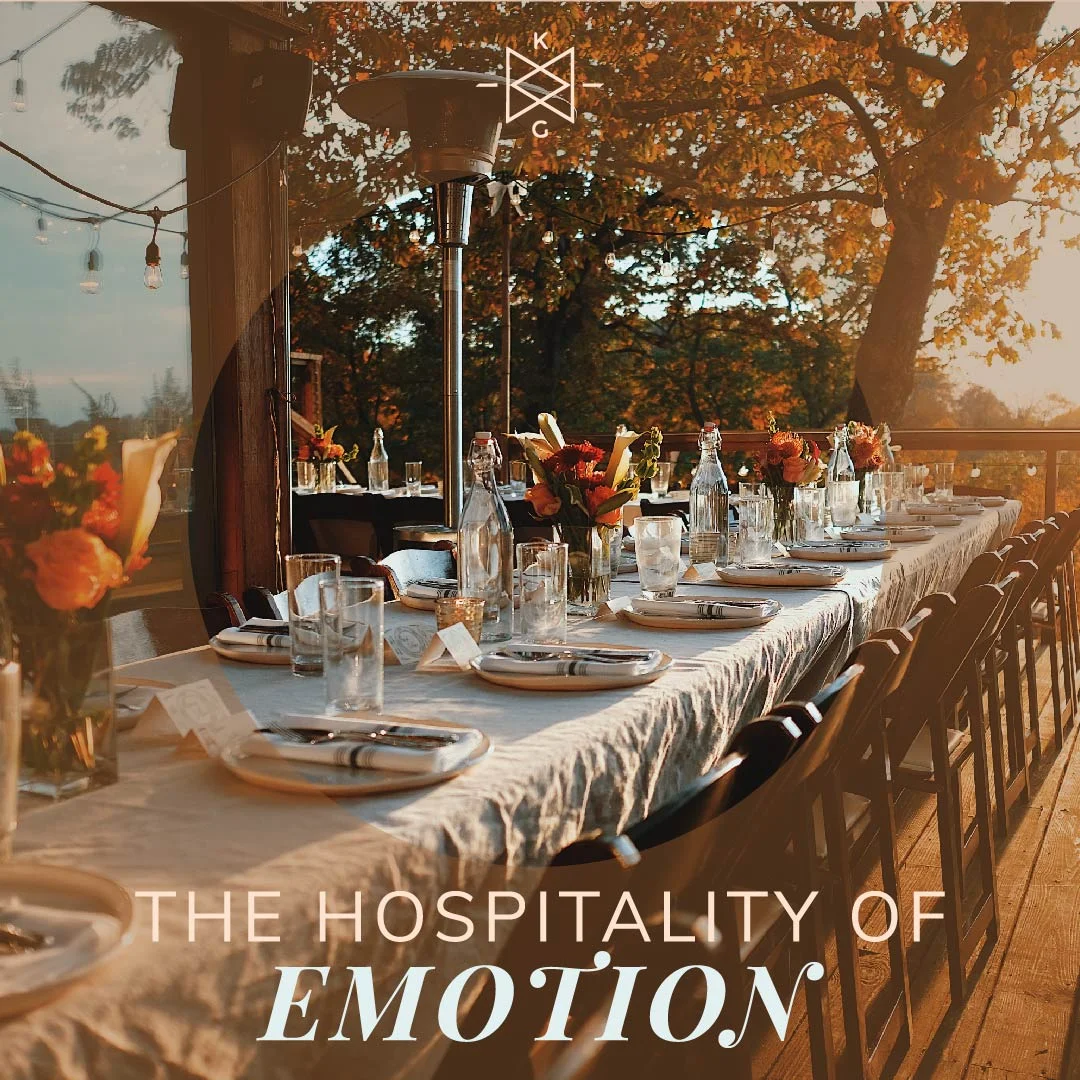
I love hosting dinner parties– the planning, shopping, prepping, pairing, cooking, connecting, eating, lingering– hell, I don’t even mind the clean up so much. I’m pretty sure my most domestic moments happen in the kitchen. (Laundry? Not my gig, much to my husband’s chagrin.) For me, cooking has always been a creative as well as a therapeutic outlet for me. For a hot minute in my mid-twenties, I toyed with the thought of culinary school. In my short-lived career as a sous chef at a local wine bar/cafe, I found that cooking on someone else’s watch for people I couldn’t actually connect with was a deal breaker. It hijacked the joy for me.
I eventually discovered two real driving passions behind my love for all things culinary: the connection that happens around it and the creativity had in the process (oh, and there is that eating thing as well). Hence, this favorite past time of mine—throwing dinner parties. I get a buzz just thinking about it.
We live in a world on crack–a world jacked up and in a constant crazed state of busy, exhausted, immediacy, devices, and traffic–all set to repeat. Hospitality has become a lost art because it forces us to slow down and do things that can't be automated and/or bypassed by hitting the nearest Chipotle or even the newest foodie hot spot on the scene. As a result, we lose out on a beautiful process that facilitates good old-fashioned, real-time connection, intimacy, and laughter.
This past Saturday evening, myself and five other ladies hosted a wedding celebration at my house. Having an outdoor sit-down dinner party in the young days of November in Nashville is like betting your life savings at a craps table in Vegas. It’s risky, if not ludicrous.
Much to our amazement, God flexed his creative muscles and painted the most magical fall scape one could possibly ask or pray for. The wind, cold, and rain came to a precise halt. The sun-drenched rolling hills popped with a smattering of brick, gold, and orange. The burn your-eyes-out blue sky held on patiently all the way up to sunset. Between the outdoor heaters, cozy blankets strewn on every other chair, and the roaring conversation and laughter, we stayed warm well into the night. It was delicious and lovely complete with clinking glasses, a stained table runner, and hours of clean up the next morning. Perhaps my favorite part of the evening was the interesting mix of friends who came, both new and old. Stories were shared, intimate toasts given, and wild connections were made. It was truly a magical evening.
As I sat back contentedly and observed conversations happening across the table, glasses being filled, fall flavors offering up their glory, something occurred to me...something big.
Why can’t we learn to practice hospitality internally with our own full cast of emotions? What if, we welcomed them openly, leaning in to the complex story they are trying to tell instead of handing them the keys to our misery? I’ve been intrigued by this idea ever since, playing around with it in my head and heart…and I like it.
Emotions are a gift if you can believe it. I sure didn’t for long stretches of my existence. I always thought emotions had all the power, dictating the success of any given day from the moment my eyeballs popped open in the morning. I used to feel totally powerless over my emotions, especially anxiety, she was a loud and clumsy beast. What I have come to learn and embrace with open arms, and a big fat sigh of relief, is that my emotions are not who I am. I am not my anxiety, sadness, hurt, depression, etc.
They are also not against me. Of course, there are more enjoyable ones we feel such as glad and excited; we tend to coddle them like spoiled children. Then there are negative feeling ones such as guilt and anger we attempt to avoid like loud, messy roommates. However, the truth is they all invite us to the greater wisdom of our needs and desires. Our emotions are a gift nudging us towards a more colorful, expansive experience.
Just as the generous practice of hospitality beckons deeper connection and understanding of our unique perspectives and experiences across a dinner table, the inner landscape of our feelings long for a space to be heard. How will we host these voices, facilitating a curious exchange, an open conversation? Here are a couple of questions to ask them when they chime in, with their often abrasive tone.
What am I feeling? Sad, hurt, fear, anger, lonely, guilt, glad? Naming it identifies and externalizes it.
Where do I feel this feeling in my body? (Our body’s center of intelligence houses emotions just as our heart’s center does.)
What is the story you are trying to tell me? i.e “I am afraid I don’t have what it takes to succeed, I'm not enough”. “I am guilty because I spoke harshly to my co-worker”.
What is the need attached to the emotion? i.e. “I need some encouragement and affirmation, ” or “I need to apologize for reacting at work. I was pretty fried and took it out on Sarah.”
How will I meet that need? i.e. Reach out to a trusted friend or have a conversation to set the record straight, etc…
Emotional hospitality removes unnecessary shame from our internal experience by letting light and air into dingy, dusty corners of our beings. It swings wide open the door of our heart and places a fresh mix of flowers on the table, welcoming deeper connection and cohesion. It nourishes our beings to live with presence and generosity. When we are willing to curiously experiment with each and every emotion, engaging it like we would a stranger at a dinner party, we gain new insight and perspective. We hear a new story. If we listen closely enough, we may even hear our own story.
Love & Gratitude,
Katie
Thoughts on motherhood, breast cancer, and what attachment theory and the Enneagram taught me about being loved