
Typing Cards How-Tos
Instructions
How to Use Your Enneagram Card Deck
These cards are designed to support self-discovery through recognition and reflection, not testing or scoring. The goal isn’t to decide your type quickly. It’s to notice which patterns feel familiar over time.

What's in your deck
| Set | Cards | What it's for |
|---|---|---|
| Orientation | 3 | Start here: how the deck works and the key ideas behind it |
| Summary | 9 | Set aside at first. A reference for each type once you've narrowed your options |
| Step 1Quick Recognition | 36 | Four short statements per type, sorted by first impression |
| Step 2Deep Inquiry | 9 | A closer look at the motivation behind each type |
| Step 3How You Land | 10 | How your pattern is experienced by others (includes a how-to card) |
| 67 cards total | ||
Telling the sets apart: The name of each set is printed at the top of every card front. The three steps also carry a 1 · 2 · 3 marker, with your current step filled in.
Finding a type: Card colors are grouped by center of intelligence, so you can pull out every card for a type at a glance.
Terracotta: Body center, Types 8, 9, and 1
Mauve: Heart center, Types 2, 3, and 4
Blue: Head center, Types 5, 6, and 7
Before you begin
Read the three Orientation cards. They cover how to use the deck, the key ideas behind it, and what to look for as you go.
Set the Summary cards to the side. You'll come back to them later. Reading full type descriptions first makes it harder to sort by gut recognition, so save them until you've narrowed your options.
Find a quiet space and give yourself time. There's no rush, and there's no wrong answer.
Step 1: Quick Recognition
Sort by first impression
Shuffle the 36 Quick Recognition cards. Read each statement one at a time and place it in one of three piles:
Sounds like me: This feels familiar or true most of the time.
Maybe / Sometimes: This fits occasionally, or depends on the situation.
Not like me: This doesn't feel like my typical experience.
Go with your first impression and try not to overanalyze. Notice what feels familiar, not what you admire.
You're looking for your natural patterns, not who you wish you were, who you've worked hard to become, or how you behave at your best.
Notice the patterns
When you've finished sorting:
Pick up your Sounds like me pile.
Turn those cards over to see the type on each one.
Notice which types appear most often.
You'll usually see 2–3 types showing up more than the others. These are your likely type candidates. Set the rest of the cards aside.
Step 2: Deep Inquiry
Pull the Deep Inquiry card for each of your top types. These cards are the bridge between "some of these sound like me" and "this is the pattern that actually organizes my life."
Read the front first. It describes the type's focus of attention, core concern, habitual pattern, and what it feels like when that pattern is active. Read slowly.
Then turn the card over. The back shows the type's core strengths and growth edges: the gift and the cost of the pattern. For many people, this is the moment the type really clicks.
As you compare your top types, ask yourself:
Which type feels most familiar across my whole life, not just right now?
Which pattern shows up automatically, even when I wish it didn't?
Which description feels a little uncomfortable or exposing?
Your Enneagram type reflects your habitual focus of attention and motivation, not your strengths or abilities. If more than one type still fits, ask which one feels most uncomfortable to admit.
Step 3: How You Land
The first two steps look at your pattern from the inside. How You Land looks at it from the outside: how your strategy is experienced by the people around you. Each card covers what people tend to notice first, how others describe you over time, the language you return to, and what those closest to you know.
Pull the How You Land card for each type still in the running.
Read each card slowly.
Sort them into three piles:
Yes: Consistently true of me.
Sometimes: Situational or partial.
No: Not really how I'm experienced.
Eliminate any type that lands mostly in No. Keep the Sometimes types as possibilities, but weaker ones.
Look for the card where several lines feel uncomfortably accurate. That's usually the one.
The right card rarely feels like a perfect fit. It feels like… that's a little too accurate.
Remember: this is not who you are. It's how your strategy is experienced.
Return to the Summary cards
Now pick up the Summary cards you set aside earlier. Pull the card for the type (or types) you've landed on. Use them to confirm what you've found and to learn more about your type.
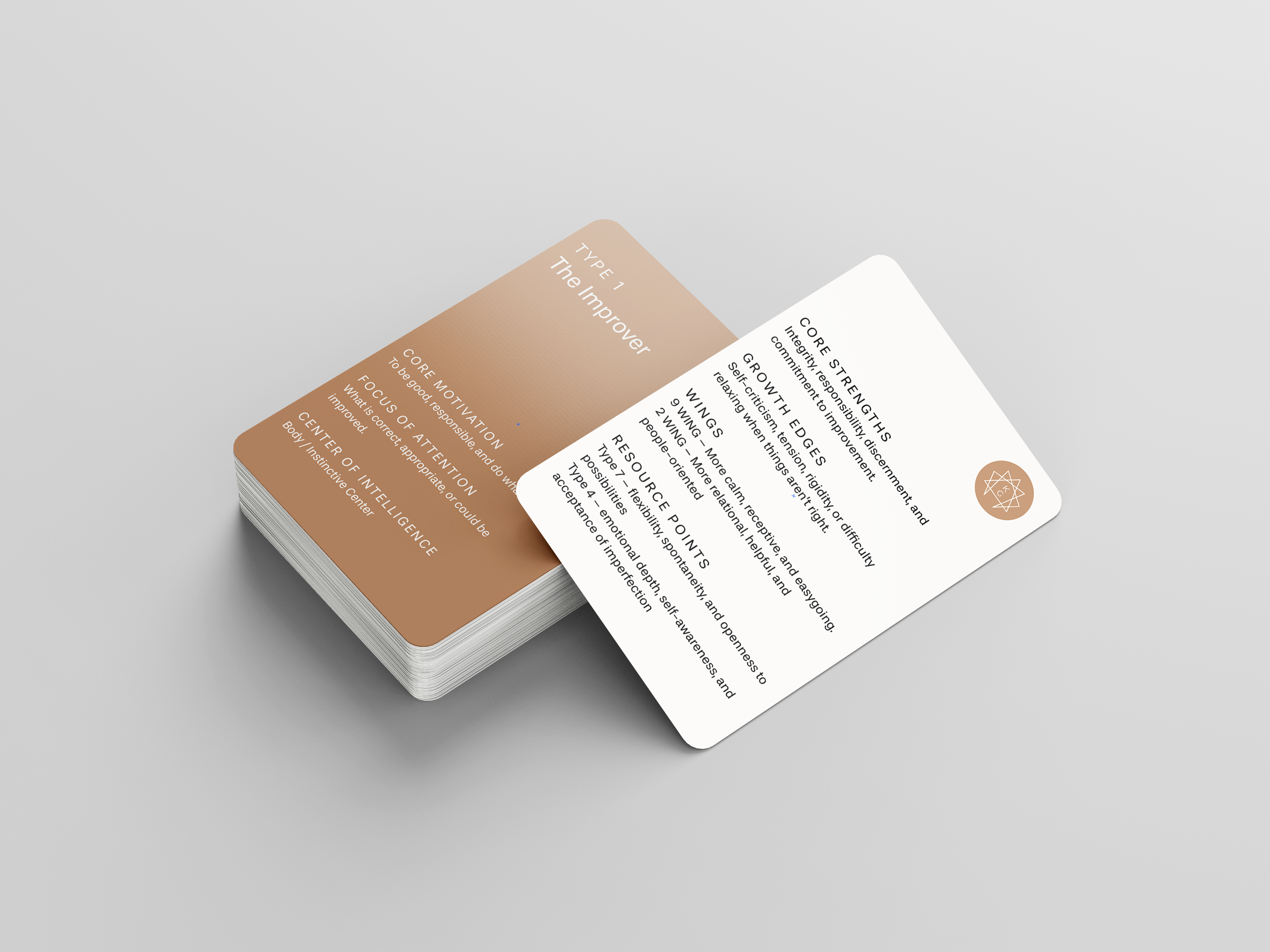
The front covers the type's core motivation, focus of attention, and center of intelligence.
The back covers:
Core strengths: How the pattern serves you.
Growth edges: Where the pattern can become limiting.
Wings: The two types on either side of yours. A wing can flavor how your type shows up. Wings influence your style and energy, but your core type reflects your primary pattern of attention and motivation.
Connected points: The two types linked to yours by lines on the Enneagram symbol. Their qualities can show up in you under stress or when you feel secure, and you can draw on them for balance and growth.
If you're still deciding between two types, read both Summary cards side by side. Notice which one explains more of your life, not which one you'd rather be.
Reflect over time
Type clarity often develops gradually. Over the coming days and weeks, you might:
Notice your attention patterns in daily life
Pay attention to how you react under stress
Reflect on long-standing themes in your relationships and work
Talk through what you're noticing with a therapist, coach, or trained facilitator
Keep in mind
Everyone recognizes themselves in more than one type. The goal isn't to find the type you like most. It's to find the pattern that best explains how your attention and behavior are organized most of the time.
There is no perfect type. Your type is a protective strategy, not your identity.
Typing is a process of recognition, not diagnosis. Look for what feels automatic, what creates stress when it's threatened, and what feels risky to lose.
Key terms
| Term | What it means |
|---|---|
| Type | A constellation of protective patterns organized around attention and motivation |
| Core motivation | The emotional need driving the pattern |
| Focus of attention | Where your mind goes automatically |
| Strategy | What you do to feel safe, valued, or in control |
| Center of intelligence | Where your protective strategy is rooted. Body types tend to react first from the gut, Heart types from feelings and connection, and Head types from thinking and planning. |
| Core strengths | How the pattern serves you |
| Growth edges | Where the pattern can become limiting |
| Wings | The two neighboring types that can flavor your style and energy |
| Connected points | The two types linked to yours by lines on the Enneagram symbol. Their qualities can show up in you under stress or when you feel secure, and you can draw on them for balance and growth |