

The Blog
Recently Featured


All Blogs











Self-Esteem vs. Self-Compassion
“When we’re mainly filtering our experience through the ego, constantly trying to improve or maintain our high self-esteem, we’re denying ourselves the thing we actually want most. To be accepted as we are, an integral part of something much greater than our small selves. Unbounded. Immeasurable. Free.”
-Kristin Neff

I’ve had it all wrong for a long time now. I’ve thought somehow if I could just do self-help perfectly, I’d be well on my way to confidence and a sense of personal freedom. If I could just will myself into the knowledge and experience of self-love and acceptance, we’d be good.
After all, I’ve used perfectionism to my advantage all these years, why stop now? Why not just transfer that zipped up effort to my desperate longing to truly know and love myself? If I could just sit in front of the mirror each and every day and say nice things about myself, or take hundreds of bubble baths, or perhaps read the right self-help books…or blogs, I’d be healed. Or better yet, I could try and recall all those limiting beliefs I played over in my head, write them down, cross them out, and slap some lipstick on them. You know the drill:
“I’m just too much to handle. No one will love me just as I am.”
Er…I mean:
“I’m the greatest thing since sliced (gluten-free) bread and have every reason to deserve love now.”
Sounds like an SNL sketch waiting to happen to me. It also sounds reactionary and surface-level, not genuine and compassionate. Quite honestly, this should be a relief for you and I. We are not meant to be fixed; we are meant to be understood.
We cannot will ourselves into loving relationship with ourselves or anyone else for that matter because we are human beings, not human doings. We are messy, complex, and perfectly imperfect. Our souls call us to something deeper, bigger than mere performance.
Enhancing our sense of value and worth solely from this angle is like pumping a poor chicken chock full of toxic hormones to go further at your local Kroger. It may seem satisfying and full of culinary possibility in the minute, yet it probably has long-term health concerns.
Self-esteem is based on the way we view ourselves to the degree with which we like ourselves. This sounds pretty important and inherently benign, right? Sure, there’s nothing wrong with seeing ourselves in a good light, however, what happens when circumstances change and we fail to get that promotion, call back, date, or worse, push people away out of fear of rejection?
The temporary illusion of self-esteem takes a hard and fast nosedive into a muddy puddle of shame.
Typically, if we depend on circumstances to prop up our self-worth, there’a steep, hard and unexpected fall coming just around the corner.
Another shortcoming of self-esteem lies in the fact that it can feel self-indulgent and divisive in an effort to “one-up” those around us. Looking back at our limiting belief turn-around, notice the correction. If I replace my limiting belief with a pep talk that tells me “I’m the greatest thing around,” I’m puffing up my ego (which operates from a place of fear instead of belonging) and pitting myself against the world in an effort to prove myself, not lovingly accept myself.
So, what’s the solution? If I can’t rely solely on self-esteem, what am I supposed to do?
Three years ago, I picked up a book called Self-Compassion, by Kristin Neff. It has changed the way I relate to myself and others on every level. It has also called me into this beautifully caring dialog with myself as opposed to the harsh, striving one that had been so loud and exhausting for decades.
What I’ve learned is that self-compassion looks vastly different than self-esteem. It is not circumstantial; it is relational. Self-compassion is based on the awareness that the human condition is frail at best, less than perfect all day long, and totally capable of resilience. This new way forward is all about mindfully and compassionately relating to ourselves when we fall short or miss the mark just like we would a dear friend.
Self-compassion is cultivated like any relationship. It fills in all the holes self-esteem leaves gaping. By this I mean, when we don’t measure up or fail to live up to our expectation, self-esteem dips, inviting two extremes: negative self-talk or puffed up ego, (even…gasp…narcissism).
This is not the case with self-compassion. It comes flooding in when our insecurities, flaws, and shortcomings stare us back in the mirror.
Perhaps one of my favorite things about self-compassion is it binds us together in the reality of our human experience. It doesn’t divide, puff up, or need to isolate. It breeds vulnerability because we aren’t all out to prove our worth and successes; there is no need to when we embrace ourselves through the lens of “imperfect—still enough.”
Self-compassion says, “I see you are hurting. I understand where you are coming from, and I am here with you in the midst of it all. I’m not going anywhere.”
Her voice is the strong and steady anchor in the midst of the storm.
Her voice doesn’t wait on sunshine or rainbows to speak.
Her voice gets louder and more frequent when we slow down to feel our feelings and touch our pain.
Therein lies the beauty: It is only through our pain we ever experience deep and lasting joy.
Love & Gratitude,
Katie
xoxo

Fall, Body Image, & the Gift of Procrastination (Yep, you heard me.)
“Almost anything will work if you unplug it for a few minutes, including you.”
Ann Lamott

Do you feel the swing of fall kick up all the busy energy like I do?
It happens every October. The kids are back in school, schedules lock in step, and a cozy waft of pumpkin spice beckons our senses around every corner.
Fall is my favorite. I’m not sure if it’s because I was deprived of clear-cut seasons growing up in Mobile Alabama’s constant humid sweat or if it is simply the fact that I’m a sucker for jackets, boots, scarves, and those glorious warm colors. It’s both–perhaps. The moral of the story here is: there is a crisp, tangible shift that dials in and carries me through to the year’s end.
Festivity is the oversized centerpiece of fall’s table. The striking hallmark in that centerpiece—busyness. Work schedules often really wake up as do social gatherings and travel, leaving self-care and connection optional at best. For me at least, the treadmill starts to speed up, and I let go of all the rituals and reasons I’ve come to rely on for a sense of sanity and serenity throughout the year.
Last Wednesday, I had the distinct honor of joining my friend, Mary Hyatt, on her Facebook Live show. Mary’s an incredible personal coach, entrepreneur, and Essential Oil guru who shares a passion for empowering others to live their fullest and most authentic lives. We had the best time talking about perfectionism, especially as it relates to body image.
Now you may be thinking, “What the heck do perfectionism, body image, and Fall have to do with anything?”, and that would be fair. Hang in though.
After the show, I left her studio still marinating in our conversation. I was curious why perfectionism is this rampant, especially for so many women, and how we grow to get so attached to its limiting and fearful message.
Perfectionism is such a manipulative lie and one that actually stunts any lasting success, acceptance, creativity, and joy. It always backfires.
As a recovering perfectionist, I’m all too familiar with its soul-sucking grip. At the bleeding heart of it is the bondage of comparison with others, and/or some unrealistic version of who we should be that doesn’t actually even exist.
We can’t throw the baby out with the bathwater though. After all, the seed of perfectionism’s pursuit is a massive desire for acceptance and belonging, two things we actually block when we become captives to the prison of its stark and lonely cell.
Your Desire is everything! It indicates a longing for something more and leads you into the path of your truth. However, the straight jacket of control, typically fueled by fear, stunts the hope of desire.
Perfectionism won’t allow for vulnerability and acceptance, and belonging requires loads of that V stuff. It’s a tricky conundrum, indeed.
In my experience, when I’ve fallen so hard into the lull of perfectionistic sleep, it’s a subtle process, one that definitely doesn’t feel intentional. This typically happens in seasons of disconnection with self—busyness.
So procrastination is a thing. You get it. Chances are, you’re really good at it too. My hope for you and I in this yummy fall season is that we would practice awareness as to exactly what we are procrastinating. What are you putting off in order to facilitate the ramped up energy of fall?
Is it sleep, exercise, meditation, journaling, or simply downtime? Where will these deficits show up? Typically, they show up at some point in relationships with self and others. Another resulting deficit is our peace. I love the quote that says, “If it costs me my peace, it’s too expensive.”
With the alluring temptress of perfectionism lurking not so subtly on social media, presenting universes of shiny, packaged worlds, my challenge to you today is this:
Rebel. Procrastinate perfectionism— Just for today.
Perhaps tomorrow you can pick it up, maybe. Instead, slow down and lean heavily on the courage of self-compassion. Look at yourself,—your life, in the mirror and speak to that longing, loving soul as you would your best friend. No one ever accomplished great things by hating themselves into submission.
Life does get busy, and stress often feels like our annoyingly perky roommate. Just remember, your “me,” that little person who looks a whole lot like you, is patient and up for the adventure. Don’t leave her behind or worse, trade her in, for an illusory version. The most beautiful life happens when we embrace ourselves as perfectly imperfect, quirky, messy, and all.
Freefall into the unique loveliness of you. Perfectionism is playing far too small.
Love & Gratitude,
Katie
xoxo

Rising from the Rubble — 3 Timely Reminders about Trauma
"Don't allow your wounds to transform you into someone you are not."
- Paulo Coelho

Hello Friend,
Today’s post is one I’ve had a difficult time writing for two weeks now. The horrific blow of last Sunday’s shooting at the Route 91 Harvest Festival in Las Vegas has left me pretty numb in the way that this type of fear-generated evil does. I hate it.
I don’t know how you’ve processed it, yet if you are like me, layers and layers of hateful behavior tend to leave me feeling helpless, and often as a result, apathetic.
How can I help?
Is our world going to hell in a handbasket?
What next?
The grim reality sets in and my callouses begin to peek through.
Wait a minute though, that’s me responding to fear with fear… or even worse, apathy!
This is perhaps the greatest danger possible: that fear would settle into apathy, and we might surrender to a new normal of acquiescence and cynicism.
Fear, in the very least, elicits some reaction. Apathy does nothing.
After a week of wallowing, I feel a healthy dose of righteous anger rising up and simply can’t back down.
I’m grateful not to have lost anyone in the tragic attack. However, I’ve witnessed several who have been directly affected, unexpectedly saying goodbye to loved ones and life partners as well as having a branded traumatic experience filed away on a cellular level. I cannot begin to comprehend that depth of sorrow, and I sincerely pray for comfort in their desperate time of need.
How are you doing in light of all of this?
Do you find yourself in the throws of pain and powerlessness despite not being directly affected by the shooting? I’ve found that highly creative people also tend to be highly sensitive to what is happening around them. You fall in this category.
You are drawn to the interior journey towards wholeness and integration which is something not everyone signs up for. Your willingness to connect is in and of itself intrinsically a creative, out-of-the-box endeavor.
Here are a couple of reminders regarding trauma as we assess the damage, lean into the conversation, and rise from the rubble:
1) Trauma is trauma no matter how you slice it.
I like the definition of trauma that says it is anything unwanted or unnatural that happens to you. Just because you weren’t there in that open amphitheater in Vegas does NOT mean you aren’t suffering secondary or tertiary trauma.
Simply being victim to 24-hour news coverage of the terror can be enough to blanket you in a thick layer of indirect trauma. Knowing our limits to information and “breaking news” is a good thing.
We’ve all been affected on different levels, and no one is comparing trauma to trauma: it's all relative, and we’re all in this together as different parts of the collective body.
2) Grinning and bearing it is old news and going the “stoic” route won’t cut it.
Inevitably, when we try to stuff our trauma or any emotion for that matter, it will eventually come out somehow and not in the loveliest of fashions.
Any time we experience loss, we must grieve it. What I’m learning about grief is it MUST be witnessed by safe people in our court whether it be a family member, a trusted friend, and/or a therapist/spiritual director. We cannot grieve in a void.
3) Find a creative outlet.
For me, this is writing. I’ve damn near filled up two journals in the past month boiling over with unfiltered and unapologetic responses to natural disasters, political conundrums, and most definitely, the recent shooting in Vegas. (I may as well be committed if anyone were to read said journal entries.)
I devoted several pages to Tom Petty in there as well— he was surely a brave and gifted soul, iconic and irreplaceable on every level.
What is your outlet? Painting, baking, sculpting, guitar, yoga, or dance? Whatever it is, pour your heart into it. Emotional energy must be expressed, not repressed. Repression and avoidance are siren songs that allure numbing agents like booze, food, drugs, work, and the like to make their seductive pitches. We’ve got to get out in front of them by tapping into our inherent creative essence.
I’ve got more resources coming to you here very soon, but for now, here’s the invitation for you and me: we all have our own work to do in keeping our interior landscapes clean so as not to fall asleep in a stagnant pool of apathy.
If you or someone you know is currently experiencing a fall-out from recent tragedies, reach out. Don’t let lack of resources, fear of judgement, or perhaps the unknown, hold you back. Nashville is fighting back from a place of love and accountability. Join me on this path to connection, integration, and courage as we bridge the gap for the broken and openly talk about our wounds.
Take heart, my friend—you are not alone. We are all inexplicably in this together. That is the invaluable, stunning nature of the human spirit in its purest form: our pain joins us together and binds us into a beautifully broken patchwork that heals us over time. Let this be your anchor as chaos and loss sweep heavily over our hearts. It has surely been mine.
Love & Gratitude,
Katie
xoxo
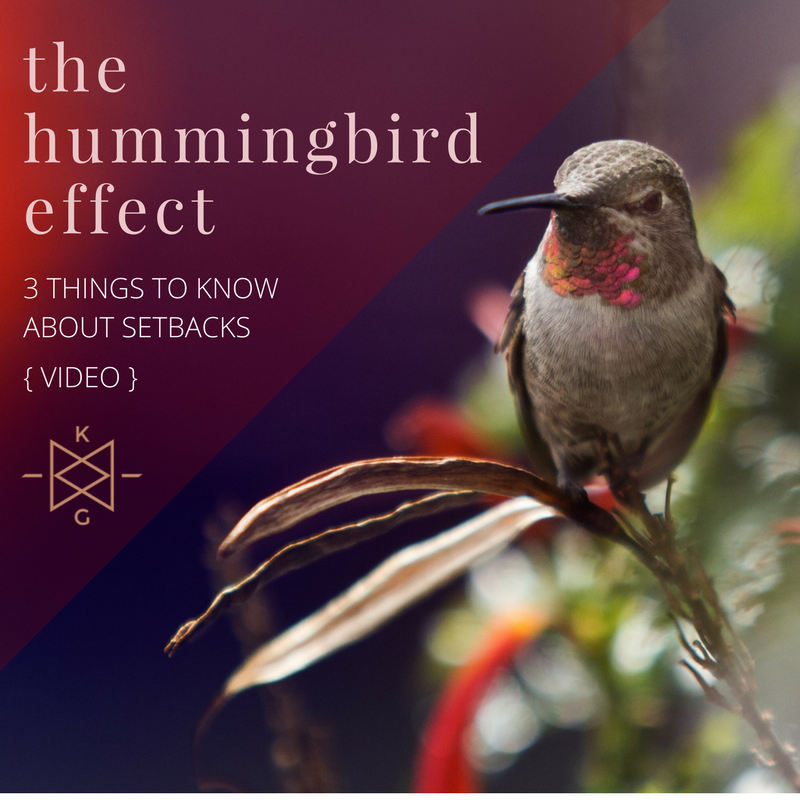
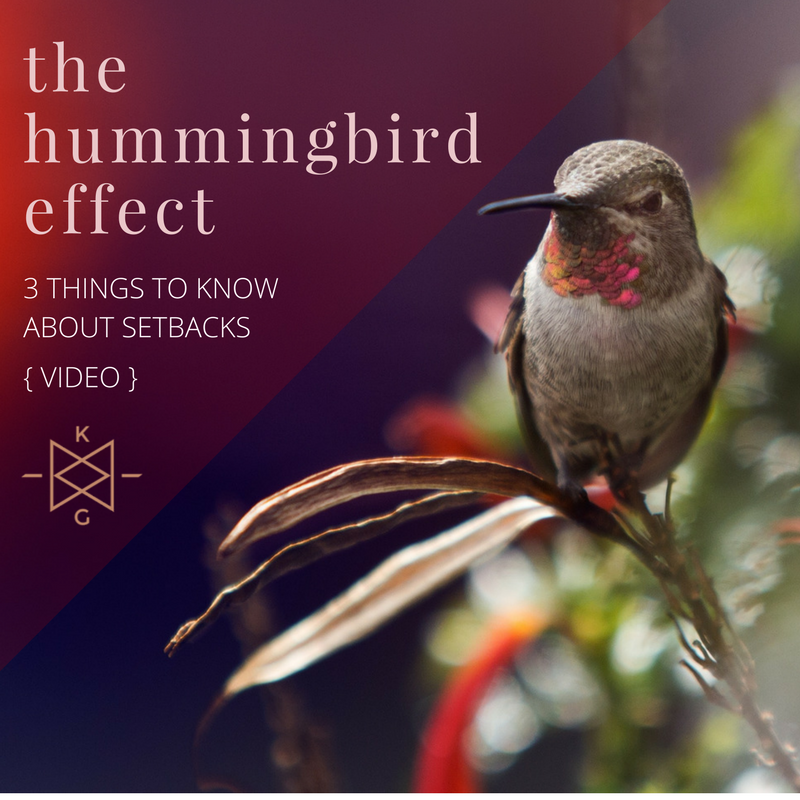
{Video} The Hummingbird Effect: 3 Things To Know About Setbacks
“Whatever happens to you belongs to you. Make it yours. Feed it to yourself even if it feels impossible to swallow. Let it nurture you because it will.”
-Cheryl Strayed
Tiny Beautiful Things
Hello Friend,
I hope your week is going great!
Question: How many times have you walked head-on into a (closed) glass sliding door?
Me? More times than I’d care to count.
What emotions fire up on the other side of that unexpected dose of humility?
Humiliation, shock, frustration, exasperation, and perhaps a sore nose among other things.
If people are watching, (and they always are. This NEVER happens in a vacuum), the old ego needs a bit of time to heal from the gnarly bruise she just incurred.
If you’re like me, unexpected setbacks feel like a punch in the gut, and all I want to do is slap myself around, dust myself off, pull up the bootstraps, and carry on pretending nothing really happened. “Keep calm and carry on” right?
Well, this approach works good and great for a while, and then eventually we begin to grow increasingly disconnected from the truth of our needs and our pain eventually masks our identity. Our attachment to ego clouds everything.
This past weekend, I witnessed the loveliest, tiniest, kelly-green feathered hummingbird take a deadly if not accidental nosedive straight past the bird feeder on our deck and into the window behind it.
Barely breathing and with a broken wing, he hung on to dear life for hours as we nursed him back to health. He is on the mend at an animal shelter nearby, but I can’t help but contemplate all that this sweet hummingbird taught me.
If you are in the midst of a heartbreaking setback or find yourself still sore from a recent one, I hope you’ll check out a little video I put together for you.
I’ve been tossing around some ideas, or questions, to ask myself next time I experience an unexpected setback:
1) What am I believing to be true about my set back?
2) Is this in fact true?
3) What do I need in order to extend kindness and compassion to myself in the moment as I would a dear friend?
I absolutely love Cheryl Strayed’s quote from her latest masterpiece, Tiny Beautiful Things:
“Whatever happens to you belongs to you. Make it yours. Feed it to yourself even if it feels impossible to swallow. Let it nurture you because it will.”
What setback do you currently find yourself in? I’d love to hear how you are finding your way through and what comes up for you around these three questions. Pray, tell….
Love & Gratitude,
Katie Gustafson
P.S. Stay tuned for an exciting fall group opportunity coming your way soon!

Ordinary Things — Lessons from Graham Nash
“No reward anyone might give us could possibly be greater than the reward that comes from living by our own best lights.”
- Parker Palmer
This past week, Nashville did her thing and hosted the Americana Fest. Living in Nashville for over twenty years now, I often find myself taking Music City (and sometimes music in general) for granted what with all the insane talent boiling over at every turn. Hell, you can even hear some pretty first-class country covers the second you deplane at BNA. Yep, the airport Tootsies will nearly have you convinced 99.99% of this town can carry a tune.
Friday night was special in that I fell in love with songs all over again and was reminded just how vital story really is. I had the honor of accompanying my better half to a live recorded tribute to the incomparable Graham Nash. The night featured him as well as other established and burgeoning talent, all offering their versions of some of his most memorable tunes.
His second skin embodiment of the sounds he creates blows me away. You simply can’t separate him from his music; you’d be dismembering a limb of sorts. If you’ve ever seen him live, you know his passion and reverence for the craft is unmistakably palpable.
Perhaps my favorite part of the show was hearing the story behind his song, Our House, Crosby, Stills, Nash, and Young’s smash hit. It seems I’ve become just as mesmerized if not more by where songs come from as I am the song itself.
In his charming British way, Graham (just going to go ahead and assume we’d be pals) recalls a lovely if uncharacteristic blustery, grey Los Angeles afternoon with his then live-in girlfriend, Joni Mitchell—naturally.
He wryly renders “oftentimes songs come from the most ordinary of experiences,” you know, like a Saturday afternoon shopping jaunt with ordinary people like Joni Mitchell?!
He had us all engaged, leaning in, smiling and hungrily eating out of his hand. Apparently, Joni had found a quirky little antique vase for a steal and was eager to put it to good use. Upon their return home, he turns to her contentedly and urges, “I’ll light a fire, and you should go put some flowers in that vase you found just now…” An hour later she returns with an arrangement to find Graham wrapping up a classic. And so, the conception of a song—no big deal.
This post is not about songwriting or Graham Nash for that matter. It’s about you and the story you believe about your value. The day after the show I turned to my husband Daniel and said, “You know, he’s had thousands of opportunities to dial in that Joni Mitchell story. It’s so good and clever partly because he’s lived in it so much.”
Cynical much? No really, that wasn’t my heart behind the comment. It’s an epic song with an epic story and cast, yet, he’s had decades to perfect it, test it, and perform it. He’s not getting in his own way every time in order to re-create the wheel; he’s working his edge.
What I’ve curiously pondered in my heart the last several days since is how ingrained our stories get into our hearts and brains; so ingrained we believe them, bowing down to them as if they had the keys to our life’s success.
You see, people believe what we show them to be true about who we are. Oftentimes, we clumsily miss the opportunity to draw them in because we’re stuck living out our scarcity story— fearful and highly undervalued.
Over the next several weeks on the blog, we will explore practical ways of tweaking our story in order to “work our edge.” I heard that phrase in a yoga class recently. It was one of those classes where the heat’s cranked up, and it smells like a gargantuan eucalyptus plant is sweating. Our annoyingly fit and enthusiastic teacher kept charging, “find your edge and work it.” I was too busy slipping all over my mat and looking like a frustrated beet to remotely find anything edgy. Still, the phrase stuck and I kind of love it.
Awareness is the first step towards change, so this week, I encourage you to be a student of yourself. With a beginners mind, simply observe the little things you do that make you come alive. This can be cooking a meal or writing in your journal or going for a run. What are those things that come naturally to you that you assume everyone else does with such pleasure too? Is it writing a thank-you note, encouraging a friend, or researching printer ink (sky’s the limit here, folks)? These little things are the making of your edge. They are how you lead, and consequently, they are highly valuable.
So, just like we learned from Mr. Nash, oftentimes the most brilliant stories come from the most ordinary-seeming things. Your story is one of a kind. Now, its time to work that edge.
Love & Gratitude,
Katie