

The Blog
Recently Featured


All Blogs







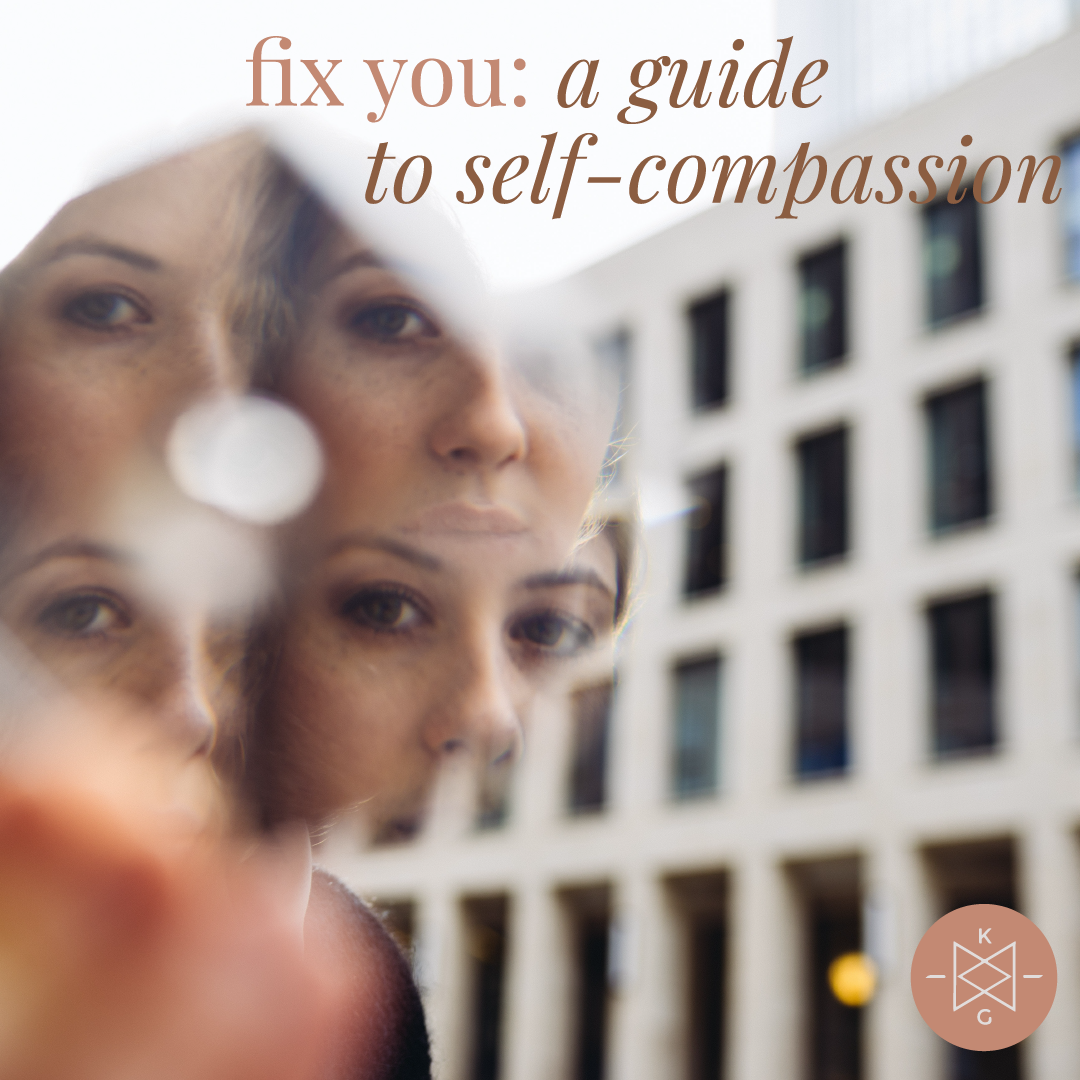
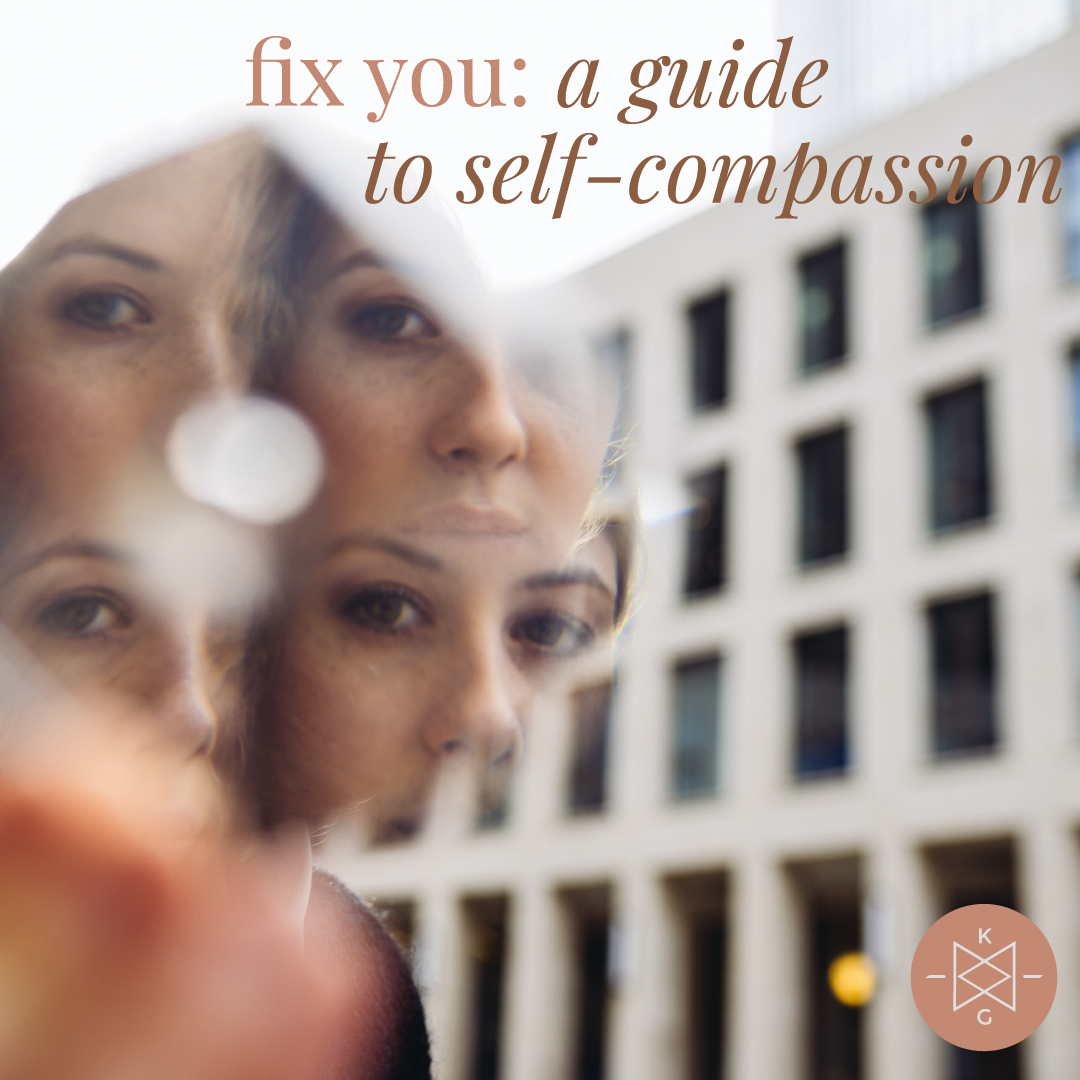
Fix You: A Guide to Self-Compassion
“The biggest reason most people aren’t more self-compassionate is that they will become self-indulgent. They believe self-criticism is what keeps them in line.”
- Dr. Kristin Neff -
I had it all wrong.
I thought if I could do self-help perfectly, I’d be well on my way to confidence and a sense of personal freedom. If I could will myself into the knowledge and experience of self-love and acceptance, I’d have arrived. There might even be a red carpet and some Valentino couture involved.
After all, I used perfectionism to my advantage for years, why stop now? Why not transfer that zipped up effort to the pursuit of self-acceptance and love. With just enough muscle, I knew I could fix her.
Spoiler alert: no matter how many affirmations or bubble baths or self-help books were had, the “am I enough?” ballot’s still out.
Oh, I went gangster with it, too—you know, the “fixing homework.”
I’d recall all my limiting beliefs about myself, write them down, cross them out, and slap ruby red lipstick on them—with feeling.
“I’m unloveable.”
Er…I mean:
“I’m the greatest thing since (gluten-free) sliced bread and have every reason to deserve love now.”
Sounds more like an SNL sketch to me. It also sounds reactionary and surface-level, not genuine or believable.
Good news!
You’re not meant to be fixed; you’re meant to be understood.
We can’t will ourselves into a loving relationship with ourselves, or anyone else for that matter. Humans aren’t math equations. We’re messy, complex, and perfectly imperfect.
The self-esteem quick fix is much like pumping a poor chicken chock full of toxic hormones to go further at your local Kroger. It may seem full of juicy possibility in the moment, yet it probably has long-term health concerns.
Why doesn’t self-esteem work?
Because it’s based on the way we view ourselves to the degree with which we like ourselves. Sounds benign, right? Sure, until circumstances change. What happens when we fail to get that promotion, call back, book deal—or can’t get the weight off?
The temporary illusion of self-esteem takes a nosedive into a muddy puddle of shame.
Typically, if we depend on circumstances to prop up our self-worth, there's a hard and unexpected fall coming just around the corner.
There’s more.
Self-esteem can be divisive in an effort to “one-up” those around us. Let’s revisit our earlier limiting belief turnaround. If I replace it with a pep talk that tells me “I’m the greatest thing around,” I’m puffing up my ego (which operates from a place of fear instead of belonging) and pitting myself against the world in an effort to prove myself, not lovingly being with myself.
So, what’s the solution? If I can’t perfect self-esteem, what am I supposed to do?
Four years ago, I picked up a book called Self-Compassion: the proven power of being kind to yourself, by Kristin Neff. It has changed the way I relate to myself and others on every level. It’s also called me into a more caring dialog with myself as opposed to the harsh, striving one that’s been so violent and intrusive for decades.
Rules without relationship breed rebellion.
If I’m constantly inflicting rules on myself instead of trying to relate to myself, I’m on the fast track to self-sabotage.
• Self-compassion is relational, not circumstantial. It’s based on the awareness that the human condition is frail at best yet capable of resilience.
• Self-compassion is cultivated like any relationship—over time. It fills in all the holes self-esteem leaves gaping. When we fail to live up to our expectation, self-esteem prompts two extremes: negative self-talk or puffed up ego (even…gasp…narcissism).
This is not the case with self-compassion. It comes flooding in when our insecurities, flaws, and shortcomings stare us back in the mirror.
• Most importantly, self-compassion binds us together in the reality of our human experience. It doesn’t divide, puff up, or need to isolate. We see ourselves through the lens of “imperfect—yet still enough.”
When that brutal inner critic pipes up, self-compassion says, “Hold on. I see you. I understand your pain. And I am here with you.”
Her voice is firm and tender.
She doesn’t wait on the clouds to pass or the proverbial sun to shine. She speaks her truth in the broken moments.
You’ve known her cadence a long, long time. Then you met fear. It drowned out the love.
You know what?
Your birthright is love, not fear. Just as you learned fear’s luring language, you can also unlearn it.
Birds don’t soar because of effort or willpower. They do so by surrender—and risk.
It’s time to work with—not against—the choppy current of life’s wind.
Alone? Not in a million. You’ve got a bold little guide waiting inside to illuminate the path. She was born ready.
Love & Gratitude,
Katie
xoxo
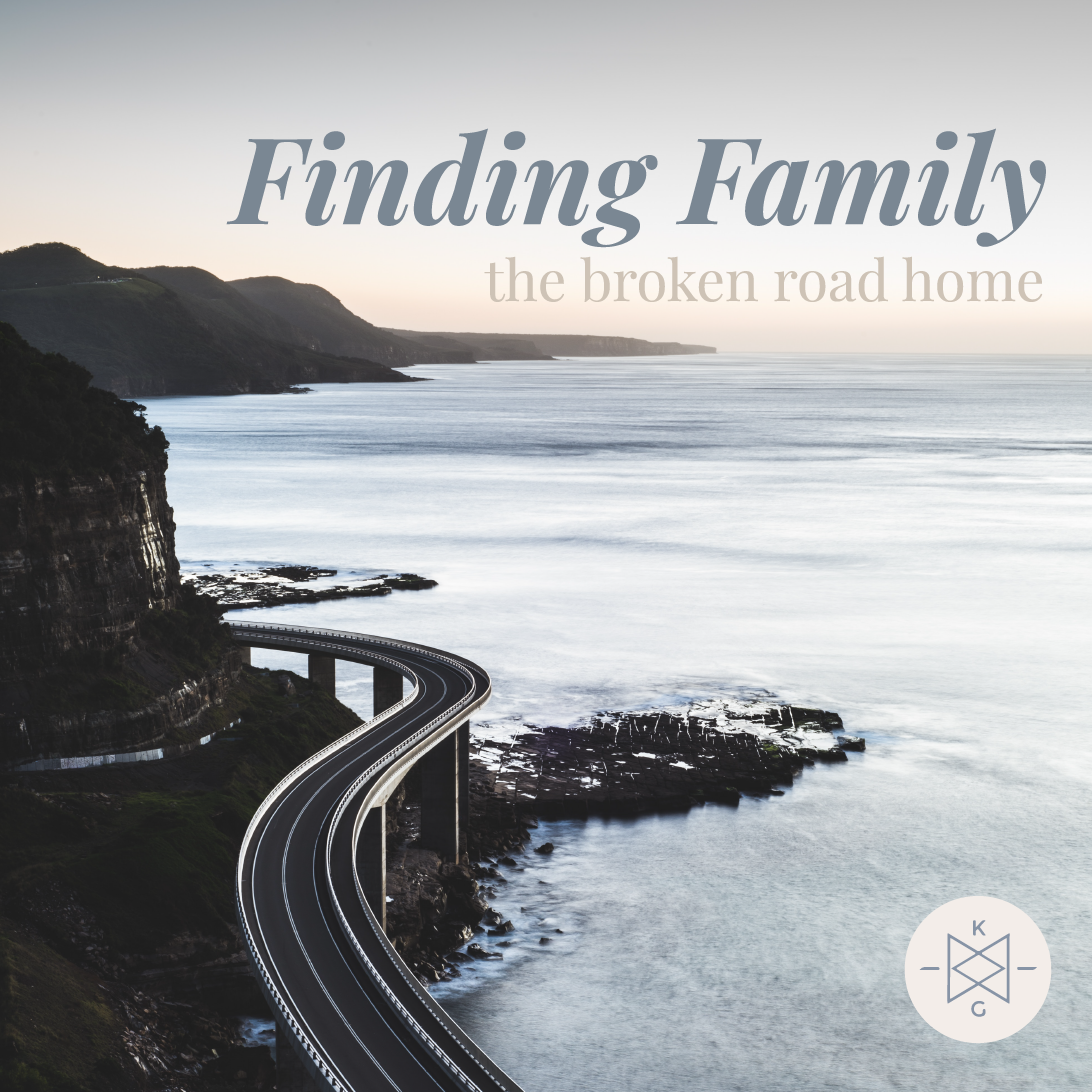
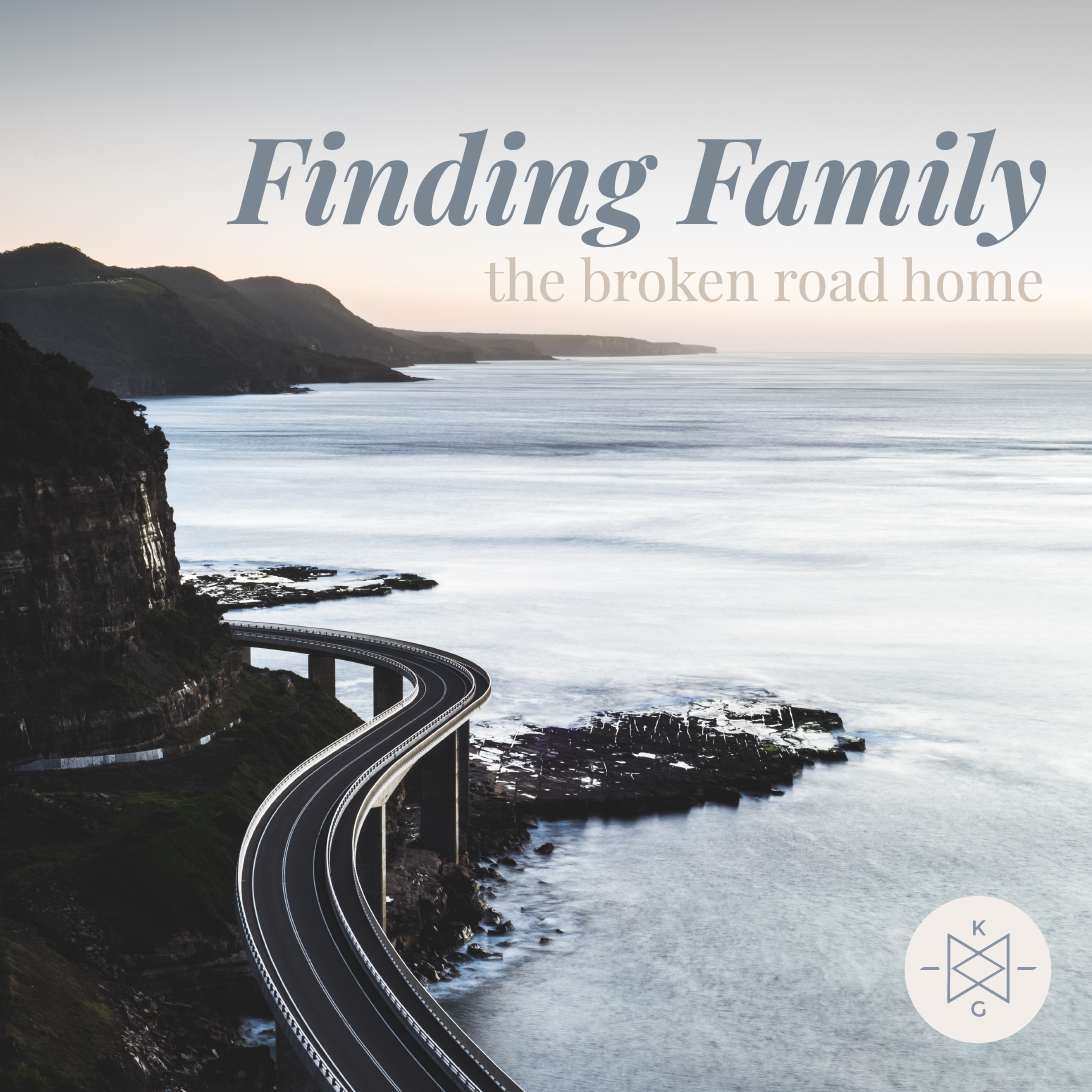
Finding Family - The Broken Road Home
“Loneliness is proof that your innate search for connection is intact.”
- Martha Beck
I’m not sure if it’s the Holiday season or the fact that I’m becoming more nostalgic with age, but something has been at the forefront of my heart and mind as of late.
I can’t seem to shake it. I don’t want to shake it.
It’s beautiful, complex, frustrating, exhilarating, heartbreaking, fun, weird, grounding, dangerous, and safe all at once.
Everyone has it on some level and has been seriously impacted by it, undoubtedly. I believe we must somehow, either literally or figuratively, leave it at some point in order to honestly choose to love and enjoy it in the end.
“What the….?” you ask.
Ah yes, the “F” word. Not that one, the other “F” word: Family.
What comes up for you with the mention of family? Is it sadness? Regret? Longing? Love? For me, this slow and heavy wave of gratitude washes over. Don’t get me wrong. It wasn’t always like this. I’ve had some long dark stretches of distance from my family. Sure, there were disappointments due to impossible expectations, but what I’m realizing is many of those expectations were really for myself, not my family. They were just the closest, easiest targets.
Do you relate to this longing for family—for home? If you find yourself in a place of loss and loneliness this season, keep reading. This is for you.
Last Thursday, as I sat around the Thanksgiving dinner table surrounded by family and an arsenal of casseroles that would make Paula Deen squirm, I cried. Fear not. There was no drama to speak of and the sides were superb. I cried because of how far we’d come and how much we’d grown in awareness and compassion for one another despite the broken road that’d led us to that place and those casseroles.
A convincing bolt of insight hit me as we went around the table sharing what we were most thankful for and not one person talked about their careers, accomplishments, or stuff. Each colorful character gave high praise to the same gift: relationship. Relationships are the powerful connections that sustain human life on this earth. For the record, I wasn’t the only sap who cried either.
I realized something deep and glaring and worth its weight in gold: Relationships are the most important thing in life.. More important than money, power, ideas, and influence (especially influence), relationships are King and must be intentionally cultivated and nurtured over time. (Read: not only on Thanksgiving.)
Sometimes this comes in the form of a family of origin; often times this comes in a family of choice—the one(s) we build.
The truth is, for many of us, the word family brings up immeasurable pain and anxiety as safety and protection were needs that went missing in our family of origin.
In therapy, we spend a great deal of time unpacking that pain, which isoften traumatic, in order to rewrite a narrative of value, love, acceptance, and possibility. Needs such as provision, encouragement, affection, play, and structure were denied and as a result, had to be met elsewhere. Survival became a fight, resulting in unhealthy relationships, the denial of needs, parenting aloof parents, acting out behavior, and on and on.
In Falling Upward, Richard Rohr aptly concludes, “When you get your, ‘Who am I?’, question right, all of your,'What should I do?’ questions tend to take care of themselves.” The first half of life is often spent grappling with identity, or at least mine was. Hell, some days I feel the ballot is still out. Our first mirror of identity dwells in the home and is largely held up by our families. This natural flow of life and development, however, is not always accurate and/or affirming for many. I have wonderfully loving, encouraging parents who instilled their values and beliefs into us five kids. This infrastructure is necessary for ultimately receiving, learning, doubting, questioning, and forming a collective of tested individual convictions from which we grow and live out the second half of life.
Now this can be a brutal process as we must often lay down that set of values inherited from our parents in order to refine and embody a set that brings more congruence into our daily experience. For me, that process was peppered with anxiety, depression, and bouts of insomnia. With age and maturity (we hope), the invitation is to take responsibility of our today, and offer compassion and forgiveness to our family of origin. Our parents, after all, are just people. They were never meant to stay up on that pedestal you put them on. It was just too far to fall.
I can remember sitting in my spiritual director, Gail’s office like it was yesterday. She had this big old winged-back chair with robin’s egg blue toile fabric and a worn-in seat. Her office felt like a dreamy English cottage or something: a collection of kindness, tears, books, mismatched story-ridden antiques, and the occasional whip of tired laughter. During stretches in my twenties I would sit with her and shed my stories of disappointment and loneliness as if she had an “all better” pill to give me in the end. Well, she didn’t. Yet, I miraculously made it out of that decade alive. I remember her gentle response to my weary, longing soul, “You know Katie, loneliness is really the human condition. Stillness isn’t the worst teacher, either.” I know, I know, I would reply with a deflated sigh.
Coming to embrace this as truth has been a peaceful rendering for me. Because we are relational beings who long for and are made for connection, we constantly ebb and flow on that spectrum energetically. It is impossible to stay in a static place of fullness at all times. You may be an over-achiever, but you’re not a machine. I realize this when I ask my friends who appear bulletproof and fabulous on Instagram how they’re doing only to find out in conversation that they are really struggling with a deep sense of disconnection and sadness. The rat race of keeping social media appearances may be a glossy, temporarily successful campaign, however it does not satiate the desires that well up beneath the surface after all those hearts and likes cease to flow.
There is simply no substitute for family: the one we’ve been given or the ones we have chosen. “Feelings of worth can flourish only in an atmosphere where individual differences are appreciated, mistakes are tolerated, communication is open, and rules are flexible — the kind of atmosphere that is found in a nurturing family.” Virginia Satir had it right. I take that a step further and add this: the flourishing of self-worth and acceptance can also be re-created in families we cultivate along the way; those safe people who have earned the right to hear and bear witness to our stories.
This, like so many things in life, starts with intention and openness and requires patience and time. On your unique journey of cultivating family, community, and home, I hope and pray that you will not abandon ship when the space feels too big and the silence too loud. Listen to that constant longing and echo it to the world, though your voice may crack and your heart falls flat. And then do it again, and again, and again. You’re on your way to a place called home and that journey starts within. You are worthy of connection.
Love & Gratitude,
Katie

Upper Management: How to Lead your Life
“One isn’t necessarily born with courage, but one is born with potential. Without courage, we cannot practice any other virtue with consistency.”
-Maya Angelou
If there is anything I've learned from my own winding journey of emotional and spiritual integration, it is the importance of ritual—or practice. How do I take full responsibility for my experience, and in doing so, create the life I desire as opposed to a life I settle for? It’s the difference between leading your life and merely managing it. I believe we close this gap by developing self-awareness through simple practices.
Chances are, if you’re reading blogs about emotional health and wellness such as this one, or have sought therapy at some point, you’re a leader. Why? Because you are actively participating in cultivating the hidden potential in your life. You’re finding your edge and sharpening it.
I like Brené Brown's definition of a leader in her latest book, Dare to Lead: “Anyone who takes responsibility for finding the potential in people and processes, and who has the courage to develop that potential.”
Sounds doable, right? Within reach? Without a doubt, I believe it absolutely is.
Hold up though. If you and I are going to be leaders, developing and speaking into the lives of others, don’t we first need to lead our own lives fairly well? Otherwise, we prop up a flimsy facade of ego and lack the deep roots of character and credibility necessary to sustain leadership from a place of truth and integrity.
So here we are, headed full-throttle into the glorious blur of the Holiday season. For me, this time of year resembles a dialed-in dance with Upper Management. By this I mean, the steady samba of forgetfulness—losing touch with all those grounding practices and rituals that keep me connected to presence and structure {read: sanity} throughout the months leading up. I start managing my life instead of leading it, like a crazed Sugar Plum Fairy twirling to Tchaikovsky on repeat. Can I get a witness?
How then do we slow down that dance and lead from a place of intention instead of reaction? I’m convinced the unsexy truth is we get really good at practice.
Practice what??
I’ve got three uber simple rituals for you to practice this week. Feeling frisky? Commit to six weeks that will carry you, soaring high right into the new year.
First thought: When your eyeballs pop open first thing in the morning, guess what? A first thought also starts to percolate. That first thought has the power to steer your day either north to Mt. Abundance, or south, to Lake Scarcity. You have creative license to craft that thought, coloring the trajectory of your day. If that thought is, “I’m just so tired and didn’t get enough sleep.” Guess which direction you're headed? Yep… straight south to scarcity. You’re in the driver's seat though, so take one minute first thing in the morning, to carefully choose the thought that will direct your day in the right direction. The scenery is much better on this route, I promise.
Gratitude: Throughout the day, take three one-minute breaks and identify at least three things you are grateful for in the moment. Meal times are ideal to practice this as we (hopefully) slow down and hop off the treadmill of our day. The goal here is to keep them simple (i.e. lungs that work, food to eat, a new day, a job or hobby, a dear friend).
Belly-breathing: It’s fascinating to me that as a culture, we largely suck at breathing. Our overall vitality and quality of life immediately improves when we practice deep, steady breathing. But guess what? We’re just. so. busy. I’m calling BS on busy. For at least one minute each day, practice slow, belly-breathing. Breathing into our belly, or body’s center of intelligence, brings a tangible feeling of groundedness. Place your hand on your belly and feel it rise and fall, like a cashed-out kid at naptime. We’re often so disconnected from our bodies, which stunts us from experiencing the fullness of each moment. Belly-breathing is the quickest way to connect us back to presence and the intelligent knowing of our bodies.
If these seem too pedestrian—or basic—as you step into CEO of YOU, guess what? Get over it. Tough love, my friend. The best musicians in the world got that way because they nailed the basics, and still practice them. We’re all guilty of getting in our own way by not practicing what we preach. I’m pretty sure I wrote the book on self-sabotage. However, now is the time to return to the basics and start leading a life that inspires hope and desire. My challenge to you is this: have the courage to do the small things that lead to big change. Inspire yourself so much that others start to lean into your light and see themselves in a new, empowered way. I’m pretty sure that’s called an icon. Greatness starts off small and grows in that light.
Love & Gratitude,
Katie
How the Light Gets In
“There’s a crack in everything. That’s how the light gets in.”
-Mr. Cohen
Last Tuesday I received some tough news—a beast of a horse pill to swallow. I bet you can relate. Suddenly, your skin starts to feel cold, the room gets blurry, and the conversation in the room sounds like that droning “wah wah” teacher talk of Miss Othmar from Peanuts. You’ve forgotten what you ate for breakfast and aren’t quite sure if words, tears, or laughter to mask the pain is appropriate in the moment. The whole “adulting” thing seems entirely overrated.
After a week to digest, readjust expectations, and lick the wounds of that blow, I’m feeling much better. Time does provide the complex salve necessary to make sense of madness. However, inthe heat of the moment, I feel a primal need to find God, and fast—to run to that loving source of comfort. I always sense that tangible power in nature. Thankfully, the silver lining in that day was the gift of clear, crisp fall weather to temper the stormy disposition of my heart. I did the only thing I knew to do: I hit the hiking trails at my favorite nearby park, Radnor Lake. This is my high church. For two solid hours, I got lost in her music.
There were no inspiring podcasts or feel good playlists on Spotify. I didn't even take my phone. Nor did I take pictures to later post on Instagram. I needed to be all in—immersed and undistracted by the false hit of social media’s temporary high. I put one foot in front of the other, stared down creation, and looked for answers to my riddle. I didn’t much find them.
What I did find was far more literal if unsexy. I noticed warning signs all throughout the park trail. The warning signs kept barking, “Fragile Ecosystem,” followed by a slew of “don’ts” such as running, picnicking, dog walking, and the like. In my 20’s, I’d scoff at these rules, reading them as light suggestions while running up and down the trails like a grinning, coked-up banshee.
Last Tuesday, in a more humble state, they made perfect sense. If this nature’s trail was my Church, these warning signs had become the Ten Commandments.
Now I’m all for mental toughness, make no mistake. The idea of training the mind to persevere in times of discouragement, and emotionally detach from circumstance in a healthy way so as not to fold under the deluge of emotion is a practice worthy of devotion. That old victim mentality can sneak in the back door of our perspective and camp out indefinitely if we’re not careful!
Yet I do believe we must honor the fragile nature of our inner ecosystem. We must do this by slowing down to honor our experience, feel the pain, and preserve our story with kindness and compassion. Otherwise, we become proud, crusty iterations of humanity, bowing down to ego while abandoning true Presence. We must stay soft—open.
Therein lies the paradox, my friend. It’s the constant toggling between bold action and bleeding vulnerability. It’s the both-and, not the either-or. When we lean into this tension, we build those tiny accessory muscles of resilience. Resilience, over time, breeds a version of joy that outweighs happiness. I believe true joy looks a lot more like equanimity than certainty.
What broken pieces of your heart do you find yourself picking up off the kitchen floor these days? How did they get there? Your journey’s been arduous and I can imagine you’re weary—weathered. No, you’ll never be able to fit all those pieces perfectly back together. And for this you must grieve. But you must also take heart because God’s in the grieving and the healing. He didn’t bring you all this way just to leave you. As the brilliant Mr. Cohen says, “There’s a crack in everything. That’s how the light gets in.”
Honor your story—your light—your pain. It’s the only way you’ll find the courage to keep writing it.
Love & Gratitude,
Katie
Food, Fashion, & the Pursuit of Happiness
“No emotion is final.”
If there are three things I am deeply passionate in this life, they are surely food, fashion, and mental health (among other things, of course). Along my squirrelly (at best) career path, I flirted hardcore with romantic ideas of moving to NYC and working in fashion or becoming a chef more times than I can count. I finally chickened out because A) I love to cook, but on my own watch and for people who are nice, and B) God spoke to me through a slew of convincing nightmares after watching “The Devil Wears Prada.” I’ve never been so terrified of Meryl Streep in my life.
Eventually, I landed where I am today, in the armchair of psychology/mental health. Yet I must say, the beauty and inspiration I find in cooking/hosting, as well as fashion, is something of therapy for me.
You may guess where I’m headed here.
Last week the human race suffered a massive loss. I was gutted upon hearing of Kate Spade’s suicide. Then, Anthony Bourdain’s only two days later? I never had the opportunity to meet them, but somehow, somewhere deep down, I felt connected to them, like we might have been friends. I loved their gumption and their wildly unique approach to business and art, and most of all perhaps, I love that they inspired us to get a little bit outside of our comfort zones and do something remarkable.
After wrestling with sadness, anger, and confusion for a solid week, I think I know why the mack truck of this news hit me so hard: I too, know the desolate, lonely corridors of self-destruction. In the throes of my own crippling depression, self-loathing and a seriously jacked up belief-system pushed me to the edge of this life, photoshopping out any inkling of hope. I didn’t have the rational mind to reach out for help in those times. Thankfully, I had enough people around who did and could carry my frail heart into truth and light.
Left to my own devices though, I’m not entirely sure I’d be here today without them.
I’m certain you or someone you know has had a similar story.
Now, in my rational, healthy mind, I’ve learned to practice (and love) asking for help. Hell, you’d know it all the way in Seattle in less than a minute if I stumped my big toe.
However, the fact is depression can very much be a fatal disease. This logical ability to reach out and “ask for help” simply isn’t baked in.
Last week reminded me why I do what I do. It is why I keep showing up every week to write these silly posts that may never even be read. I don’t care; the conversation must go on. It is why, in the end, you and I must not only hold space for the hurting around us but proactively reach out to those who can’t due to the silencing, eternal trans of suicidal depression.
In tennis, there are these things called unforced errors. They are missed points due to avoidable mistakes. I grew up binging on televised tennis tournaments with my big sister Kristen, who was a tennis champ herself. We bickered over clothes and things a lot, but you better believe, when Wimbledon came around every year, we were strangely harmonious.
Andre Agassi (the crush of our lives as we knew it then) would miss a shot, double fault a serve, or get flustered by Pete Sampras’ clever drop-shot—fair enough. However, an unforced error was simply a waste. Those were avoidable.
I think of suicide as the ultimate unforced error, the ultimate loss. Unlike the game of tennis, you can’t come back and redeem yourself in the next tournament of this life after the loss of suicide. There’s no do-over.
Suicide is a permanent solution to a temporary feeling. No feeling is final. You and I get the math here, yet for Kate Spade and Anthony Bourdain, math didn’t matter. I suppose they felt there was no other choice. We shouldn’t judge them or assume to know what it felt like to walk around in their very visible shoes.
I want to leave you with this thought, or conviction really.
Success, fame, wealth, even the pursuit of what we are passionate about and think will make us happy and add value to the world is smoke and mirrors if we are building it from a place of ego. By ego, I mean our false self—who we are when we’re manipulating circumstances around us to make us worthy or significant. This self is motivated by fear and scarcity. When we live out of ego as opposed to a loving presence, we will never be satisfied, even after we think we’ve “arrived.”
I’m an evangelist for doing what you’re passionate about and creating a life you love. I write about this a lot and coach people who are on this journey in my work. You know what though? It’s all a lie if we are not first and foremost convinced of the truth of who we are as opposed towho the world tells us we’re supposed to be. This truth comes from a bigger story, a more profound love.
We must stay tethered to connection: connection to Love, Truth, Healthy relationships, and Community, and to the Authentic essence of who we are if we want to truly be successful—known.
Last week, we lost two iconic industry leaders. They made a final, fatal decision based on only a small, painful part of a much bigger story. For all we know, they “had it all.” That narrative came to a screeching halt.
Depression can feel powerless, like there aren’t any other options. What a terrible, if not convincing lie.
Lovely, you are powerful. You are worthy. You are beautiful. You have the incredible ability to cultivate happiness in the now, without contingencies and red tape. Perhaps best of all, you get to write the next hopeful chapter.
Remember this; you are the ocean. You have complex waves of emotion. They build and break. They crash and wash. They wane. They shine. They move.
They will never overcome the power of your depths though. You are Love.
Love & Gratitude,
Katie
P.S. If you or someone you know is battling depression, reach out. Despite it being the opposite of what feels normal or comfortable. It is our responsibility to be the voice and hands of those that aren’t able to use them due to their disease.
Thoughts on motherhood, breast cancer, and what attachment theory and the Enneagram taught me about being loved