

The Blog
Recently Featured

All Blogs











Resilience - The Story of You
"The useless days will add up to something. These days are your becoming."
-Cheryl Strayed
Every year around this time, I get a bit nostalgic, even sappy. (Shocker.)
I start to scroll through all the memories, struggles, victories, heartaches, and lessons learned. Without fail, the year at hand proves a very thought-provoking teacher. Thanks to scarily intuitive portals, it’s hard to escape montages of these memories—hell, Facebook already made a highlight reel of them complete with a companion soundtrack to take us there.
Throughout the bleakest years of my struggle with depression, my Dad always knew exactly how to encourage me. He would take me to dinner and we would talk. He knew good food and deep conversation were the way to my heart. I suppose I inherited this from him.
He taught me how to zoom out and see the bigger picture as he’d remind me how far I had come—my winding story up until then. He would stress that God didn’t bring me here to leave me here; no, God was far too clever for that. He reminded me of my unique story and that despite the pain I was feeling at the moment, I was being broken open and forever changed in a good way. One day this might make more sense. It didn’t then, but it sure does now.
I’m not sure he used the word resilience, but now I know that’s what he meant: my willingness to show up, fall after fall, to the call of my life.
I just looked up the definition of resilience and here is what Merriam Webster gives us:
1: the capability of a strained body to recover its size and shape after deformation caused especially by compressive stress
2: an ability to recover from or adjust easily to misfortune or change
I especially like the second one.
Something 2017 has reminded me of in a convincing way is that change is indeed inevitable. All forms of change, even positive, incurs a loss because when we embrace change, we must let go of something.
We must grieve loss. Loss doesn’t occur in a vacuum. To let go is to change, even if it’s letting go of something harmful in order to experience something better. Whenever we embrace change, we must also grieve what’s been left behind.
As you look back at this fascinating year in your life, I wonder what you'll see? What emotions bubble up to the surface? How have you practiced resilience and embraced changed, as fragile as it felt? Did you grieve the losses brought about by change?
No, don’t get hung up on perceived success or failure, that’s entirely too pedestrian for our purposes. We are talking about your becoming. Becoming what? Becoming yours—you belonging to you through the barren drought of testing, loneliness, and doubt.
It’s about coming to love the quirky beat of your own drum.
I’m leaving you with this Brené Brown nugget of pure gold wisdom,
"True belonging is the spiritual practice of believing in and belonging to yourself so deeply that you can share your most authentic self with the world and find sacredness in both being a part of something and standing alone in the wilderness. True belonging doesn’t require you to change who you are; it requires you to be who you are.”
Resilience allows your sacred and most authentic self to shine through all those cracks you never knew existed, and in doing so, gives the gift of true belonging. We don’t get there without a refiners fire to burn off the dull and rusted edges of fear we learned along the way.
Bravo, my dear. You are here. You’ve worked hard to get here. You have a story to tell that may never be read by the masses, but it’s your greatest work of art and one no one can ever take it away.
Own it. Tell it. Keep writing it.
It’s high time to celebrate this beautiful story that is YOU.
Love & Gratitude,
Katie

Advent of the Soul: Get Ready for Your Brightest Year Yet
When you get to where you’re going, where will you be?

When you get to where you’re going, where will you be?
I ask myself this question often as I easily confuse busyness with productivity. I imagine you fall into the same trap as well. Consider this, how many times a week do you ask someone how they’re doing and they respond with a slight sigh, eye roll, and an arsenal of reasons there’s just not enough time in the day. “Life is just so busy these days!” I’m definitely guilty of it. I tend to wear exhaustion proudly like a badge of honor just so you don’t have any qualms or confusion in your mind about my level of productivity.
I’m pretty sure shame is the culprit here. Last year, I read Shauna Niequist’s book, Present Over Perfect, and was rocked to the core by her level of honesty regarding her addiction to productivity and responsibility.
She shares,
“We all have these complicated tangles of belief and identity and narrative, and one of the early stories I told about myself is that my ability to get it done is what kept me around. I wasn’t beautiful, I didn’t have a special or delicate skill. But I could get stuff done, and it seemed to me that ability was my entrance into the rooms into which I wanted to be invited.”
In my case, I find myself hustling for acceptance by constantly going, achieving, producing. It feels really good, until the payoff just isn’t enough anymore.
We all do this to some degree. There is a lack of perceived deficiency as well as a need for acceptance, so we buy into narratives of belief about ourselves that were validated by someone important to us at some point along the way. Eventually, subconsciously, these beliefs build out a life blueprint of identity. I believe discovering and aligning with our truest self is absolutely crucial in order to thrive and throw off the thin storylines we’ve bought into. They don’t hold up anymore.
We must take time and space to ask ourselves this vital question: Where am I going?
There’s no better time than now to ask. Stop addressing those Christmas cards, just for a minute. Chances are, if they’re getting a card, they also care about your overall well-being.
According to the Western liturgical church calendar, the season of Advent is upon us. I’m not concerned whether or not you consider yourself a religious person or church-goer, what I am interested in is your desire to stay grounded and committed to a vision for your life that’s evolving— flourishing.
Advent simply means ‘coming'. It’s an anticipatory time of preparation for hopeful things yet seen. In church tradition, this thing is the birth of Christ, a savior. It includes all these beautiful, sacred practices enrolling candles, wreaths, songs, smells, and colors. I often attend an Episcopal church that’s super liturgical and relic-heavy. They do ritual really, really well and I absolutely love it, largely because I need all the reminders I can get. Rituals create infrastructure and order within to practice life-giving reminders.
You and I have the opportunity to apply these same rituals this season to the interior spaces of our lives and daily experience. I call it the Advent of the Soul. That’s a really woo-woo way of describing our own sacred processional of time and space leading up to the birth of unique dreams and desires for the coming year. The community we want to build, the business we want to start, the relationships we want to attract, the cities we want to explore, the joy we long to cultivate, and on and on.
The cool thing about this process is just how much power unlocks as we tap into it and access its truth. Other bonuses include: you don’t have to dress up, leave the house, or fight the cold of Sunday morning. Traffic’s never an issue, oh, and the doors are always flung wide open, ready to welcome you in.
This advent takes place in the most exquisite cathedral—your very own heart and it’s offered all day and every day, wherever you are. Disclaimer: this largely depends on our decision to stay present and awake instead of checked out with Netflix, a vat of Chex Mix, and a tumbler of Chardonnay.
Rituals are meant to ground us, and that’s exactly what I need this time of year: a strong tethering to hope and a steady guide into truth. This ritual of advent locks into my favorite daily practice: writing. Don’t worry; I’m not heaving more homework on your already crazy schedules. This will only take ten minutes, (of course more if you’ve got it!)
Answer these three questions:
1) What have you gained in 2017?
2) What is your word?
Pick one word that is meaningful and representative of this new season and write it down. Take a minute to unpack the story behind that word. For example, I spoke with a man the other day who described this heaviness he’d carried the past several months due to lots of family drama. He desperately wanted to put that unnecessary extra baggage down and decided “Levity” was his word for 2018.
3) What narrative or belief are you willing to let go of that’s holding you back?
Write that sucker down and see what comes up. Try not to judge it, just notice what’s there.
Now commit to these truths, over and over and over again. This is the stuff of that magical, sacred journey called rebirth— the Advent of our soul. You will forget, stumble, and fall into those dusty dark corners of old familiar voices time and time again. That’s not the point. The point is you keep daring, keep reaching, keep walking, one foot in front of the other, into what will come. It’s a courageous path to forge, and most settle for a lesser resistance.
You, my dear, are not most.
Love & Gratitude,
Katie

Letting Go of Extremes - To Embrace the "Both-And"
Our Western dualistic minds do not process paradoxes very well. Without a contemplative mind, we do not know how to hold creative tensions. We are better at rushing to judgment and demanding a complete resolution to things before we have learned what they have to teach us.
-Richard Rohr

I remember sitting in my therapist’s office several years ago. Gosh, it must have been about twelve. Her name was Gail, and she’s everything a brilliant therapist is in my mind: accepting, compassionate, wise, firm, seasoned by her own broken story, and the kind of listener that makes you feel like you’re the only soul on the planet.
I was in the chapter of my life I refer to as the “falling” stage. Everything around me seemed to be crumbling, and my job was to let it do so against every ounce of my will. She held the sacred space for that painful fall to unfold. At every break, she simply wanted to better understand me, not try and fix me. Gail saw me.
Have you ever been in that frustrating place where the best and safest thing to do is NOT break the fall? I’ve often heard this with surfing and skydiving, for example (two pastimes I have zero experience with). In my understanding, there are actual ways we must learn to fall—to lean into the plummet.
Resisting with tension, grit, and that secret stash of Xanax bars you snaked from your mama aren’t included.
Gail patiently taught me how to fall, over time. Something she said to me one day, in the vortex of my despair was this: “Katie, it doesn’t have to look a certain way. You get to choose.”
This stuck with me perhaps more than anything she ever said. Funny how that works isn’t it? We remember much more poignantly how people make us feel, not necessarily what they say. However, I carry her words with me to this day.
You see, so much of my struggle was existing in a world of extremes, all-or-nothing thinking and the “either-or.” Either I'd be alone and depressed my whole life with little hope for anything resembling joy or I'd be a hyper version of myself, feeding heavily on perfectionism and people-pleasing. (Clearly, this was before I came into my own combination skin: quirky, stubborn, and embracing my inner introvert.)
Looking back, I’m so grateful that zipped up idea of success stayed just that, an idea.
Falling for me meant moving from this dualistic or binary way of extreme thinking and leaning into the open relief that life, in fact, didn’t have to look a certain way. It could be “both-and.”
I could feel majorly depressed and understand that hope was possible. I could feel lonely, longing for relationship and community and know that it very well may look different in several weeks time. I could long for certainty and lean into the unknown. Richard Rohr calls it “holding creative tensions.”
Holding the tension between a longing and its unmet fulfillment is indeed a creative, tight place. It looks a whole lot like faith.
Does your extreme thinking feel exhausting? Do you find yourself awfulizing situations by projecting worst-case scenarios onto perfectly neutral possibilities? If so, I feel you; it’s a relentless habit.
Take heart though! That old way of “either-or” that is judgment-heavy and rigid is a habit worth breaking so we can wake up to the lovely landscape of balance, curiosity, and “both-and.”
Next time you get stuck in either-or, simply notice it, honor it, and let it be. Then ask yourself what you need at that moment. Is it hope, acceptance, a friend, time, or provision?
Find the space in that very moment that allows for the lack as well as the possibility. “I’m overwhelmed with deadlines, and, I know there is light at the end of the tunnel.” Or it might sound like this, “I’m so angry with my friend and how she’s treating me, and, she may be really struggling right now.”
Lean into the contemplative, creative space that invites possibility. When we rush into our old judgmental patterns, we snuff out hope with our need to control. Loosen the reigns a bit. Let go of that death grip. There’s a bright world of life in those tiny spaces.
Love & Gratitude,
Katie
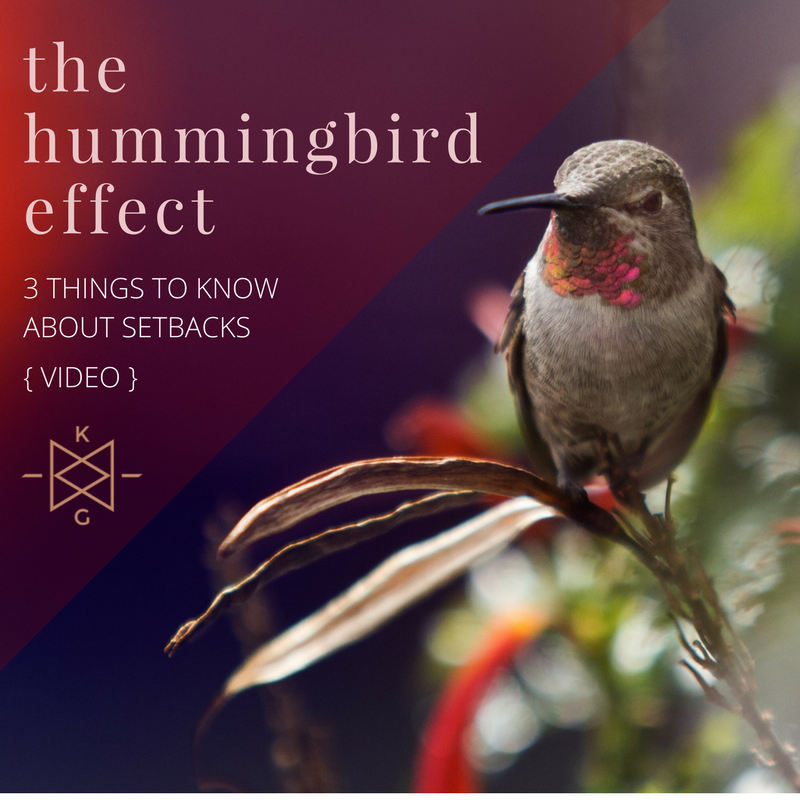
{Video} The Hummingbird Effect: 3 Things To Know About Setbacks
“Whatever happens to you belongs to you. Make it yours. Feed it to yourself even if it feels impossible to swallow. Let it nurture you because it will.”
-Cheryl Strayed
Tiny Beautiful Things
Hello Friend,
I hope your week is going great!
Question: How many times have you walked head-on into a (closed) glass sliding door?
Me? More times than I’d care to count.
What emotions fire up on the other side of that unexpected dose of humility?
Humiliation, shock, frustration, exasperation, and perhaps a sore nose among other things.
If people are watching, (and they always are. This NEVER happens in a vacuum), the old ego needs a bit of time to heal from the gnarly bruise she just incurred.
If you’re like me, unexpected setbacks feel like a punch in the gut, and all I want to do is slap myself around, dust myself off, pull up the bootstraps, and carry on pretending nothing really happened. “Keep calm and carry on” right?
Well, this approach works good and great for a while, and then eventually we begin to grow increasingly disconnected from the truth of our needs and our pain eventually masks our identity. Our attachment to ego clouds everything.
This past weekend, I witnessed the loveliest, tiniest, kelly-green feathered hummingbird take a deadly if not accidental nosedive straight past the bird feeder on our deck and into the window behind it.
Barely breathing and with a broken wing, he hung on to dear life for hours as we nursed him back to health. He is on the mend at an animal shelter nearby, but I can’t help but contemplate all that this sweet hummingbird taught me.
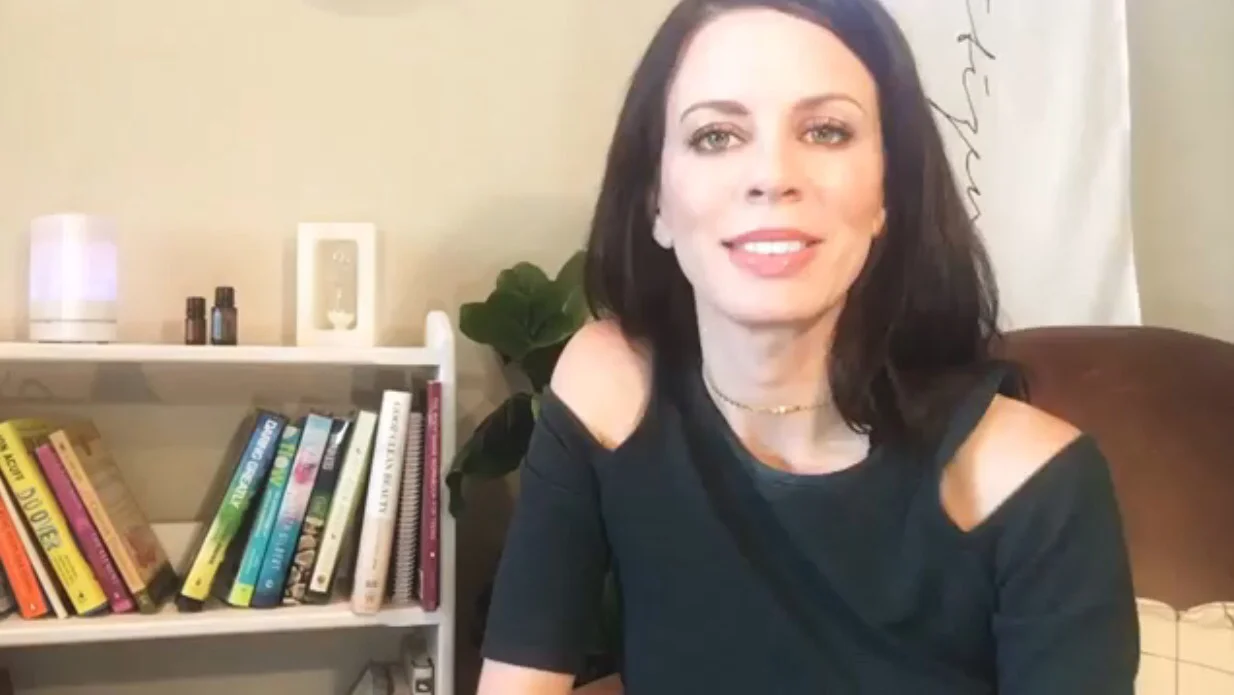
If you are in the midst of a heartbreaking setback or find yourself still sore from a recent one, I hope you’ll check out a little video I put together for you.
I’ve been tossing around some ideas, or questions, to ask myself next time I experience an unexpected setback:
1) What am I believing to be true about my set back?
2) Is this in fact true?
3) What do I need in order to extend kindness and compassion to myself in the moment as I would a dear friend?
I absolutely love Cheryl Strayed’s quote from her latest masterpiece, Tiny Beautiful Things:
“Whatever happens to you belongs to you. Make it yours. Feed it to yourself even if it feels impossible to swallow. Let it nurture you because it will.”
What setback do you currently find yourself in? I’d love to hear how you are finding your way through and what comes up for you around these three questions. Pray, tell….
Love & Gratitude,
Katie Gustafson
P.S. Stay tuned for an exciting fall group opportunity coming your way soon!

Ordinary Things — Lessons from Graham Nash
“No reward anyone might give us could possibly be greater than the reward that comes from living by our own best lights.”
- Parker Palmer
This past week, Nashville did her thing and hosted the Americana Fest. Living in Nashville for over twenty years now, I often find myself taking Music City (and sometimes music in general) for granted what with all the insane talent boiling over at every turn. Hell, you can even hear some pretty first-class country covers the second you deplane at BNA. Yep, the airport Tootsies will nearly have you convinced 99.99% of this town can carry a tune.
Friday night was special in that I fell in love with songs all over again and was reminded just how vital story really is. I had the honor of accompanying my better half to a live recorded tribute to the incomparable Graham Nash. The night featured him as well as other established and burgeoning talent, all offering their versions of some of his most memorable tunes.
His second skin embodiment of the sounds he creates blows me away. You simply can’t separate him from his music; you’d be dismembering a limb of sorts. If you’ve ever seen him live, you know his passion and reverence for the craft is unmistakably palpable.
Perhaps my favorite part of the show was hearing the story behind his song, Our House, Crosby, Stills, Nash, and Young’s smash hit. It seems I’ve become just as mesmerized if not more by where songs come from as I am the song itself.
In his charming British way, Graham (just going to go ahead and assume we’d be pals) recalls a lovely if uncharacteristic blustery, grey Los Angeles afternoon with his then live-in girlfriend, Joni Mitchell—naturally.
He wryly renders “oftentimes songs come from the most ordinary of experiences,” you know, like a Saturday afternoon shopping jaunt with ordinary people like Joni Mitchell?!
He had us all engaged, leaning in, smiling and hungrily eating out of his hand. Apparently, Joni had found a quirky little antique vase for a steal and was eager to put it to good use. Upon their return home, he turns to her contentedly and urges, “I’ll light a fire, and you should go put some flowers in that vase you found just now…” An hour later she returns with an arrangement to find Graham wrapping up a classic. And so, the conception of a song—no big deal.
This post is not about songwriting or Graham Nash for that matter. It’s about you and the story you believe about your value. The day after the show I turned to my husband Daniel and said, “You know, he’s had thousands of opportunities to dial in that Joni Mitchell story. It’s so good and clever partly because he’s lived in it so much.”
Cynical much? No really, that wasn’t my heart behind the comment. It’s an epic song with an epic story and cast, yet, he’s had decades to perfect it, test it, and perform it. He’s not getting in his own way every time in order to re-create the wheel; he’s working his edge.
What I’ve curiously pondered in my heart the last several days since is how ingrained our stories get into our hearts and brains; so ingrained we believe them, bowing down to them as if they had the keys to our life’s success.
You see, people believe what we show them to be true about who we are. Oftentimes, we clumsily miss the opportunity to draw them in because we’re stuck living out our scarcity story— fearful and highly undervalued.
Over the next several weeks on the blog, we will explore practical ways of tweaking our story in order to “work our edge.” I heard that phrase in a yoga class recently. It was one of those classes where the heat’s cranked up, and it smells like a gargantuan eucalyptus plant is sweating. Our annoyingly fit and enthusiastic teacher kept charging, “find your edge and work it.” I was too busy slipping all over my mat and looking like a frustrated beet to remotely find anything edgy. Still, the phrase stuck and I kind of love it.
Awareness is the first step towards change, so this week, I encourage you to be a student of yourself. With a beginners mind, simply observe the little things you do that make you come alive. This can be cooking a meal or writing in your journal or going for a run. What are those things that come naturally to you that you assume everyone else does with such pleasure too? Is it writing a thank-you note, encouraging a friend, or researching printer ink (sky’s the limit here, folks)? These little things are the making of your edge. They are how you lead, and consequently, they are highly valuable.
So, just like we learned from Mr. Nash, oftentimes the most brilliant stories come from the most ordinary-seeming things. Your story is one of a kind. Now, its time to work that edge.
Love & Gratitude,
Katie
In April, I bombed a keynote—45 minutes late, broken A/V, a room that wanted their drink tickets.
Here's what that failure taught me about participation, discernment, and why every Enneagram type has its own sophisticated reason to wait until it's "ready."