

The Blog
Recently Featured


All Blogs







Great Expectations (or not)
Expectations are resentments waiting to happen.
-Anne Lamott
Here we are.
This is not a throw away sentence. It’s perhaps the most profound reminder we’ve got.
We will never ever experience the present moment ever again. It’s gone in a heartbeat and yet is the only sure thing we ever really touch—presence, being, the here and now.
If you’re like me, presence becomes harder and harder to fully grasp in seasons of waiting and anticipation. At nearly eight months pregnant, I’m struggling to stay in the moment and soak up these final days of life as a non-parent (read: sleep).
I’ve always felt summer can be a bit like the Holidays as it kicks up a whole host of unique demands and expectations, leaving me often anxious if not resentful. It’s tempting to compare my life to others I see magically splattered all over social media cavorting around far away places by fake looking bodies of water with glamorous wardrobes to boot. Hell, I haven’t even gotten in a pool all year long and feel more like a weary beached whale than an energetic summer explorer.
Where do these expectations even come from? My hunch is, they come from the stories we make up in our heads. Ah, those glorious narratives of certainty, guarantees, entitlement, essentially—suffering.
Last week we unpacked this idea that pain is inevitable while suffering is optional.
Why? Because suffering is the story we make up about our pain. “I should have a better job that lets me travel more.” “I should have a partner that enjoys doing the same things I do.” “I shouldn’t have to work so hard. After all, it’s summer and I deserve to relax and enjoy my time.”
Whereas these may be true, I don’t know how much progress we make changing our reality by playing the victim. In fact, there are no guarantees in this life. That said, keeping unrealistic expectations flush in our back pocket is a fast way to prevent abundance in our everyday experience.
As an Enneagram type four, I often struggle with this pervasive longing for what’s missing in the moment. For example, “Ah, the sunset is beautiful, but I wish it were a bit cooler so I could really enjoy it more.” I know. Gross.
This dangerous habit creates a crusty resentment which in turn drives away joy.
Because the struggle is so real for me, I created a little Expectation Inventory to keep me in check a few years back. I’ve come to wholeheartedly believe the pivotal moment in every unrealistic expectation is simple: gratitude. It tethers us in the here and now. It gently leads us back home to presence. Gratitude changes everything in an instant.
Today, I’m sharing my inventory with you. Keep it close and use like guard rails when you start to slip into resentment. Maybe, like me, they will keep you on track and reminded of what you do have as opposed to what you lack.
Expectation Inventory:
How do I feel right now?
What unrealistic expectations am I feeding into?
What is the payoff for having these expectations of myself or others?
What would it feel like if I were able to let go of these?
What do I need in order to let these expectations go?
What am I grateful for?
Enjoy…truly!
Love & Gratitude,
Katie

Only the Lonely
"Loneliness is proof that your innate search for connection is intact."
- Martha Beck

If there is an emotion that feels truly hollow and hopeless, in my experience, it has been loneliness. It’s an ache that reaches for miles and miles and photoshops out any trace of perspective or existing motivation to grab hold of.
This is why, for me anyway, it’s necessary to stuff it, sweep it, and quickly look the other way before the bleakness of its stare can call my flimsy bluff. The tears would be a storm. The storm might never pass. …Keep it together, Katie… the show must go on.
This is also why loneliness is currently proven a more dangerous health epidemic than obesity and smoking. No joke. On the surface, it’s asymptomatic. We can hide it famously. Yet right beneath the surface its death grip is suffocating.
Whereas I believe loneliness is not something to mess around with over time, I do believe--like anything--it can create spaces in life to dig deeper into an otherwise hidden ecosystem of awareness and insight.
Curiously, loneliness became one of the most prolific teachers I’ve ever had. Come to think of it, she used very few words, if any. Just like most memorable teachers, she was a real hard ass at first. Over time though, she softened.
Today, if you sit in a scary room of loneliness, I want to reach you. Not to fix you, Lord knows I can’t. I want to simply say “I see you,” and perhaps in doing so, lessen the penetrating sting of that thick and clumsy needle. I want to validate your pain, take it out of its dark and shadowy corner, and simply give it some breathing room. Lonely shouldn’t bear the weight of such baggage. Yes, she’s strong, but not that powerful.
Plus, the felt pain of our emotions lifts a bit when we let some light in and talk about them.
My loneliness gave me a space to dig into the real, unseen meat of my needs and desires. I hated and resisted her for so long, until I held that resistance up against the light. Here are the most stunning realizations she gave me.
Loneliness is the human condition
I remember sitting in my therapists office one crisp February afternoon. I was at the bottom of the bottom. My anxiety was so deafening, I couldn’t separate out my words and thoughts from her loud yell. She beat frantically on the drum of my chest without reprieve.
I was anxious because of this pervasive sense of loneliness laced with depression I couldn’t escape from. It doesn’t make much sense looking back now, but man did it feel like fact then. It put me in the hospital, literally.
My therapist, Gail, looked at me with her wise and nurturing eyes that day and said, “Katie, loneliness is the human condition. It’s what we all have in common.”
Whereas I wanted a pill or a promise, she gave me that weighty nugget. I’ve carried it since.
To know that my loneliness is not unique or special, and in fact, is a pre-requisite for being human felt like a heavy wave of relief.
Your loneliness is part of what connects you to the frayed fabric of humanity. It points you to reach out.
Lonely is different than being alone
Some of the loneliest people I know are married, have a couple of kids, are well-connected in the community, or have big jobs. I’ve got a friend who lives in New York City and tells me it can be the loneliest place in the world.
Despite being surrounded by people, we can still be deeply lonely. Solitude, even for all you extroverts out there, is a gift worth tearing open.
It was during a thin people-season with little community and support that I was forced to befriend solitude. Sure, it felt lonely, partly because I’d been so dependent on people to tell me who I was and what I should do and believe. This unfamiliar place of open-ended quiet felt terrifying. Ironically, this was the season I started to hear the sound of my own voice.
We create out of silence. We can only truly listen in the stillness. This requires getting alone yet is different than loneliness. Quiet passages of solitude invite the most valuable connection possible: you and you. This is when we learn to belong to us.
The fear of loneliness is often rooted in shame
What I notice in seasons of loneliness, and yes, they still exist, is that I’m really grappling with the shame of inadequacy. I’m afraid I’ll be rejected or misunderstood or simply won’t have what it takes. This fear always leads me down the path of trying to fit in or people-please. I’ve had to call BS on so many of my attempts at being liked instead of being true.
This is when loneliness tells us we’re on the right path and we’re not merely masquerading. I was reminded of this when I read Brene Brown’s Braving the Wilderness.
Her research has proven that in order to truly belong we must often times stand alone and risk being highly vulnerable. Courage and comfort are not synonymous.
In order to belong, we must be willing to talk about, and in doing so, reveal those areas we are most shameful in to safe people.
This process feels incredibly lonely. Yet, it’s far better to take this risk and own our truth than to fake it on the surface and disconnect from self. That’s an exhausting detour.
Being truly alive means getting dirty in the arena, not sitting all zipped up in the nose bleeds.
Does the shame of your loneliness, whether that looks like singleness, creative frustration, personal rejection, transition, or grief keep you hustling to keep it together or fit in?
I can assure you, you are not alone.
This may be a season to slow down, exhale, and lean in to hear what she’s trying to say. She tells me I’m alive and on the right track more times than not. She tells me to heed the resistance because pain typically signals opportunity. She tells me I belong, if to no one else, to myself. The most creative and courageous giants stood alone more times than not. Oh, they got dirty alright.
Yes, I see you. Yes, I hear you. Only the lonely days taught me to reach out and risk the comfort of what’s known for the beautiful mess of what’s to come. I pray they do the same for you.
Love & Gratitude,
Katie
Want Love? Meet Forgiveness....
“The weak can never forgive. Forgiveness is the attribute of the strong.”
-Mahatma Gandhi

If we are shaped by anything in life, it is surely by the pang of painful past experiences. You know this pain all too well. The ones in life who were supposed to protect, provide, and nurture instead inflicted deep and sorrowful hurt, abandonment, and abuse. Expectations were dashed, self-expression wasn’t allowed, eggshells were everywhere.
In therapy, I hear the broken, brutal stories of courageous people who have somehow made it through. They look for greater freedom and joy. They refuse to let their past define their present and future. I often find myself angry as I hold space for these stories to live and breathe, sometimes for the very first time. It’s never fair.
And this is the truth. Injustice isn’t fair. Yet I am learning it’s part of life. How we deal with that injustice is truly our making. The trauma of our past breaks us in a way that often feels irreparable...futile. This trauma doesn’t just dissipate either. It’s stored in the tissues and neural pathways of our bodies. For this reason, a holistic, mind-body-spirit approach to healing is vitally important.
The voluntary and visceral reactions to a past experience are so significant it gets branded into your body. My hunch is you’ve experience the effect of painful past experiences manifesting in your body. If so, lean in. The wisdom of your body is trying to get your attention.
In fact, your body is brilliant and tends to literally block out old trauma, having no memory of it until physically exposed to stimuli. We learn to detach, shut down, and numb.
Bessel van der Kolk, psychiatrist and author of The Body Keeps the Score, explains:
“Traumatized people chronically feel unsafe inside their bodies; The past is alive in the form of gnawing interior discomfort. Their bodies are constantly bombarded by visceral warning signs, and, in an attempt to control these processes, they often become expert at ignoring their gut feelings and in numbing awareness of what is played out inside. They learn to hide from their selves.”
This insight fascinates me as it’s helped me understand that we can’t talk our way out of healing from this “gnawing interior discomfort.” We must learn two things: how to feel safe in our bodies and how to forgive. I love using Brainspotting with clients to begin unlocking the process of re-attachment and develop a sense of safety in our bodies. It has been a game changer for me and many.
I’ve noticed the more difficult of the two is often the forgiveness piece, which isn’t a surprise to me. We think of forgiveness much like we do vulnerability: as weakness. Thus we choose to carry the perpetrators of our pain around, heaping tons of power on them. Oftentimes the one we need to forgive the most is ourself, which can feel nearly impossible.
When we choose unforgiveness, we not only stay connected to the pain and its source, we allow our past to define us. Isn’t it time we put down that heavy burden? Isn’t it time we take back our power and re-focus that wasted energy on giving and receiving new, hopeful opportunities and love?
This week, I encourage you to do some inventory and see if there might be any lingering unforgiveness that weighs you down and holds you back from your highest self. Support throughout this process is key, so know that I am here if you need a safe place to process and land along the way.
Remember, you are not the crumbs of your past. You’re invited to a grand, exquisite table of the present moment to feast on freedom and be satisfied by love. It’s a wide open space to explore and move around in. You are always welcome here.
Love & Gratitude,
Katie
xoxo
Fix You: A Guide to Self-Compassion
“The biggest reason most people aren’t more self-compassionate is that they will become self-indulgent. They believe self-criticism is what keeps them in line.”
- Dr. Kristin Neff -
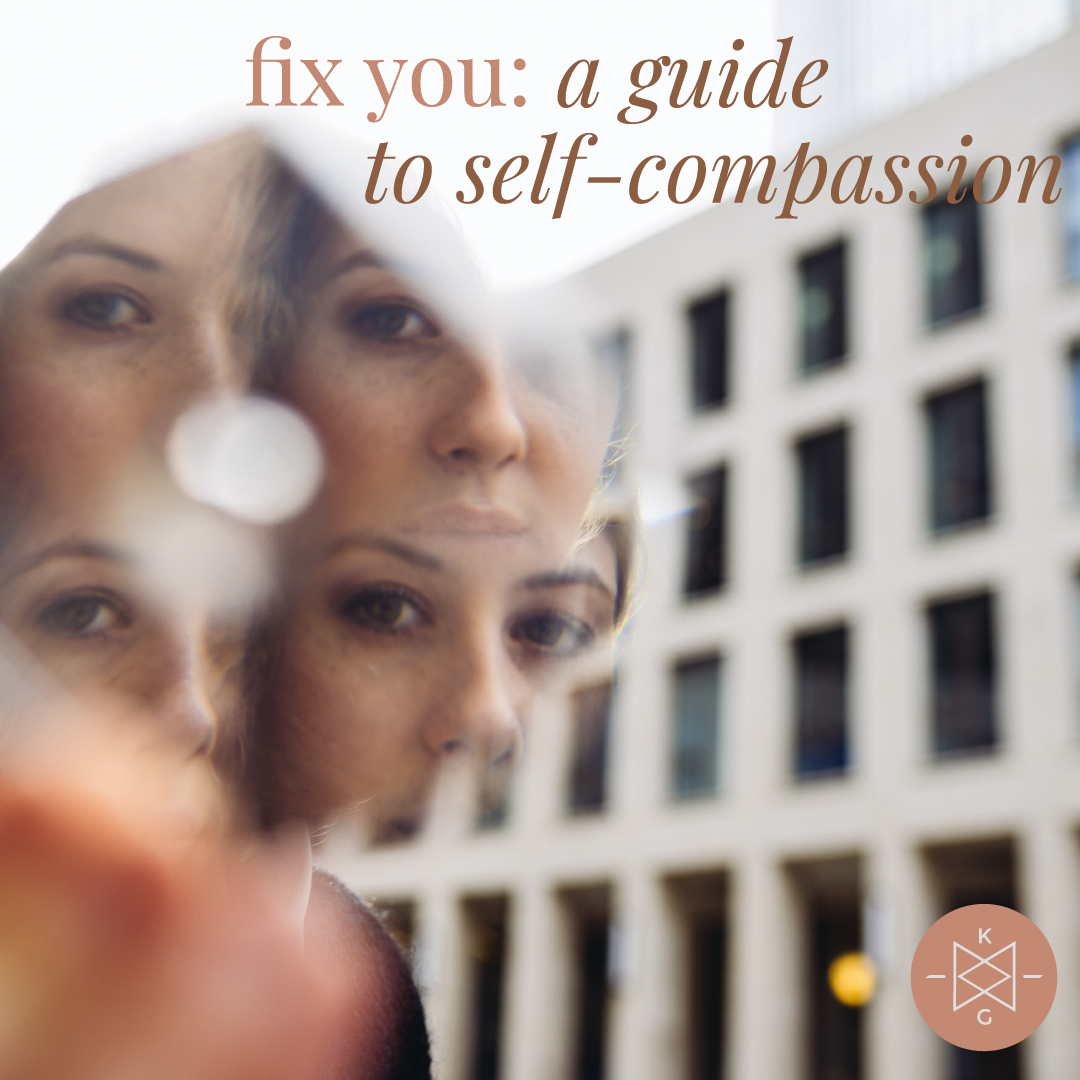
I had it all wrong.
I thought if I could do self-help perfectly, I’d be well on my way to confidence and a sense of personal freedom. If I could will myself into the knowledge and experience of self-love and acceptance, I’d have arrived. There might even be a red carpet and some Valentino couture involved.
After all, I used perfectionism to my advantage for years, why stop now? Why not transfer that zipped up effort to the pursuit of self-acceptance and love. With just enough muscle, I knew I could fix her.
Spoiler alert: no matter how many affirmations or bubble baths or self-help books were had, the “am I enough?” ballot’s still out.
Oh, I went gangster with it, too—you know, the “fixing homework.”
I’d recall all my limiting beliefs about myself, write them down, cross them out, and slap ruby red lipstick on them—with feeling.
“I’m unloveable.”
Er…I mean:
“I’m the greatest thing since (gluten-free) sliced bread and have every reason to deserve love now.”
Sounds more like an SNL sketch to me. It also sounds reactionary and surface-level, not genuine or believable.
Good news!
You’re not meant to be fixed; you’re meant to be understood.
We can’t will ourselves into a loving relationship with ourselves, or anyone else for that matter. Humans aren’t math equations. We’re messy, complex, and perfectly imperfect.
The self-esteem quick fix is much like pumping a poor chicken chock full of toxic hormones to go further at your local Kroger. It may seem full of juicy possibility in the moment, yet it probably has long-term health concerns.
Why doesn’t self-esteem work?
Because it’s based on the way we view ourselves to the degree with which we like ourselves. Sounds benign, right? Sure, until circumstances change. What happens when we fail to get that promotion, call back, book deal—or can’t get the weight off?
The temporary illusion of self-esteem takes a nosedive into a muddy puddle of shame.
Typically, if we depend on circumstances to prop up our self-worth, there's a hard and unexpected fall coming just around the corner.
There’s more.
Self-esteem can be divisive in an effort to “one-up” those around us. Let’s revisit our earlier limiting belief turnaround. If I replace it with a pep talk that tells me “I’m the greatest thing around,” I’m puffing up my ego (which operates from a place of fear instead of belonging) and pitting myself against the world in an effort to prove myself, not lovingly being with myself.
So, what’s the solution? If I can’t perfect self-esteem, what am I supposed to do?
Four years ago, I picked up a book called Self-Compassion: the proven power of being kind to yourself, by Kristin Neff. It has changed the way I relate to myself and others on every level. It’s also called me into a more caring dialog with myself as opposed to the harsh, striving one that’s been so violent and intrusive for decades.
Rules without relationship breed rebellion.
If I’m constantly inflicting rules on myself instead of trying to relate to myself, I’m on the fast track to self-sabotage.
• Self-compassion is relational, not circumstantial. It’s based on the awareness that the human condition is frail at best yet capable of resilience.
• Self-compassion is cultivated like any relationship—over time. It fills in all the holes self-esteem leaves gaping. When we fail to live up to our expectation, self-esteem prompts two extremes: negative self-talk or puffed up ego (even…gasp…narcissism).
This is not the case with self-compassion. It comes flooding in when our insecurities, flaws, and shortcomings stare us back in the mirror.
• Most importantly, self-compassion binds us together in the reality of our human experience. It doesn’t divide, puff up, or need to isolate. We see ourselves through the lens of “imperfect—yet still enough.”
When that brutal inner critic pipes up, self-compassion says, “Hold on. I see you. I understand your pain. And I am here with you.”
Her voice is firm and tender.
She doesn’t wait on the clouds to pass or the proverbial sun to shine. She speaks her truth in the broken moments.
You’ve known her cadence a long, long time. Then you met fear. It drowned out the love.
You know what?
Your birthright is love, not fear. Just as you learned fear’s luring language, you can also unlearn it.
Birds don’t soar because of effort or willpower. They do so by surrender—and risk.
It’s time to work with—not against—the choppy current of life’s wind.
Alone? Not in a million. You’ve got a bold little guide waiting inside to illuminate the path. She was born ready.
Love & Gratitude,
Katie
xoxo

This Is Us
“We have all known the long loneliness, and we find that answer is community.”
-Dorothy Day

I didn’t become a therapist because I felt I’d be any good, saw myself as hyper-empathic, or wiser than the next gal. Far from it! In fact, when I started grad school, I had about as much confidence in myself as a three-legged cat. There were obstacles.
I became a therapist because I knew I had too. And for some unidentified reason, I desperately wanted to. It was and is part of my calling.
I’ll never forget my very first therapist. Her name was Angie Smith and I thought she was the bee’s knees. I was 15 and losing a battle to anorexia nervosa, the presenting iteration of my chronic depression at the time. We lived in Mobile, Alabama, an unapologetically southern town dripping with Spanish moss and too many syllables. Lovely? Indeed. Progressive? Not so much. I’d never heard of “therapy” before. I also kept the fact I was in it (and taking medication for depression) on the DL. High school is brutal enough.
My work with Angie made a lasting impact on my life and work. I’d meet with her every Wednesday at 2pm, and when I left, I noticed a vague sense of hope well up inside. This wasn’t because I got to leave school early either. It ran deeper—it was a feeling I would slowly build on throughout my recovery.
Angie had also suffered from and overcome an eating disorder. Yet today, she seemed so put together—and pretty. Not to mention she was from Nashville where she’d been a singer-songwriter for many years. So she was smart, pretty, and cool...a triple threat, but in the most inviting way.
In our work together, I learned the value of having a safe space and person to tell my story to and feel unconditional love and acceptance on the other side. I was lucky enough to have this from my parents (and big sister when we weren’t fighting over clothes), yet to have a totally objective experience without emotional ties or history was something profound.
Fast forward a decade and some change. Thankfully, I’d gotten a handle on my relationship with food. However depression still clung tightly, like a red-faced, wailing toddler to his mom the first day at pre-school drop-off.
Sure, I’d been in and out of therapy the whole time, and Lord knows it had been a lifeline. Yet individual therapy didn’t fix my loneliness. Isolation was often how I’d cope with the sadness and 50 minutes of talk therapy every week or two just didn’t cut it. This wasn’t a reflection on my therapist either. In my book, I worked with some of the best.
I discovered something shocking: I’d been hiding behind therapy. Mind you, it wasn’t the worst place to hide, it just wasn’t giving me the context to practice the insight and tools I’d been gaining with other humans who might possibly relate.
Now that was a new concept, and a terrifying one at that. Yet my depression had become life-threatening once again and I didn’t have a choice.
Enter Onsite workshops, a beautiful treatment facility right outside Nashville specializing in experiential group therapy. Just like Angie, Onsite left an unforgettable imprint on me. It was the ultimate reset button I needed and showed me the vital importance of experiencing healing in community.
Make no mistake, I wholeheartedly believe in the power and necessity found in individual therapy. I'm not saying we throw the baby out with the bathwater. However, I do feel it's simply not enough to get the optimal results we're looking for in our lives. I believe we need a layered approach consisting of individual and group work.
Before you call it a day and hit the snooze button on this post, hear me out. This is all about you and me and how we work together in order to bring more wholeness and connection into our daily experience.
This year, I’m changing up the way I work so as to provide a more holistic prescription that facilitates deeper connection with self and others. This new model is based on the belief that EVERYTHING is relational—everything. From relationship with self, to others, to food, to work, to emotions, and so on.
If this is true, (and it is), we must learn to grow and heal in relationship and community, not isolation. To that end, I’m thrilled to share with you what I’ve been designing these last few years based on tons of research and inspiration from you.
Later this month, I’ll be rolling out the specifics and an opportunity for you to take part. For today’s purposes, get excited! It’s going to be loads of fun and involves three core principles I believe to be the most powerful for the journey we’re on: community, experiential therapy, and the Enneagram.
Indeed, this is your year to tell your story, be seen, be known, and be loved. But even more, it's our year...2019, this is us.
Love & Gratitude,
Katie
Thoughts on motherhood, breast cancer, and what attachment theory and the Enneagram taught me about being loved